In the rolling countryside of Suffolk, where cottages dotted the green hills and chimneys smoked softly against the mist, there once lived a poor woman and her daughter. The woman was not lazy, but she was careless with her words, and that habit would one day lead her into great trouble.
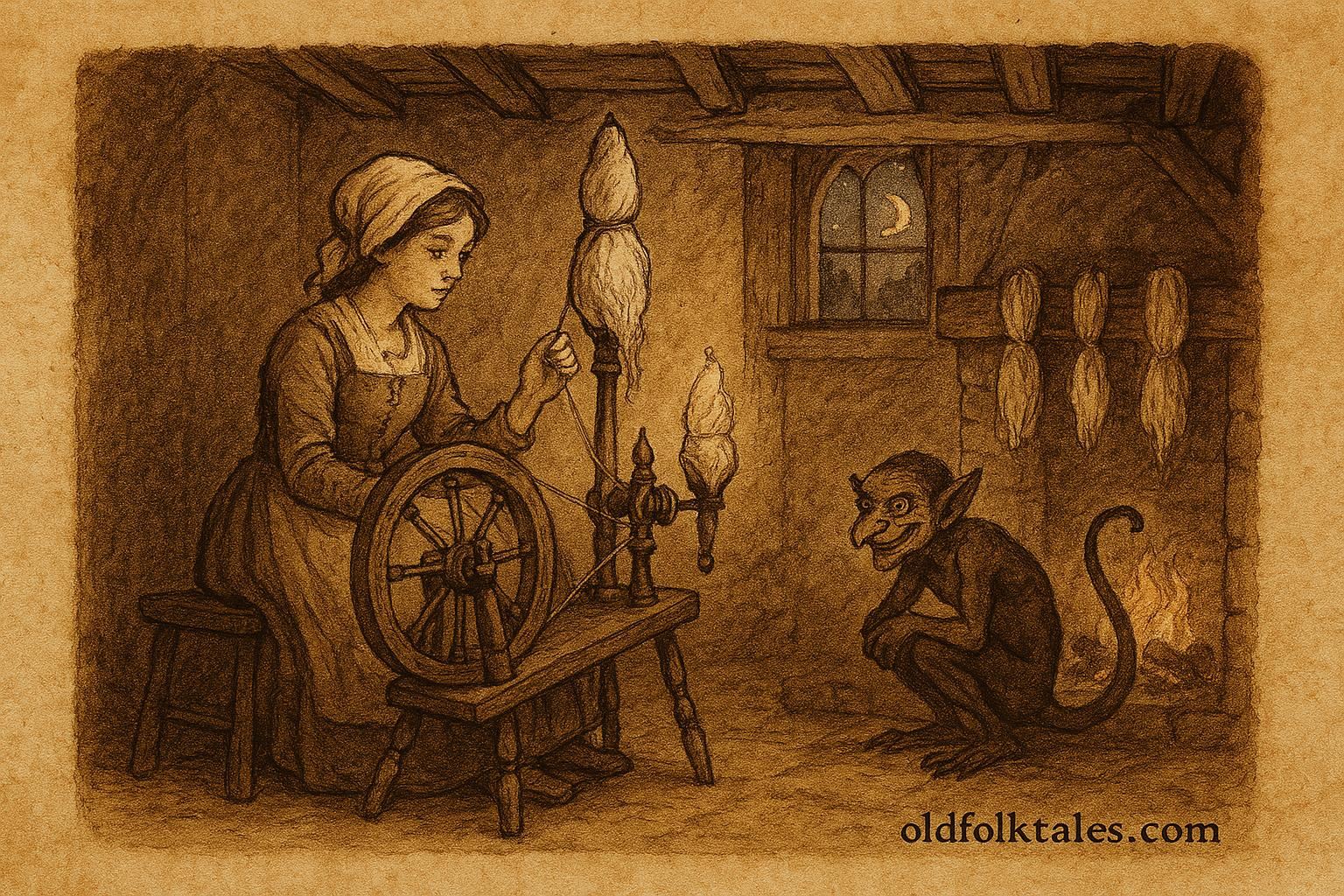
One evening, as she was spinning flax by the fire, her spindle slipped and broke. Frustrated, she muttered, “I’d rather my girl spun five skeins a day than sit idle like me!” Little did she know that a strange, shadowy man was listening outside her door. He had a long tail and eyes that glimmered like coals. The creature, neither man nor beast, knocked once and entered, bowing low.
“I can grant your wish,” he said, his grin sharp as a sickle. “Your daughter shall spin five skeins a day for five days, if you’ll promise me one thing.”
The mother, startled but desperate, asked, “And what is that, sir?”
“When the five days are done, I’ll return,” he said. “If your daughter cannot tell me my name, she’ll be mine.”
Terrified yet hopeful, the woman agreed. By morning, the spindle was mended, and in the corner of the cottage sat her daughter, spinning fine flax faster than any mortal could. The thread gleamed like moonlight. For five days and nights, the spinning wheel hummed until five perfect skeins were done. Then the creature vanished as quickly as he had appeared.
The next day, the King’s steward rode by the cottage and, seeing the fine skeins laid out, thought the girl had spun them herself. He hurried to tell the King, who prided himself on finding wives skilled in womanly arts. The King rode to the cottage, looked at the skeins, and said, “If you can spin five skeins a day for a month, you shall marry me and be my queen.”
The poor girl trembled, for she could not spin at all. Yet she dared not speak the truth. The King led her to the palace, locked her in a tall chamber, and said kindly but firmly, “Each morning I shall bring you flax. Each evening, five skeins I must find.”
When the King left, she fell to her knees and wept. “What shall I do? I cannot spin even a thread!”
At midnight, the door creaked open. Out of the shadows stepped the same strange little man with the long tail. “Good evening, my dear,” he said with a grin. “Shall I help you again?”
“Oh, please!” cried the girl. “Spin for me, and I’ll give you anything!”
He twirled his tail thoughtfully. “In three nights I’ll have spun all the skeins. But when your month as queen is over, if you cannot tell me my name, you’ll be mine forever.”
The girl nodded through her tears, for she had no choice.
That night and the two that followed, he came and spun. The flax became thread, the thread became skeins, and each morning the King found perfect piles upon the table. On the third day, he declared her his bride and ordered the grandest wedding in Suffolk.
The feast was merry, and the girl, now queen, smiled for the first time, until she saw a shadow flicker across the hall. In the corner stood the little man, smiling with his sharp teeth, mouthing words she could not hear. She knew he would return soon to claim her.
On the third night after the wedding, she sat alone in her chamber, trembling. Then the King came in, cheerful and kind. “My dear, you look pale. What troubles you?”
“Oh, my lord,” she said, “it is nothing.”
But he pressed her, and at last, she told him everything, about the strange man, the spinning, and the terrible bargain. The King, astonished but loving, swore to help. “Tomorrow I ride to hunt in the forest. I shall ask all I meet if they know of such a name.”
At sunset, the King returned with no answers. But just as he neared the castle gate, he heard faint singing from the woods. Peering through the trees, he saw a tiny figure dancing around a fire, singing:
“Nimmy nimmy not,
My name’s Tom Tit Tot!”
The King’s heart leapt. He galloped home and told his wife at once.
That night, as the moon climbed high, the little man appeared in the queen’s chamber. “Well, my lady,” he grinned, “do you know my name?”
She shook her head once. “Is it Jack?”
“No.”
“Is it Will?”
“No!”
He cackled, stamping his foot so hard the floorboards creaked. “Then, my dear, you are mine!”
But she smiled and said softly, “Is it… Tom Tit Tot?”
At that, the little man howled. “The devil told you that! The devil told you that!” He stamped so furiously that his foot went through the floor, and with a scream, he vanished into the earth, leaving only a curl of smoke behind.
From that day on, the young queen lived in peace. She spun no flax, but she never forgot the lesson, that names hold power, and cleverness can defeat even the darkest bargain.
Moral Lesson
This folktale teaches lessons on cleverness, self-reliance, and the power of knowledge. Through courage and wisdom, one can escape even the tightest traps. It reminds us that intelligence and resourcefulness often win over fear.
Knowledge Check
- Who was Tom Tit Tot in the story?
A mysterious spirit or goblin who spun flax in exchange for a terrible bargain. - What task did the girl have to complete for the King?
To spin five skeins of flax a day for a month. - How did the girl learn Tom Tit Tot’s name?
Her husband overheard him singing his own name in the woods. - What does the story symbolize about names?
It shows that knowing someone’s true name grants power and protection. - What moral value does the tale highlight?
The triumph of cleverness, persistence, and quick thinking over fear and deception. - Where does this folktale originate?
From Suffolk, England, part of English rural folklore collected by Joseph Jacobs (1890).
Source: Adapted from English Fairy Tales by Joseph Jacobs (1890), Suffolk, England.
Cultural Origin: England (Suffolk Region)