Long before the village bells of Lucerne rang with Christmas cheer, when winter winds howled across snow-draped fields, the people spoke in hushed tones of a fearsome figure known as Türst. His name alone could make children pause mid-step and shepherds glance nervously toward the darkened forest. Türst was no ordinary huntsman. He was a spectral figure, a harbinger of storm and winter, whose horn echoed through valleys in the nights before Epiphany, warning all who dwelled nearby that nature’s wild power was awake and vigilant.
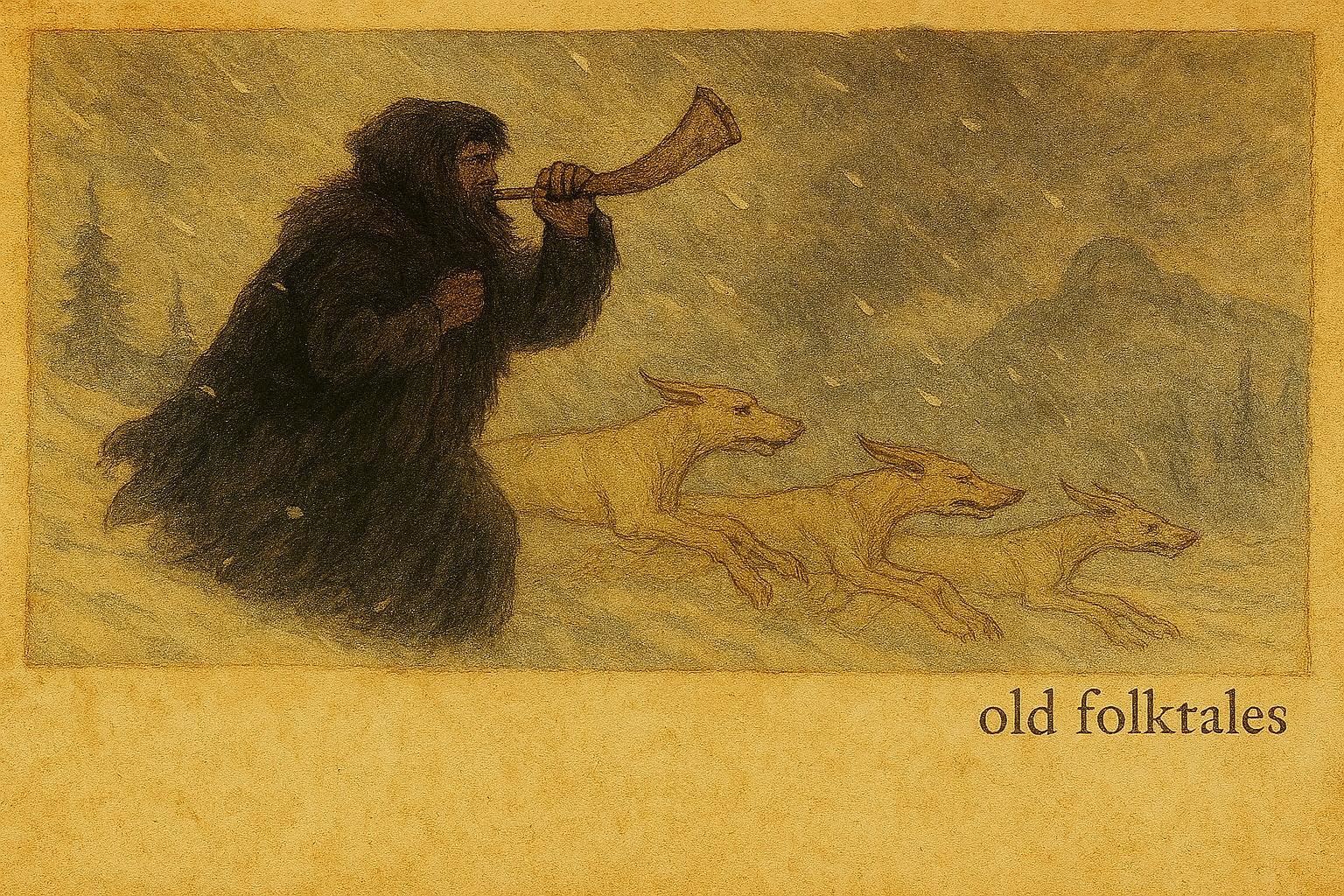
The legends tell that Türst rode alone, or rather, with a pack unlike any other. His hounds were ghostly, spectral creatures, each with only three legs, yet each swift as the winter wind. They were said to be fierce beyond reckoning, eyes glowing like embers through the falling snow, their breaths forming icy mist as they streaked across the frozen meadows. Farmers who had crossed paths with Türst described him as tall, cloaked in furs dark as storm clouds, his face hidden beneath a hood, and always carrying his horn, polished to a spectral gleam. The sound of his horn was said to rattle through the village like a drumbeat, announcing the approach of tempestuous weather and the might of his supernatural hunt.
Stories passed from generation-to-generation spoke of Türst’s appearances with uncanny regularity. Each year, as the old calendar waned toward Epiphany, the villagers would notice signs: a sudden frost that crept across the fields, the first snow that clung to rooftops in unnatural patterns, and a strange wind that seemed to carry the far-off cry of hounds. Those who ignored the warnings were thought to risk more than frostbite; Türst’s hunt could sweep the unwary into the spectral chase, lost in the blizzard and never seen again. Shepherds, careful to mark their livestock and secure their barns, were the first to respect these omens, knowing that Türst’s presence was as real in winter as the ice on the mountain streams.
The legend’s origins lie deep in the pre-Christian past, in the farming communities that tended flocks and fields across Lucerne’s valleys and Alpine slopes. It was a world in which survival depended on respect for the cycles of nature, where storms were not just weather, but messages, and the forest held powers that demanded acknowledgment. In these communities, Türst was both feared and revered. Children were warned to stay indoors when the wind carried the sound of a distant horn, while adults took care to appease the spirit through ritual, often by leaving out a small offering of bread, cheese, or smoked meat, ensuring that the spectral huntsman passed their homesteads without incident.
Accounts of Türst describe his hunt as a terrifying spectacle. Those who claimed to have glimpsed it described a swirl of wind, a blur of three-legged hounds, and the echoing horn that seemed to shake even the walls of stone cottages. Some villagers said that the hounds ran through the night sky, leaping over frozen rivers and snow-laden pines, leaving a trail of frost behind them. Farmers spoke of waking to find their fields strangely patterned by the passing hunt: snow sculpted into strange, swirling shapes, and the faint, ominous hoofprints of a supernatural rider pressed into the earth. The townsfolk learned quickly that to ignore Türst was dangerous, but to respect him was to survive the harshest storms unscathed.
Yet Türst was not purely malevolent. His hunt had a purpose, deeply tied to the rhythms of winter and survival. The horn that carried through valleys warned of storms that could destroy crops and freeze livestock. The spectral hounds were agents of winter’s force, reminding villagers that nature’s power could not be bargained with. Those who prepared, who respected the cycles of the year, and who maintained care for their animals and homes, emerged safely from the storm season. It was as if Türst’s fearsome appearance was a mirror of the natural challenges that the Alpine winter imposed on human life: awe-inspiring, terrifying, but ultimately instructive.
Legends emphasize that Türst’s timing was precise. He appeared only in the nights preceding Epiphany, a period long associated with the turning of the year and the culmination of winter’s trials. Parents would tell their children that if they stayed indoors and respected the mountain winds, Türst would pass them by, but if they ventured out into the dark or mocked the hunt, they might vanish into the swirling snow, never to be seen again. Some claimed that Türst’s horn carried messages from the mountains themselves, a supernatural language understood only by those attuned to the rhythms of nature. Listening carefully to its echo was said to grant insight into the weather, the state of livestock, and even the fortunes of the coming season.
The tale also preserved a warning about human arrogance. There were stories of young men, brash and reckless, who thought themselves immune to the hunt’s power. They would race across frozen meadows or attempt to call back the spectral hounds with mocking whistles. None who disrespected Türst ever returned unscathed. Their absences served as a lasting reminder to the villagers that the Alpine wilderness demanded respect, humility, and attentiveness to the cycles that governed life in the mountains. Even in the warm glow of the hearth, stories of Türst and his hunt kept both children and adults mindful that the natural world, and the spirits that watched over it, were to be treated with caution.
Over centuries, Türst became more than a figure of fear; he became a symbol of the human relationship with nature, a supernatural embodiment of winter’s severity, and a cautionary figure in the rural Swiss-German imagination. Songs and poems were composed to recount his hunts, and families kept accounts of the years when the winds howled strongest, matching them to sightings or sounds of Türst’s horn. Even in modern times, villagers still speak of the huntsman with reverence and playful fear, reminding themselves that survival and respect are inseparable in a land shaped by mountains, snow, and winter storms.
Thus, the legend of Türst persists as a vivid narrative of winter, warning, and the supernatural. The huntsman’s spectral pack reminds all who dwell in the Lucerne valleys that nature is neither cruel nor indifferent, it is a force demanding attention, respect, and humility. And though no mortal can follow him across the winter skies, the echoes of his horn continue to instruct each generation on the delicate balance between human life and the untamed Alpine world.
Experience legends where mountains breathe magic and heroes face moral choices that shape destiny
Moral Lesson
Respect nature’s cycles and heed the signs of the environment; arrogance or disregard for natural forces can lead to danger and loss. Survival depends on attentiveness, humility, and coexistence with the world around us.
Knowledge Check
-
Q: Who is Türst in Swiss-German folklore?
A: Türst is a mythical huntsman who rides a spectral pack of three-legged hounds during winter storms near Epiphany. -
Q: What warning did Türst’s horn signal to villagers?
A: It warned of approaching storms and the dangers of winter, signaling the need to prepare and respect nature. -
Q: What is unique about Türst’s hounds?
A: They are spectral, ghostly, and each has only three legs, running swiftly across snow and ice. -
Q: From which region does the Türst legend originate?
A: The Lucerne region in German-speaking Switzerland. -
Q: How did villagers traditionally respond to Türst?
A: They stayed indoors, prepared their homes and livestock, and sometimes offered small food offerings to avoid his hunt. -
Q: What does Türst symbolize in the folktale?
A: He symbolizes nature’s power, winter’s severity, and the importance of respect, humility, and attentiveness to the natural world.
Source: Oral tradition of Lucerne countryside, Swiss-German Alpine farming communities; documented in local folklore references.
Cultural Origin: Lucerne region, Swiss-German folklore; pre-Christian roots preserved in rural traditions.