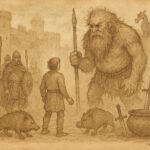
In the vast northern lands of Finland, where deep forests stretched endlessly and silver rivers reflected the pale light of the northern sun, there lived Väinämöinen, a hero of great wisdom and age. His hair and beard were as white as the winter snow, and his eyes shone with the depth of knowledge gained over countless years. But Väinämöinen was no ordinary man; he possessed a power unlike any other. With his voice, he could summon the winds, charm animals, and even shape the very elements. Music was his magic, and the songs he sang carried the strength of creation itself.
The people of Kalevala lived in villages across these forests and lakes, tending their crops and crafting their homes with care. Yet they longed for a symbol of prosperity and unity, the Sampo, a mysterious object said to bring wealth, happiness, and abundance to whoever possessed it. But the Sampo was in the possession of Louhi, the powerful and cunning sorceress of the North. Her fortress rose from the mountains like dark stone pillars, surrounded by treacherous waters and forests filled with enchantments and traps. She guarded the Sampo jealously, keeping it from those who might use it for the good of others.
Väinämöinen knew that to bring prosperity to his people, he must undertake a perilous quest to retrieve the Sampo. He gathered his companions, including the courageous Ilmarinen, a skilled blacksmith, and the young, daring Lemminkäinen, whose speed and bravery were unmatched. Together, they set out across forests, rivers, and treacherous swamps, guided by Väinämöinen’s wisdom and the songs that carried them through the cold and darkness.
Their journey was not easy. Enchanted animals tried to mislead them, and the very winds conspired against their progress. At night, the forests whispered warnings, and shadows moved as if alive. But Väinämöinen sang his songs of old, weaving magic into every note. The wind calmed, the rivers parted, and even the forest itself seemed to bend to his will, guiding them safely toward Louhi’s fortress. The companions pressed on, hearts steady despite the looming threat.
At last, they reached the sorceress’s stronghold. Louhi appeared before them, her eyes sharp and cruel, her voice a thunderous echo in the mountains. “Who dares seek the Sampo?” she demanded. “Many have tried. All have failed. Turn back or face ruin.”
Väinämöinen stepped forward, calm and resolute. “We seek it not for greed, but for the well-being of our people,” he replied. “We will face any challenge with courage, wisdom, and honor.”
Louhi laughed, a sound like cracking ice over frozen waters. “Then let your courage be tested,” she said, and the fortress itself rose in defense, walls shifting, doors appearing and vanishing. Magical guardians emerged, wolves with eyes of fire, serpents coiled around icy pillars, and shadows that sought to snatch them into darkness.
Väinämöinen’s magic guided them through these dangers. His songs calmed the wolves, lulled the serpents into slumber, and illuminated paths hidden by shadows. Ilmarinen used his skill to craft clever devices to overcome traps, and Lemminkäinen darted ahead, distracting guards and ensuring their safe passage. Each step was a combination of bravery, skill, and the old magic that Väinämöinen carried in his voice.
Finally, they reached the chamber of the Sampo. It glimmered with an otherworldly light, a symbol of abundance and hope. Louhi confronted them one last time, her magic roaring in waves. But Väinämöinen’s song, pure and powerful, resonated through the chamber. The Sampo trembled and seemed to respond to his voice. Seizing the moment, Ilmarinen lifted the Sampo carefully, and they prepared to leave.
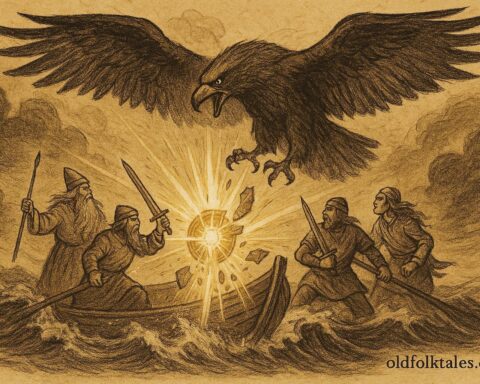
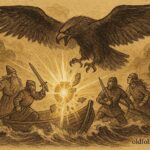
The journey back was not without peril. Louhi pursued them, her fury unleashed in storms and illusions. As they reached the river, the companions struggled to carry the Sampo across. In the chaos, the Sampo broke, and pieces of it were scattered into the water and lands of Kalevala. Yet from the fragments, prosperity flowed to the people, crops grew abundantly, and the villages thrived. Though they did not return with the Sampo whole, the quest brought blessings to the people and solidified Väinämöinen’s legend.
The tale of Väinämöinen and the Sampo spread through the villages and forests, sung by bards around hearths, teaching generations the power of wisdom, courage, and music. It became a story of hope, showing that even against great evil, cleverness, skill, and the strength of community could bring triumph, even if imperfectly.
Moral Lesson
Wisdom, courage, and cooperation are as powerful as magic or strength. True heroism is measured by intent, perseverance, and the good one brings to the community. Even partial success can yield lasting prosperity when guided by knowledge and heart.
Knowledge Check
-
Who is the main hero of the story?
Väinämöinen, the wise old hero with magical singing powers.
-
What is the Sampo, and why is it important?
A mysterious object that brings prosperity and abundance to the people of Kalevala.
-
Who opposes Väinämöinen’s quest?
Louhi, the evil sorceress of the North.
-
Which companions help Väinämöinen?
Ilmarinen, the blacksmith, and Lemminkäinen, the courageous youth.
-
How does Väinämöinen use magic to aid the quest?
By singing magical songs that calm animals, guide paths, and overcome illusions.
-
What lesson does the story emphasize for the community?
Courage, wisdom, and cooperation can bring prosperity, even in the face of great challenges.
Source: Compiled by Elias Lönnrot in Kalevala, first edition, 1835.
Cultural Origin: Finland, traditional oral epic songs.