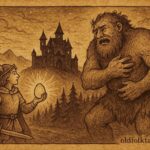
Once upon a time, in a land of towering fjords and snow-draped mountains, there lived a king with three daughters. The youngest was the most beautiful and kind-hearted of all, her hair shining like flax in the summer sun and her eyes as clear as the northern sky. One winter evening, as snow blanketed the castle grounds, a mighty knock sounded on the palace door. When the servants opened it, they beheld a magnificent white bear standing tall against the storm.
Discover the moral heart and wild spirit of the north through timeless Nordic storytelling
“Good evening to you,” said the bear in a deep, rumbling voice. “If the youngest princess will come with me, I will make her richer than she could ever dream.”
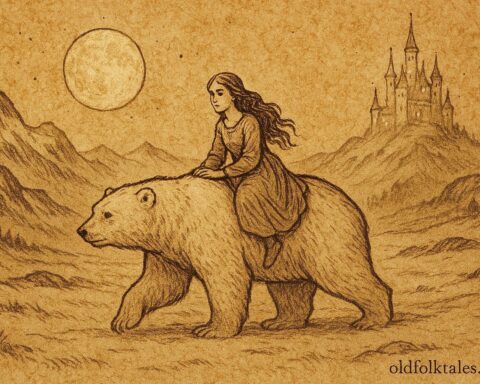
The king hesitated, but the white bear spoke so gently that it eased their fear. The two elder daughters refused the offer outright, but the youngest, moved by a strange pull of fate, agreed to go. She bade farewell to her family and climbed onto the white bear’s broad back. As they journeyed through forests of frost and over frozen lakes, the world around her glistened with moonlight and silence.
When at last they reached his palace, the princess found herself in a hall of gleaming silver and gold, with walls hung in silk and floors that shimmered like water. Each evening, a feast was laid before her. By day, the white bear was her silent companion, but by night, when the candles burned low, a man came and lay beside her in the dark. Though she could not see his face, his voice was kind, and she grew to love him dearly.
For many months, they lived together in peace. But one day, the princess grew homesick and begged to visit her family. The white bear warned her: “You may go, but do not listen to your mother’s advice, whatever she may say.” She promised, and soon they set out across the snowy mountains to her father’s kingdom.
Her family received her with tears and joy, marveling at her fine clothes and bright jewels. But the queen, her mother, noticed a shadow of sadness in her daughter’s eyes. “Tell me,” said the queen softly, “do you ever see the one you sleep beside?”
The princess hesitated. “No, Mother, I have never seen his face.”
“Then he must be under some wicked spell,” said the queen. “Take this candle. Light it while he sleeps, and you will see who he truly is.”
Though the princess remembered the bear’s warning, her heart ached with curiosity. When she returned to the silver palace, she waited until her unseen husband lay fast asleep. Then, trembling, she lit the candle. Its golden light fell upon the face of a handsome young man, so fair and noble that she gasped aloud. But as she leaned closer, three drops of hot wax fell upon his skin. He awoke with a cry of pain.
“What have you done?” he said, sorrow in his eyes. “If you had only waited one year, the spell would have been broken. Now I must go, to live with the troll queen who cursed me.”
Before she could speak, the hall vanished. The princess found herself alone in the wilderness, her heart breaking with grief.
Still, she refused to give up. She set out across the wide world to find her lost love. Through dark forests and over steep mountains she wandered, her shoes worn thin, her hands bleeding from cold and stone. At last, she came to the hut of an old woman who sat spinning by the hearth.
“Have you seen the White-Bear-King Valemon?” the princess asked.
“Not I,” said the old woman, “but take this golden apple. Roll it before you, and it will show the way.”
The princess thanked her and followed the apple through the valleys and across the frozen plains. She met two more old women on her journey; one gave her a golden carding comb, and the other, a golden spinning wheel. Each gift guided her onward until she came to a castle black as night, where the troll queen kept Valemon captive.
Inside, the troll queen was preparing for her wedding. When the princess arrived, she used her golden treasures to bargain for three nights with Valemon. The troll queen agreed, but each night she gave Valemon a sleeping potion so he could not wake.
On the third night, as the princess wept beside him, a servant took pity and told Valemon the truth. When the potion was brought again, he poured it away secretly. As the princess entered, crying softly, he turned to her and took her in his arms.
“Now I know you have suffered for me,” he said. “We must escape before dawn.”
Together they fled the troll’s castle on a great white steed that could fly faster than the wind. The troll queen and her monstrous kin gave chase, but Valemon and the princess threw behind them the gifts she had received, each one becoming an obstacle. The apple turned into a mountain of fire, the comb a thicket of thorns, and the wheel a roaring river. At last, the trolls gave up the chase.
When morning broke, Valemon’s curse was lifted. The white bear was no more, and the man she loved stood before her, free at last. They returned to her father’s kingdom, where their wedding was celebrated with joy that rang across the hills and valleys.
Discover the moral heart and wild spirit of the north through timeless Nordic storytelling
Moral Lesson
Love founded on faith and patience can overcome even the deepest of curses. Trust and endurance are often the true tests of devotion.
Knowledge Check
- Who was White-Bear-King Valemon in disguise?
He was a cursed king who appeared as a white bear by day. - What warning did Valemon give the princess before she visited her family?
He warned her not to follow her mother’s advice. - What caused Valemon’s curse to continue?
The princess disobeyed and spilled candle wax on his face while he slept. - What three magical gifts helped the princess find Valemon?
A golden apple, a golden carding comb, and a golden spinning wheel. - How did the princess rescue Valemon from the troll queen?
She bargained for three nights with him and awakened him on the third night. - What is the main moral of this Norwegian folktale?
True love requires trust, perseverance, and faith.
Source: Adapted from the Norwegian folktale “White-Bear-King Valemon” in Norske folkeeventyr by Asbjørnsen & Moe (1871).
Cultural Origin: Norway