Once upon a time, in an age so distant that if it had not happened, it would not be told, there lived an emperor and empress who longed for a child. They were young, noble, and fair, yet the blessing of a son or daughter eluded them. They sought help from every philosopher, witch, and star-reader in the land, but none could promise them an heir.
At last, the emperor heard of a wise old man living in a distant village, famed for his knowledge of fate. The emperor sent messengers to summon him, but they returned with this message:
“Let him who needs me come to me.”
So the emperor and empress set out, attended by courtiers and soldiers, to seek the sage. When the old man saw them approach, he greeted them and said:
“Welcome, mighty emperor. But beware, the wish that brings you here will also bring you sorrow.”
The emperor replied, “I come not for sorrow, but for joy. Give me the herb that will bless us with a child.”
The old man handed him a bundle of enchanted herbs and warned, “You shall have a son, handsome and wise, but you will not keep him long.”
The royal couple returned home rejoicing. Soon after, a prince was born. Yet from the moment of his birth, the baby cried endlessly. The emperor promised him all the kingdoms of the world, rich treasures, and even the most beautiful princess, but nothing soothed him. At last, in desperation, the emperor whispered:
“Hush, my child, and I shall give you youth without age and life without death.”
Instantly, the child ceased crying. The drums rolled, the trumpets blared, and the empire rejoiced for seven days and nights.
The boy grew quickly in wisdom and beauty. He learned all the arts and sciences, and people called him a second Solomon. But when he turned fifteen, he rose at a royal banquet and said:
“Father, give me now what you promised at my birth.”
The emperor grew pale. “My son, I promised what no mortal can give. I spoke only to quiet you.”
But the prince replied, “Then I must go and find it myself.”
No counsel could dissuade him. The emperor, weeping, finally gave his blessing and supplied provisions for his son’s journey.
In the royal stables, the prince sought a steed strong enough for the quest. The finest horses collapsed at his touch, but in the farthest corner stood a worn, bony horse, covered in sores. When the prince touched its tail, the beast lifted its head and said:
“Thank Heaven, a hero’s hand at last! Care for me six weeks, feed me oats boiled in milk, and I will serve you.”
The prince obeyed. He also cleaned and restored his father’s youthful weapons and garments, as the horse had advised. At the end of six weeks, the horse shook itself, and its sores vanished. Its coat gleamed like polished steel, and two great wings unfolded from its sides.
“Master,” said the horse, “in three days, we depart.”
On the morning of the third day, the prince, clad like a hero, mounted his winged steed. The emperor and empress, sobbing, bade him farewell. He galloped away like the wind, followed by two hundred horsemen, who he later dismissed with generous gifts once he reached the wilderness.
For three days and nights they rode until they reached a field strewn with bones. The horse said, “We are in the realm of the Woodpecker Fairy, cursed by her parents. She kills all who enter. Be ready.”
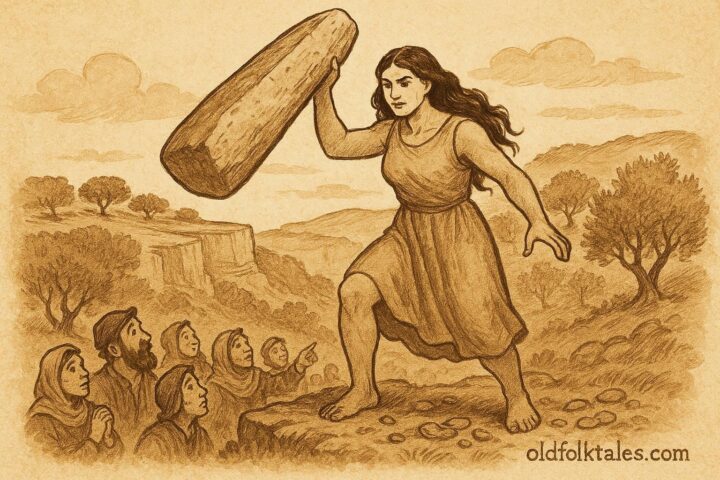
At dawn, the earth shook, the fairy approached, tearing trees from the ground. The horse leapt into the air, and the prince shot off one of her feet with an arrow. Crying out, she said:
“Spare me, young hero, and I will harm you no more.”
She wrote her promise in her own blood. The prince returned her foot, and she feasted him for three days, offering one of her daughters for a wife, but he refused. He told her he sought Youth Without Age and Life Without Death, and she blessed his journey.
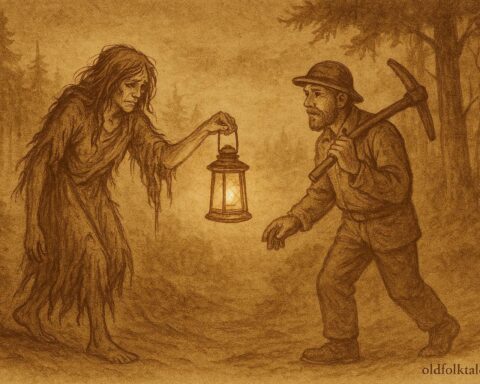
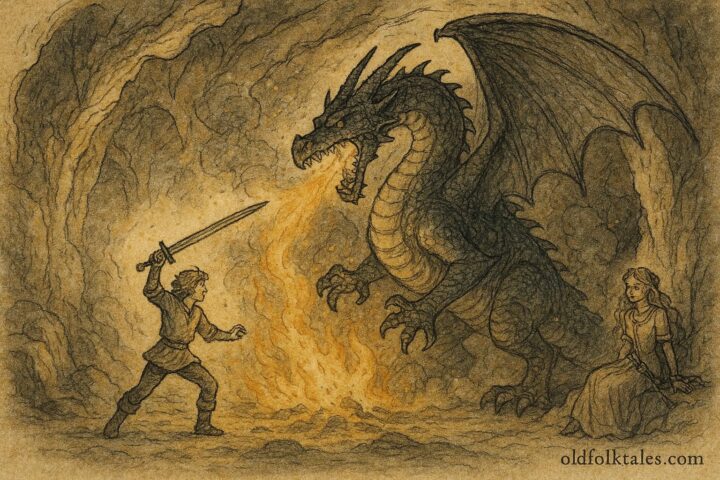
Beyond her land lay the kingdom of the Scorpion Witch, her sister, even more fearsome, with three heads and a mouth that spat fire. Again, the prince fought bravely and struck down one head before she pleaded for mercy. Like her sister, she bound herself to peace and offered him hospitality.
The hero continued his journey until he reached a vast forest guarding a golden palace, the home of Youth Without Age and Life Without Death. All the wild beasts of the world roamed its gates. “Hold fast,” said the horse, “we must leap it.”
They soared through the sky, but the horse’s hoof brushed a tree, awakening the beasts. Their roars filled the heavens. Only the mistress of the palace, a radiant fairy maiden, could calm them. Seeing the prince, she smiled:
“Welcome, brave traveler. You alone have found this realm. What do you seek?”
“Youth Without Age and Life Without Death,” he answered.
She led him into the palace, where she and her two sisters lived. The youngest became his bride. They lived in eternal spring, in peace and joy, where years passed like moments.
One day, while hunting, the prince pursued a hare into a forbidden valley, the Valley of Lamentation. As he crossed it, sorrow filled his heart, and longing for his parents overcame him. His wife wept, begging him not to leave, warning, “Centuries have passed since your birth. If you return, you can never come back.”
But his yearning was too strong. The horse tried to dissuade him, but finally agreed to carry him home under one condition:
“If you stay an hour at your father’s palace, I will return alone.”
They journeyed across transformed lands, cities where forests once stood, people who laughed at his tales. His hair grew white, his beard long. Reaching his father’s realm, he found only ruins.
The horse kissed his hand and said, “Farewell, master. I go home.”
The prince wandered through the crumbling palace until he found an old chest in the cellar. As he opened it, a voice whispered:
“Welcome. Had you delayed longer, even I would have perished.”
It was Death, shriveled with age, waiting for him. The prince fell lifeless to the ground, turning to dust.
Thus ended the one who sought eternal life, for no man can escape time’s embrace.
Moral Lesson
The quest for immortality may promise endless joy, yet true peace lies in accepting the cycle of life and death. Even eternity without love or purpose becomes a curse.
Knowledge Check
-
What did the emperor promise his newborn son?
He promised youth without age and life without death. -
How did the prince choose his horse?
He picked an old, weak horse that spoke and later revealed magical wings. -
Who were the Woodpecker Fairy and the Scorpion Witch?
Cursed sisters who guarded perilous lands and tested the prince’s courage. -
Where did the prince find eternal youth?
In the palace of the Fairy of Youth Without Age and Life Without Death. -
What caused the prince’s downfall?
His longing for his parents after passing through the Valley of Lamentation. -
What is the main message of this Romanian folktale?
Immortality without wisdom or restraint leads inevitably to loss and sorrow.
Source: Adapted from the Romanian folktale “Youth Without Age and Life Without Death” in Roumanian Fairy Tales, collected by Petre Ispirescu, translated by Julia Collier Harris and Rea Ipcar (1917), New York: A. L. Burt Company.
Cultural Origin: Romania (Romanian folklore)