In the quiet municipality of Redange-sur-Attert, nestled in the western part of Luxembourg, a dark legend has flowed through generations like the waters of the Attert River itself. Long before the town’s modern streets and bridges took form, villagers whispered tales of a mysterious figure who dwelt beneath the surface, a being they called the Kropemann, meaning “the Hook-Man.”
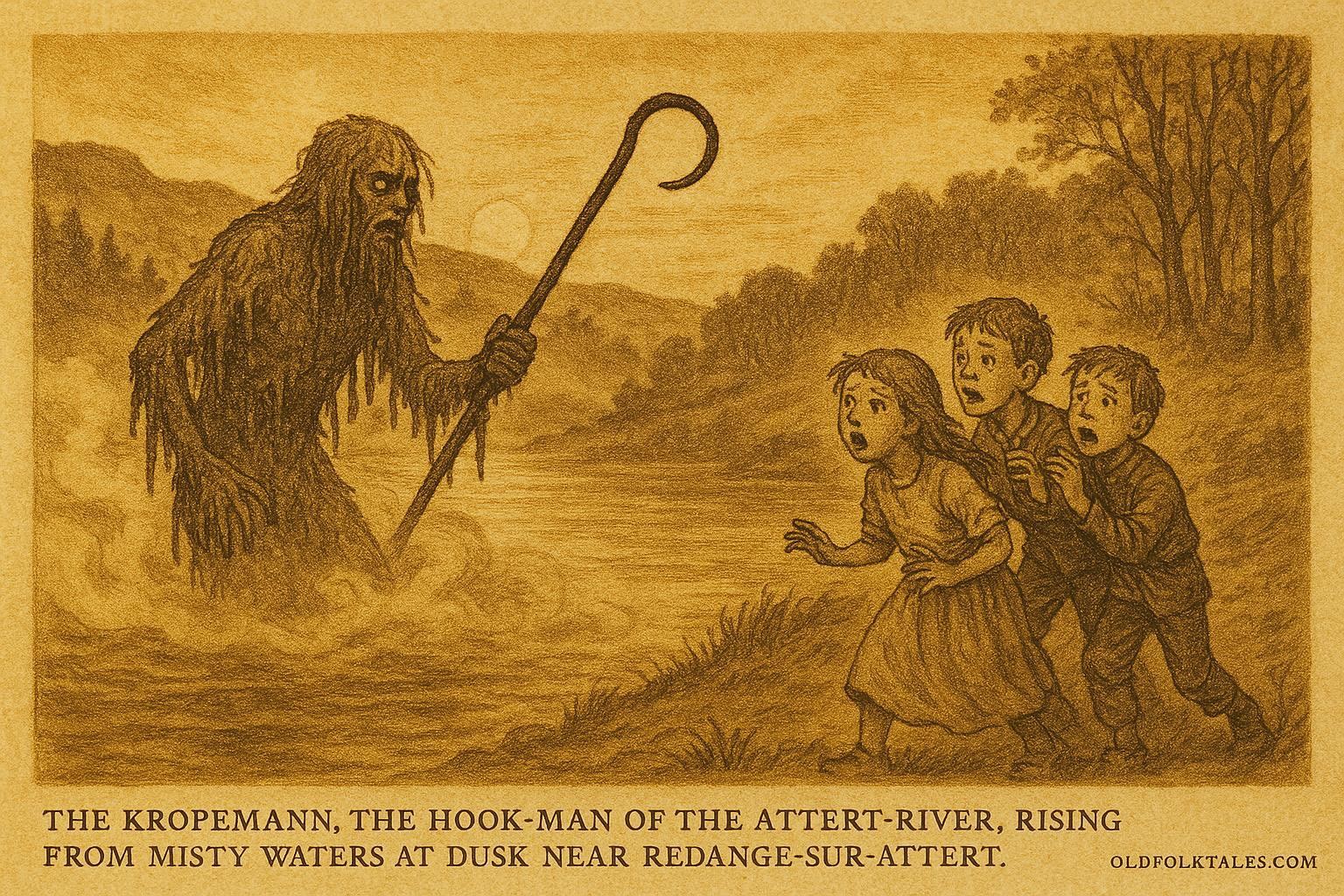
The Kropemann was no ordinary man. Some said he was once human, cursed by the spirits of the river for disturbing its peace. Others believed he had always been a creature of the water, born from its murky depths. Whatever his origin, all agreed that he was small in stature, covered in slime and green algae, and his hair, long and tangled, flowed like river weeds. His most frightening feature was his long wooden pole, tipped with a curved metal hook, the Kropestang.
By day, the river seemed harmless, its waters sparkling under the Luxembourgish sun, children laughing and skipping stones along its edges. But when dusk fell, the villagers warned, the Kropemann stirred. It was said that when the mists began to rise from the Attert and the frogs fell silent, the Hook-Man would emerge, his algae-covered face breaking the water’s surface. Slowly, he would glide toward the riverbank, his hook extended, listening for the careless laughter of children who had strayed too close.
The Kropemann’s purpose was not mischief, it was punishment. His legend served as a warning: never underestimate the river, for its depths hold more than water. Children who ignored their parents’ cautions or played by the banks after sunset risked a fate that every child in Redange feared, to be snatched by the Hook-Man and dragged beneath the rippling surface, never to return.
Parents would tell the tale in hushed tones, especially in the evenings when the scent of wet grass lingered in the air. Some elders claimed they had seen him, a shadow gliding through the reeds, or the faint sound of a splash when no one was near. A few even swore that during heavy rains, when the river swelled and overflowed, they could hear the Kropemann calling softly from the flooded fields, as if claiming the waters as his domain.
In those moments, mothers gathered their children indoors, closing shutters and lighting candles, whispering prayers that the Kropemann would pass their homes untouched.
The River’s Keeper
Unlike many monsters of European folklore, the Kropemann was not merely a creature of evil. In some tellings, he was a guardian spirit, a grim protector of nature’s balance. The Attert River, though beautiful, was unpredictable, its currents strong and its banks slippery. The legend of the Hook-Man kept people respectful of its power.
Old fishermen told stories of the Kropemann appearing before great storms, his algae-covered form drifting near the surface as if warning of danger. When the floods came, they said, he was the river’s fury made flesh, a reminder that the water could take as easily as it gave.
Generations later, as the town of Redange modernized, the tale endured. A fountain statue was erected in his honour, depicting the Hook-Man rising from the water, his curved hook in hand. For the townspeople, it was not only a monument to an ancient fear but also a symbol of local identity, a link between the modern world and the timeless whispers of the Attert.
Children still point to the sculpture with nervous laughter, daring one another to touch the base at night. The adults smile knowingly, for they too once trembled at the sound of rustling reeds and the imagined tug of an unseen hook beneath the water.
The Enduring Warning
Though centuries have passed since the tale first took shape, the Kropemann’s presence is still felt. Parents in Redange continue to tell the story on rainy nights or when their children wander too near the river. The legend, in its eerie simplicity, still serves its purpose, to protect.
The Attert River flows quietly now, bordered by trees and fields, its surface calm and silver under the moonlight. But locals say that when fog cloaks the valley and the waters churn, the Hook-Man may still rise from the depths, his green form blending with the moss and mist, his hook glinting faintly before vanishing once more.
So, if you ever find yourself in Redange-sur-Attert, standing by the river as twilight fades, listen carefully. The wind through the reeds may sound like whispers. The water’s ripple may seem like a hand reaching out. Whether you believe or not, remember the Kropemann, for every legend begins with a truth too old to dismiss.
Moral Lesson
The tale of the Kropemann reminds us that nature must be respected. Rivers, like all natural forces, can be both beautiful and dangerous. The legend teaches caution, humility, and reverence for the unseen powers that shape our world.
Knowledge Check
- Who is the Kropemann in Luxembourgish folklore?
The Kropemann, or “Hook-Man,” is a mythical river spirit from Redange-sur-Attert in Luxembourg who drags careless victims into the river using a hooked pole. - What is the main purpose of the Kropemann legend?
The legend serves as a cautionary tale to warn children and villagers to stay away from dangerous riverbanks and respect natural forces. - What does the Kropemann carry with him?
He carries a long wooden pole with a hook, known as the Kropestang, used to catch those who come too close to the water. - What natural element is central to the Kropemann story?
The Attert River, located in Redange-sur-Attert, is the setting and spiritual heart of the Kropemann legend. - How is the Kropemann depicted in Redange today?
A fountain sculpture in Redange commemorates the Kropemann, celebrating the town’s cultural heritage and folklore. - What moral lesson does the Kropemann story teach?
It teaches respect for nature’s power and the importance of obeying warnings meant to protect one’s life.
Source: Adapted from “Luxembourg Myths: Kropemann,” Chronicle.lu.
Cultural Origin: Luxembourgish Folklore (Redange-sur-Attert, Western Luxembourg)