Along the gentle curves of the Alzette River, where water glides quietly through meadows and forested slopes, the land of central Luxembourg has long been shaped by patience rather than force. The valley is neither wild nor tame, but balanced, fields yielding to woods, villages resting lightly upon the earth. It is here, where mist rises softly from the river at dusk and moonlight lingers on leaves, that people speak in lowered voices of a woman who spins by night. She is known simply as the Moon Spinner.
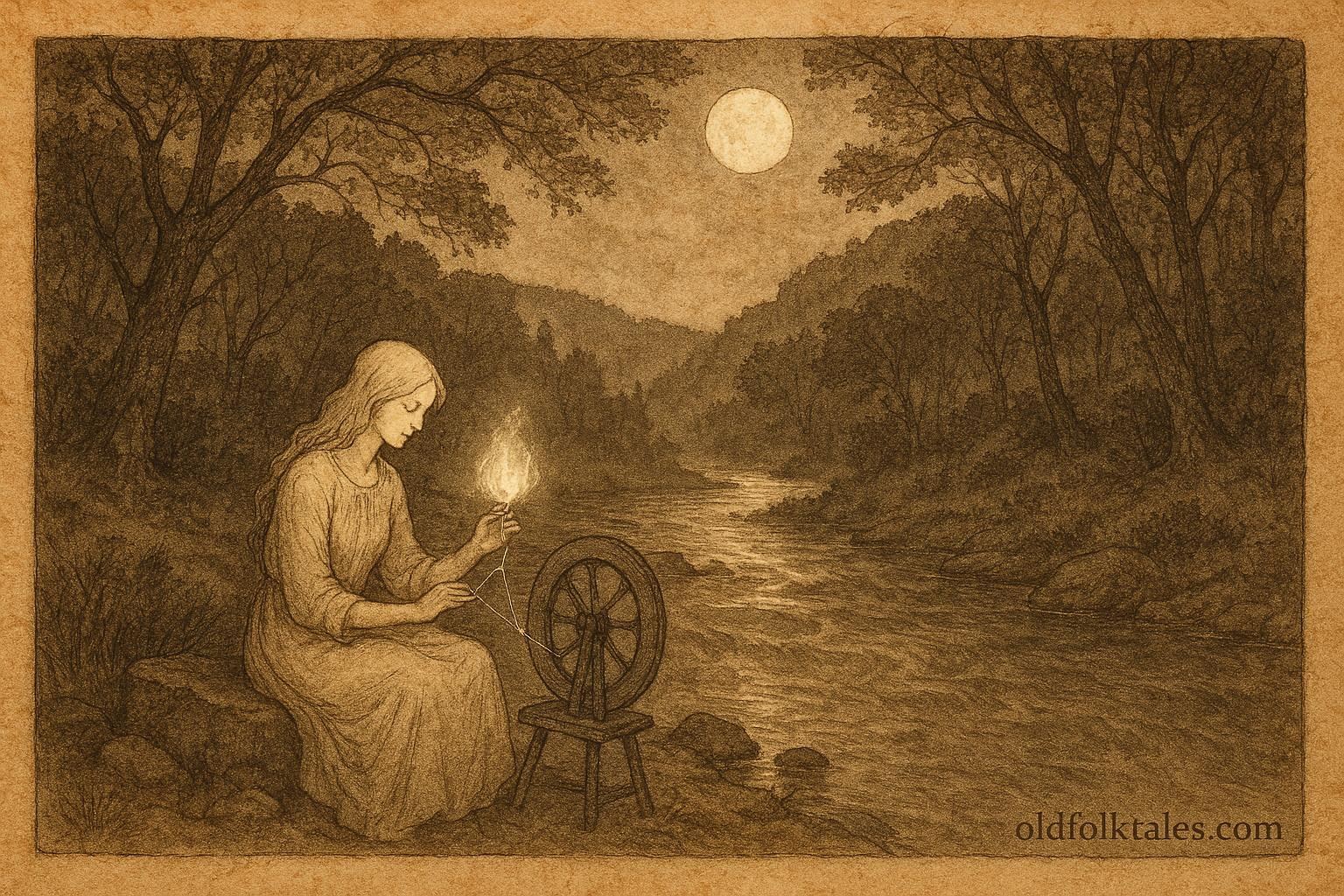
No church record names her. No stone marks her dwelling. Yet for generations, travelers, farmers, and woodsmen have shared the same account: on clear nights, when the moon is full or nearly so, a woman appears beside the Alzette, seated upon a flat stone or fallen log, her hands moving steadily as she spins silver thread that gleams like water caught in starlight.
Those who respect her presence pass unharmed and prosper.
Those who disturb her lose their way.
The Valley at Night
When daylight fades in the Alzette Valley, the world does not darken all at once. Shadows lengthen gradually, birds fall silent in stages, and the river takes on a reflective stillness, holding the sky within its surface. The moon rises slowly above the tree line, illuminating paths that are barely visible by day.
It is in these hours that the valley feels most ancient.
Fishermen returning late sometimes pause at bends in the river, unsettled by a quiet that feels deliberate. Farmers traveling between hamlets after sunset are known to quicken their pace, remembering what their elders once said: do not linger where moonlight meets water.
For that is where she appears.
The Woman by the River
Witnesses describe her with remarkable consistency. She is neither young nor old, but timeless in bearing. Her clothing is pale, often said to shimmer faintly, yet plain in form, like garments worn by rural women long ago. Her hair falls loose or loosely bound, catching moonlight as though dusted with frost.
In her hands rests a spindle.
From it, she draws a thread so fine and luminous that it seems spun from moonbeams themselves. The thread does not tangle. It does not break. It stretches endlessly, coiling at her feet or dissolving into the night air like mist.
She does not look up when approached.
She does not speak.
Her presence alone is warning enough.
Curiosity and Consequence
Not all who encounter the Moon Spinner intend harm. Some stumble upon her by chance, hunters delayed by dusk, travelers misjudging the distance between villages. At first, many believe her to be an ordinary woman working late by the river.
Those who step closer, calling out or laughing at the strangeness of her labor, soon discover their mistake.
The path behind them vanishes. Trees rearrange themselves. The sound of the river fades or multiplies until direction becomes meaningless. Such travelers wander until exhaustion overtakes them, often not finding their way again until dawn breaks and the moon releases its hold on the valley.
Some return shaken, unable to explain where they have been.
Others do not return at all.
The Gift of Restraint
Yet not every encounter ends in confusion or fear.
Those who stop at a distance, who lower their voices or simply turn away, report a different outcome. They feel a sudden clarity of direction, as though the land itself were guiding their steps. Their journeys proceed without mishap. Boats move safely through narrow bends. Crops flourish in the following season.
In villages along the Alzette, such fortunes are not attributed to chance.
The elders say the Moon Spinner rewards restraint, not obedience. She asks for no offerings, no prayers, no acknowledgment. She requires only that her work remain undisturbed.
Meaning in the Thread
The silver thread she spins has inspired much quiet speculation. Some say it represents the paths of travelers, measured and watched. Others believe it binds the land together, field to forest, village to river, maintaining balance where human hands might otherwise disrupt it.
There are those who whisper that each thread marks a boundary: between night and day, curiosity and intrusion, human need and natural order.
Whatever its meaning, the thread is never found by morning.
A Guardian, Not a Spirit of Malice
Importantly, the Moon Spinner is never described as cruel. She does not chase, curse, or attack. Her power lies not in violence, but in withdrawal, the quiet removal of guidance from those who overstep.
In this, she differs from darker figures of European folklore. She is not a punisher, but a guardian. Her task is preservation, not retribution.
The valley prospers because she exists.
The Passing of the Tale
As roads improved and lanterns replaced moonlight, fewer claimed to see her. Yet the story never vanished. It settled into proverbs and cautions shared with children, reminders given to strangers, explanations offered when someone returned late and shaken.
“Respect the river,” they would say.
“Not everything seen is meant to be approached.”
Even today, locals speak of nights when the Alzette seems unusually bright, when mist hangs too long above the water, when silence feels watchful rather than empty.
On those nights, windows close early.
Endurance of Quiet Guardians
Whether the Moon Spinner is spirit, symbol, or memory given form, her presence reflects something deeply rooted in the culture of the valley: an understanding that nature does not announce its boundaries loudly. It waits for humans to recognize them, or to learn, slowly and painfully, when they do not.
The Alzette continues to flow.
The moon continues to rise.
And somewhere along the river’s edge, the spindle turns.
Moral Lesson
The Moon Spinner of the Alzette Valley teaches that respect for the unseen, whether nature, tradition, or boundaries not fully understood, preserves harmony. Curiosity must be tempered with restraint, for not all mysteries are meant to be approached, and balance is maintained by those who know when to step back.
Knowledge Check
1. Where does the Moon Spinner appear?
Along the Alzette River in central Luxembourg.
2. What does she do by moonlight?
She spins silver thread beside the river.
3. What happens to those who disturb her?
They lose their way in the forest until dawn or beyond.
4. Who receives her blessing?
Those who observe respectfully or leave her undisturbed.
5. What does the silver thread symbolize?
Balance, boundaries, and the quiet order of nature.
6. What cultural value does this tale emphasize?
Respect for the unseen and harmony with the natural world.
Source: Nikolaus Gredt, Sagenschatz des Luxemburger Landes, 1883
Cultural Origin: Alzette Valley, central Luxembourg