Long ago, in a land of rolling hills and misty valleys, there lived a once‑great king whose world had fallen to ruin. He no longer had a kingdom, but only two golden rings set with precious gems, a modest mare, a loyal female dog, and a small garden beside his humble cottage. With his wife, he worked the land: she spinning linen and wool, he tending the soil. Their days passed quietly, but in their hearts lay a longing for a twin child.
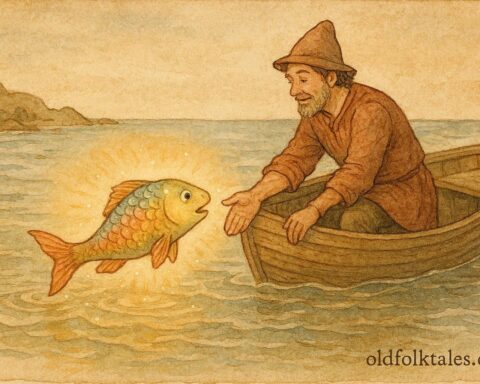
One dawn, the king went to the sea and cast his net. He hauled in a large red fish, but this was no ordinary fish. In a trembling voice, it spoke: if set free, the fish would grant any wish. Overjoyed, the king released it. The fish, as it slipped into the waves, beckoned: cast your net again, and give your next catch to your wife to eat, feed the mare the tail, the dog the bones, and bury what remains in your garden. The king obeyed.
What happened next was miraculous. His wife soon gave birth to not one, but two baby boys, twin brothers. On the forehead of one shone the radiant Sun; on the other, the gentle glow of the Moon. At the same time, the mare bore two foals, the dog two pups, and in the garden where the fish’s bones lay, two silver swords suddenly appeared.
They named the boys Zjerma (“the Fire”) and Handa (“the Moon”). Their mother raised them with love, and the king taught them to ride without saddle, to fight, to hunt in forests, and to roam the mountains, skills born of wild freedom and necessity.
When the twins turned nineteen, a heavy sorrow came: the king fell ill, and his end approached. Gathering his sons, he reminded them of their royal blood, asked them to love one another, care for their mother, and uphold honor. To each he bestowed one of the golden rings. With tears and reverence they buried him, mourning for nine nights and days. Their mother wept, but the twins, strong and dutiful, comforted her.
A year later, restless for adventure and glory, Zjerma turned to Handa. “Brother,” he said softly, “We are born for more than quiet fields. Let us travel the world, seek riches and fame, and perhaps reclaim our father’s lost kingdom.” Handa agreed. They saddled their horses, took their dogs, strapped on the silver swords, and set off.
After some time they reached a fountain under a flowering almond tree, a place where the road split. Because the horses chose separate paths, the brothers bade farewell, vowing to meet each year on this day. They clasped hands. If ever one needed the other, the gem in the ring would turn black. Zjerma’s horse trotted to the right, Handa’s to the left.
Zjerma’s Peril: The Seven‑Headed Dragon
Zjerma rode into a city whose gates were closed, its streets deserted, its people vanished. At the temple of the Sun he found a sorrowing old man. With trembling voice, the man told of a monstrous creature, a kulshedra, a dreadful seven-headed dragon, that had blocked the source of the river months ago. Since then, the city was parched. The monster demanded a maiden’s life each day. The king’s own daughter, Bardhakuqja, had just been offered. The people lived in terror.
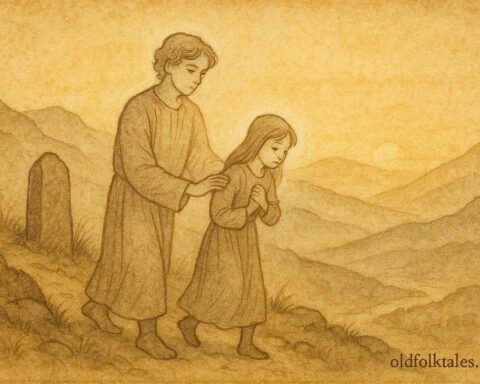
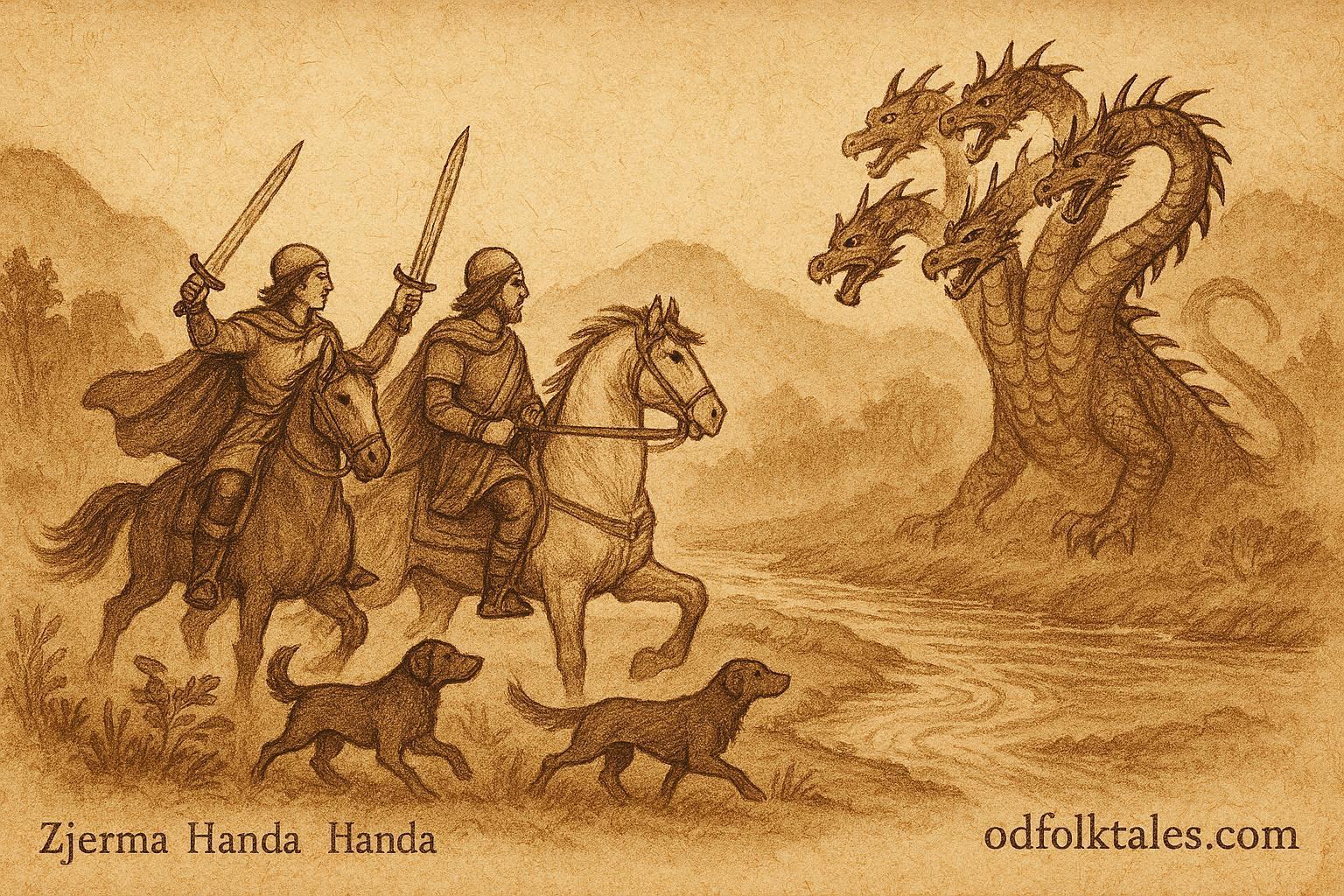
Zjerma, with fierce resolve, pledged to free the water and slay the dragon. He rode with his horse and dog deep into a dark gorge where the water ran cold and black. There he found Bardhakuqja, bound to a boulder and nearly lifeless. Her eyes widened when she saw him, and she begged him to flee, but Zjerma would not. Gently, he freed her, and wearing exhaustion like a cloak, rested his head on her knees and fell asleep.
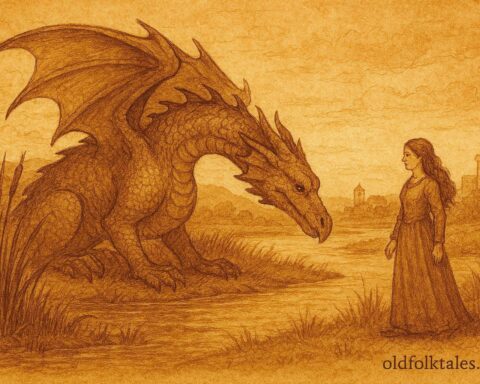
At midday the water began to stir. The maiden wept, a single tear fell on Zjerma’s face and awoke him. Sword in hand, he awaited the monster. The river boiled. From the depths rose the kulshedra: seven heads crowned with horns, poisonous fangs, hissing tongues, fire spewing from its many mouths. Its body was armored like steel, claws like iron, tail knotted nine times, wings larger than a hawk’s, with batlike fins and antennae.
With courage and skill Zjerma fought. The dragon lunged, but bit at empty air; he struck, and when at last the monstrous beast lay dead, the river’s waters returned. The city revived, and the people joyously gave Bardhakuqja to Zjerma in marriage.
Handa’s Fate, and Zjerma’s Rescue
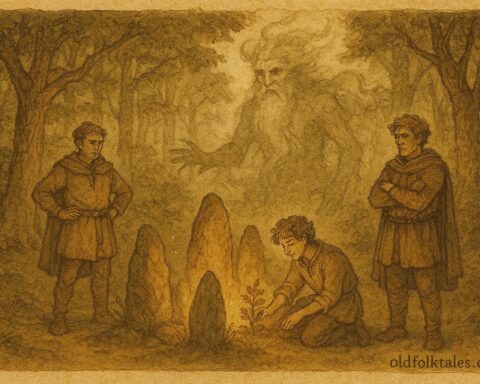
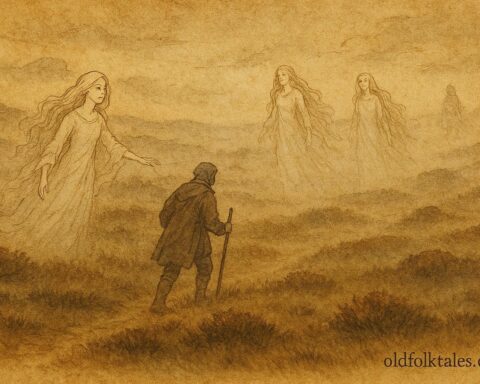
Meanwhile Handa journeyed across plains and hills to a dense forest. He reached a humble hut beside a stream, where an old man warned him: the path ahead led to danger greater than death. But Handa, his heart fixed on adventure, pressed on. Soon he came upon a garden of nymphs, the zanas, dancing in white robes, singing, offering laughter, enticement, and kisses. They told him about e Bukura e Dheut, the Earthly Beauty, said to dwell in a cave deep within the mountain. Enchanted, Handa longed to meet and marry her.
An old witch guarded the garden. She challenged him: he must solve her riddle, cleave in two a woolen bow, then vault onto his horse without touching the hedge. Handa failed on all counts. In fury the witch sprayed an herbal ointment: Handa, his horse and dog turned to stone. The ring on his finger blackened in Zjerma’s hometown.
When Zjerma returned to the almond‑tree fountain and sensed his brother’s peril, he set off at once. At a hut where a wise old man lived, Zjerma learned how to break the petrifying spell and restore life. Armed with that knowledge, he journeyed to the garden of the zanas. Ignoring their seductive songs, he demanded the path to the Earthly Beauty.
At the hedge the witch again challenged him. This time Zjerma solved the riddle, cleft the bow, vaulted clean onto his horse, and seized the witch before she could curse him. Under threat of death, she led him to the stony figures of Handa and many other men, once noble heroes.
Zjerma forced the witch to reveal how to revive them: the dew from the white-lily’s calyx, applied to their lips and eyes. With trembling hands he applied the dew. Handa gasped, life returning, then the dogs and other men followed. The witch, in rage, transformed into a black serpent and tried to uproot a tree, but the earth rejected her: she split in two and died.
Freed at last, Handa proposed a tournament to win the Earthly Beauty’s hand. But in respect to Zjerma, the grateful men unanimously offered her to Handa without a fight. The Beauty, fair as moonlight and bright as Venus, accepted. Zjerma crowned them with laurel wreaths. A joyous festival of nine days rang out across the valley.
Return of Royal Blood
With their mother rescued and their birthright reclaimed, the twins raised a small army, their strength comparable to legendary drangues, and marched to free their ancestral kingdom from foreign rule. As months passed, their small host cut through enemy lines. At last, the foreign king joined the battle in desperation. Handa struck him down with the silver sword. The crown passed to Handa: Zjerma crowned him, the throne rightfully restored.
Handa settled in his kingdom with the Earthly Beauty; Zjerma returned to his own bride, Bardhakuqja. Their mother came home too. But on the final day of Zjerma’s return, illness struck. Too weak to ride, he sent Handa to the city alone. Mistaken for Zjerma, Handa was welcomed as the returning hero, and led to Zjerma’s bed, as custom demanded. Respectfully, he lay sword between him and Bardhakuqja. When Zjerma arrived in the morning and saw them there, his anger flared, until he noticed the sword dividing them. Realization flooded him: he had found no betrayal, only brotherly honor. He laughed.
Reunited as true brothers, with their mother and wives, after three months the twins parted. Zjerma returned to his new kingdom, where his aged father-in-law abdicated and placed the crown on his head. And so the twins, born of magical fish and heavenly dawn, became wise and just rulers two lights of their land: Fire and Moon, together in righteous glory.
Moral of the Story
True brotherhood is forged not by blood alone but by loyalty, courage, and honor. When siblings stand together, guiding each other, protecting each other, and honoring their bond, they can overcome darkness, slay monsters, and reclaim what is rightfully theirs.
Knowledge Check
Q1: Who are the hero twins in the story?
A1: The hero twins are Zjerma (Fire, with the Sun on his forehead) and Handa (Moon, with the Moon on his forehead).
Q2: What magical being speaks to the king and helps bring about the twins’ birth?
A2: A magical red fish that speaks and grants the wish of a child, under conditions including feeding parts of itself to the wife, mare, and dog, and burying the rest in the garden.
Q3: What monstrous creature does Zjerma defeat, and what does it do to the city?
A3: Zjerma defeats a seven‑headed dragon, known as the kulshedra, which had blocked the river source, causing drought, and demanded a maiden’s life daily.
Q4: What happens to Handa during his quest for the Earthly Beauty?
A4: Handa fails the witch’s tests and is turned to stone along with his horse and dog. Later, Zjerma revives him using dew from a white‑lily’s calyx, with help from a witch forced to reveal the secret.
Q5: Who does Handa marry, and who does Zjerma marry?
A5: Handa marries the Earthly Beauty (e Bukura e Dheut), and Zjerma marries the princess previously offered to the dragon, Bardhakuqja.
Q6: What broader narrative motif or tale‑type does this story belong to?
A6: This tale belongs to the folktale type classification ATU 303, The Twins or Blood Brothers and includes elements of ATU 300, The Dragon Slayer.
Cultural Origin: Albanian folktale (Arbëreshë / Albanian tradition)