In the villages of Kosovo, where stone houses cluster close against cold winters and fields stretch patiently toward the hills, people have long spoken of Death as more than an ending. Death is a presence, seen by few, feared by all, and respected by the wise. He walks when it is time, neither hurried nor delayed, collecting lives as the seasons collect leaves.
And yet, the old stories say, Death can be stopped, briefly, by intelligence.
In one such village lived a young maiden named Elira, known not for beauty alone, but for her quick mind and calm tongue. She was the sort who listened more than she spoke, who solved disputes with words instead of raised voices, and who noticed what others overlooked. Elders often said, “That girl thinks before the world does.”
Elira lived with her widowed mother and helped tend a small plot of land. Though their life was modest, their house was known for hospitality. Bread was shared, water was offered, and no traveler left without a kind word.
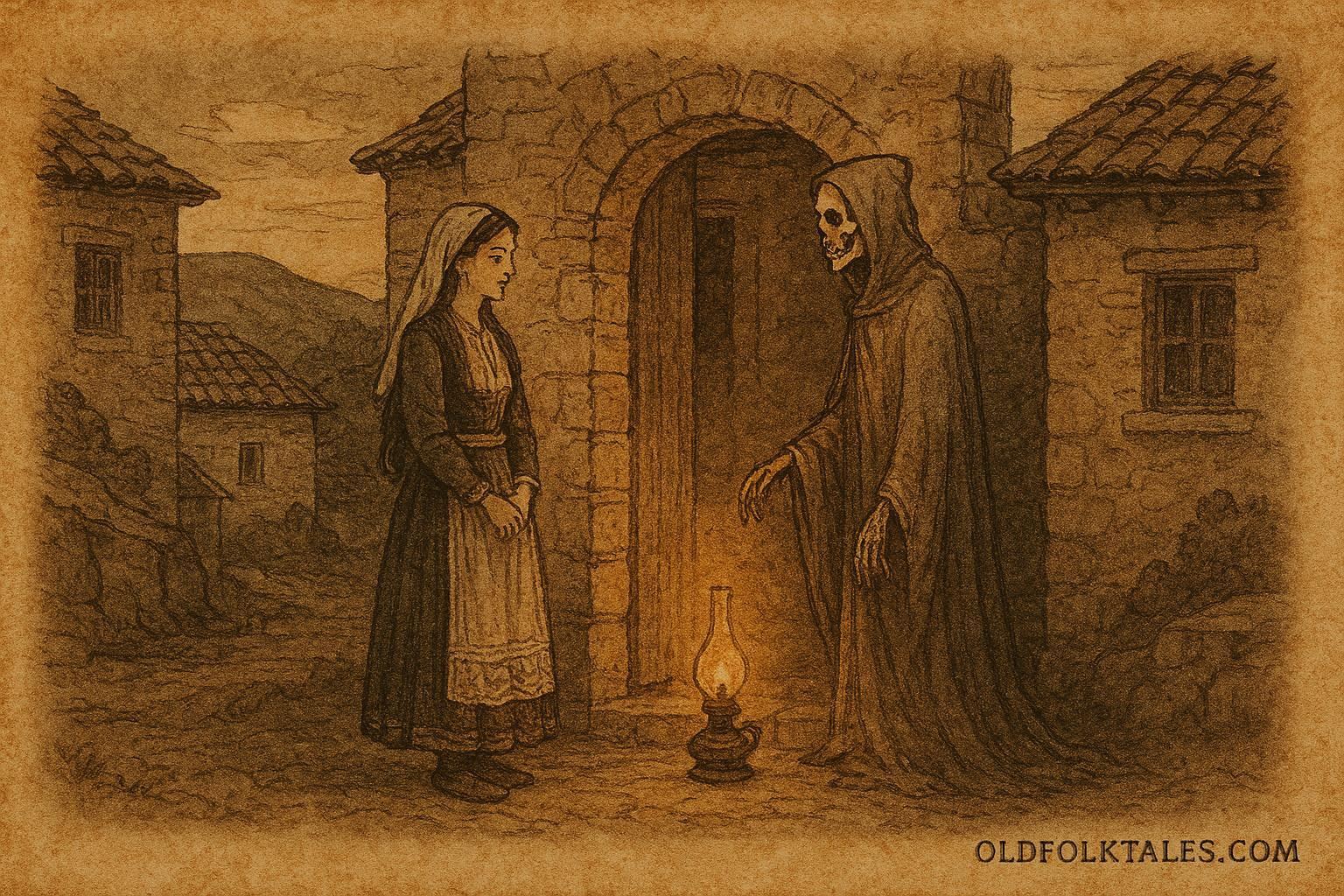
One evening, as dusk crept into the valley and the smoke of hearth fires curled upward, Elira felt a sudden chill pass through the room. The oil lamp flickered, though no wind stirred. Her mother froze.
“He is near,” the old woman whispered.
Elira turned.
In the doorway stood Death.
He appeared as a tall, thin figure wrapped in dark garments the color of ash and shadow. His face was neither cruel nor kind, only empty of emotion, like stone worn smooth by time. He carried no weapon. He did not need one.
“Elira,” Death said calmly. “Your time has come.”
Her mother wept and fell to her knees, but Elira did not scream. Her heart pounded, yet her voice remained steady.
“If my time has come,” she said, “then grant me a moment, as courtesy demands.”
Death tilted his head. “Speak.”
Elira bowed her head respectfully. “Before I go, allow me to ask you three riddles. If I fail, I will follow you without resistance.”
Death was silent for a long moment.
“I lose nothing by listening,” he said at last.
Elira smiled faintly.
Her riddles were clever, drawn from village life, seasons, and human nature, questions with answers that required thought, not strength. Death answered the first two slowly, carefully. On the third, he paused.
“What walks without feet, eats without mouth, and grows stronger the more you feed it?” she asked.
Death considered. Time passed. The lamp burned low.
“Fire,” he said finally.
Elira nodded. “You are correct.”
Death frowned, for the first time unsettled. “You are clever,” he admitted. “But cleverness does not change fate.”
“Then let me offer one more challenge,” Elira said gently. “Not for me alone.”
Death crossed his arms. “Speak.”
“In this village,” she said, “many have been taken before their work was done, children, parents, the strong and the kind. If you can answer one final riddle, you may take me now. But if you cannot, you must delay your harvest here until its proper season.”
Death’s eyes narrowed. “You bargain boldly.”
“I bargain wisely,” she replied.
After a pause, Death agreed.
Elira asked, “What is more valuable than gold, lighter than breath, and cannot be stolen, but once lost, never returned?”
Death stood motionless.
Minutes passed.
At last, he spoke, his voice low. “Time.”
Elira shook her head. “No. Life.”
Death stared at her, and for the first time in memory, he laughed, a sound like dry leaves scraping stone.
“You have spoken truth,” he said. “And truth binds even me.”
He stepped back into the shadows.
“I will return when wisdom fails this village,” Death said. “Until then, live.”
The chill lifted. The lamp burned steady.
From that night on, sickness eased, accidents lessened, and the village prospered. Elira lived a long life, not because Death feared her, but because he respected intelligence.
And when he finally returned for her many years later, she greeted him as an old acquaintance.
Moral Lesson
This folktale teaches that intelligence, calm reasoning, and respect for life can delay even the most inevitable forces. While death cannot be defeated forever, wisdom gives meaning, and time, to life.
Knowledge Check
1. How is Death portrayed in this folktale?
Death is personified as calm, fair, and bound by rules rather than cruelty.
2. What allows the maiden to delay Death?
Her intelligence, use of riddles, and respectful conduct.
3. Why does Death agree to the challenge?
Because wit and truth command respect even from supernatural forces.
4. What do the riddles symbolize?
Human wisdom, awareness of life’s value, and the power of thought over force.
5. How does the maiden’s action affect her community?
She prevents premature deaths and restores balance.
6. From which cultural tradition does this tale originate?
Kosovo Albanian oral folklore.
Source: Anton Çetta, Përralla Popullore Shqiptare, 1958
Cultural Origin: Kosovo Albanian communities