High in the rugged Dinaric Alps, where steep cliffs rise like ancient walls and pine forests whisper in the mountain winds, there lived a young shepherd. His days were long and quiet, spent guiding his flock across rocky slopes and narrow pastures where grass grew in scattered patches. The land was beautiful, but unforgiving, its beauty often masking dangers unseen.
The shepherd was not a cruel man, but neither was he careful. Like many who lived close to the land, he had grown accustomed to taking what he needed without question. Water from streams, shade from trees, pasture from hills, these were gifts he believed belonged to all who found them.
Discover Polish, Russian, Ukrainian, and Belarusian folktales where magic and morality meet
But in those mountains, not all things were meant to be taken freely.
One summer afternoon, after hours beneath a blazing sun, the shepherd found himself overcome with thirst. His lips were dry, his steps unsteady, and his flock had grown restless.
“I must find water,” he muttered, scanning the rocky terrain.
He wandered farther than usual, following the faint sound of trickling water that seemed to echo from somewhere deep within the forested slopes. The sound was soft but steady, like a hidden heartbeat beneath the earth.
Driven by need, he pushed through tangled undergrowth and climbed over moss-covered stones until he came upon a place unlike any he had seen before.
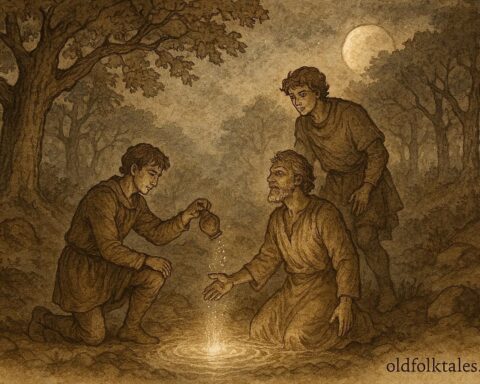
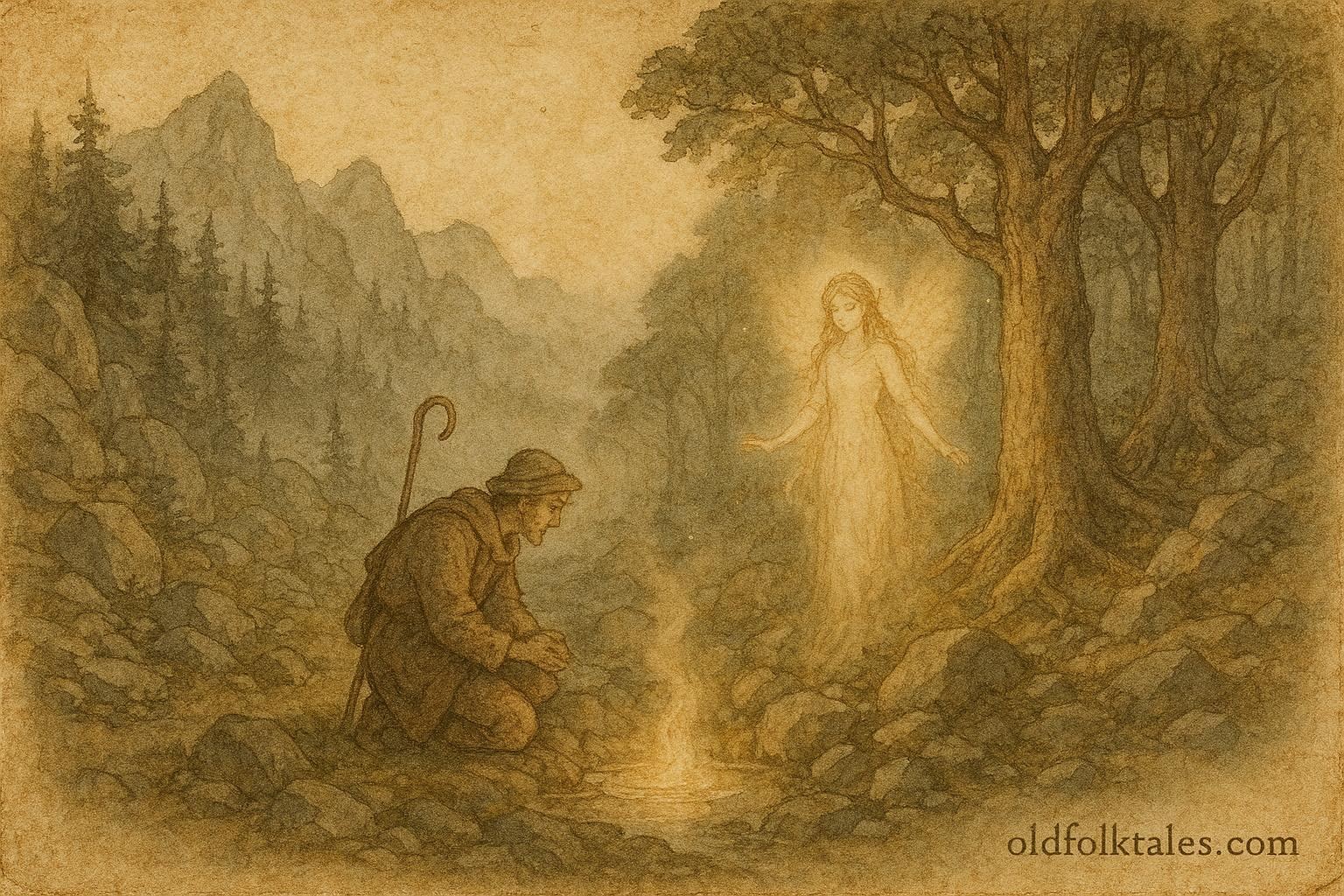
There, tucked within a circle of ancient trees, lay a spring.
Its water was clear as glass, shimmering with a faint, almost magical light. The air around it was cool and still, untouched by the harshness of the outside world. Flowers bloomed in delicate clusters along its edges, and the ground felt softer beneath his feet, as though it had been protected for centuries.
The shepherd paused.
Something about the place felt… different. Sacred, perhaps.
But his thirst was stronger than his caution.
Without calling out, without asking permission, he knelt by the spring and drank deeply. The water was unlike any he had ever tasted, cooler, purer, almost alive. It refreshed him instantly, easing his exhaustion and filling him with a strange sense of calm.
He drank again.
Then the air shifted.
A sudden stillness fell over the grove. The birds fell silent. Even the faint rustle of leaves seemed to cease.
The shepherd rose slowly, a chill running through him.
Before him stood a figure.
She appeared as a young woman, yet there was something unmistakably otherworldly about her. Her hair flowed like the water of the spring, her eyes bright and piercing, reflecting both beauty and power. Her presence was calm, but beneath it lay a force as steady and unyielding as the mountains themselves.
She was a vila, the guardian spirit of the spring.
“You have taken what was not freely given,” she said, her voice as clear as the water itself.
The shepherd swallowed hard, suddenly aware of his mistake.
“I meant no harm,” he said quickly. “I was only thirsty.”
The vila stepped closer, her gaze unwavering.
“Thirst does not excuse disrespect,” she replied. “This spring is not yours to claim. It is guarded, protected, and honored by those who understand its value.”
The shepherd felt a strange heaviness settle over him, as though the very air held him in place.
“What must I do?” he asked.
“You will learn,” the vila said.
From that moment, the shepherd found himself bound to the spring. Though he could move and speak, he could not leave the grove. Each time he tried, an unseen force turned him back. His flock wandered nearby, yet he could not follow them beyond the circle of trees.
Days passed.
At first, he grew frustrated, even angry. He muttered complaints, pacing the edges of the grove, blaming his fate on misfortune rather than his own actions.
But the vila remained, watching silently.
Slowly, the shepherd began to change.
He noticed the way the spring sustained the plants around it, how each drop of water seemed to carry life into the soil. He observed the creatures that came to drink, not taking more than they needed, moving with quiet respect.
He began to understand.
This was not simply water. It was a balance, fragile harmony that required care and reverence.
One morning, as the sun filtered gently through the trees, the shepherd knelt beside the spring, not to drink, but to speak.
“I was wrong,” he said softly. “I took without thought, without respect. I did not see what this place truly is.”
The vila stepped forward, her expression unchanged but her presence less severe.
“And what is it?” she asked.
“It is not mine,” the shepherd replied. “It is not anyone’s to take without care. It is something to be honored.”
The air shifted once more, but this time it felt lighter.
“You have learned,” the vila said. “Not through punishment, but through understanding.”
She raised her hand, and the invisible barrier that had bound him dissolved.
“You may go,” she said. “But remember this: the land gives, but it also demands respect. Forget this, and you will find yourself lost again.”
The shepherd bowed his head deeply.
“I will not forget,” he said.
When he left the grove, the world beyond seemed different. The mountains were no longer just land to be used, but a living presence to be respected.
He returned to his life, guiding his flock as before, but with a new awareness. He took only what was needed, treated the land with care, and told others of the hidden spring and its guardian.
And deep within the mountains, the vila remained, watchful, silent, and ever-present.
The spring continued to flow, clear and pure, its waters untouched by those who had not yet learned its lesson.
But for those who listened, who observed, and who respected the balance of the world, it remained a quiet blessing, hidden, yet always there.
Moral Lesson
This South Slavic folktale teaches that nature must be approached with humility and respect. Taking without awareness leads to consequences, but understanding and reverence restore balance and harmony.
Knowledge Check
- What is a vila in South Slavic folklore?
A vila is a mystical nature spirit, often associated with forests, mountains, and springs, acting as a guardian of natural places. - Why does the shepherd fall under the vila’s spell?
He drinks from the sacred spring without asking permission or showing respect. - What lesson does the shepherd learn?
He learns humility and the importance of respecting nature and its unseen guardians. - How does the shepherd regain his freedom?
By recognizing his mistake and demonstrating genuine understanding and respect. - What is the main theme of the story?
Respect for nature, humility, and the consequences of careless actions. - What does the mountain spring symbolize?
It represents the balance of nature and the need for harmony between humans and the natural world.
Source: South Slavic Folk Tales (1821)
Cultural Origin: Rural Bosnia and Herzegovina (Dinaric Alps region)