In a quiet countryside where rolling hills softened into olive groves and narrow paths wound between stone cottages, there lived a poor young man whose life was shaped more by patience than by fortune. His home stood at the edge of the village, modest and weathered, with a roof that groaned in winter and walls that held the warmth of summer. He owned little beyond his good name, his steady hands, and a heart inclined toward kindness rather than complaint.
Each day, the young man labored as best he could, mending fences, tending small plots of land for others, gathering firewood from the hills. Though his work was honest, it brought him barely enough to eat. Still, he never turned away a traveler in need or an animal seeking shelter. The villagers sometimes mocked him gently for this habit, saying that kindness filled neither stomach nor purse. The young man would only smile and continue as he always had.
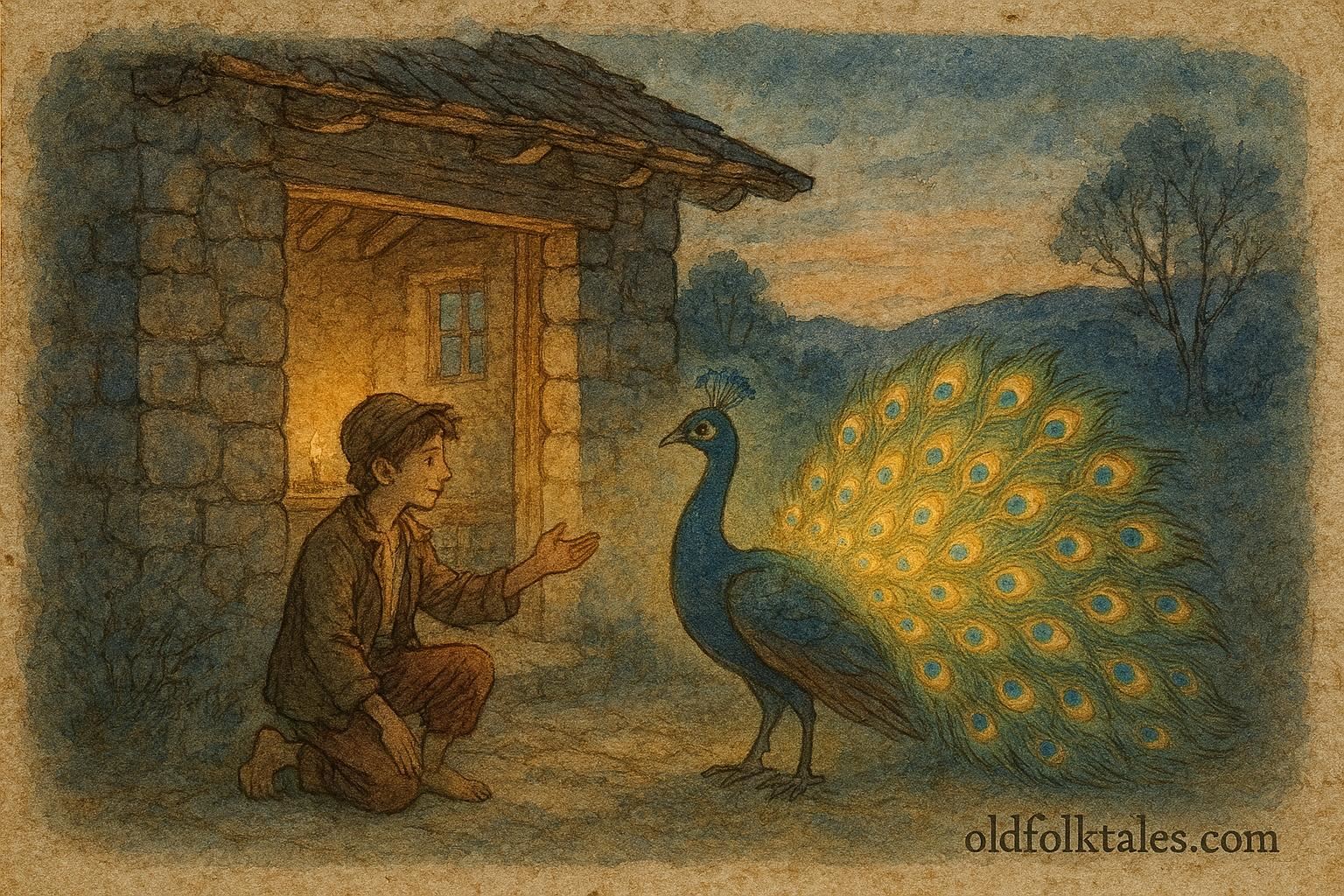
One evening, as twilight bled gold into violet and the air cooled with the promise of night, the young man heard a strange rustling near his door. When he stepped outside, he saw a sight unlike any he had known before: a peacock of astonishing beauty stood trembling in the fading light. Its feathers shimmered with deep blues and greens, catching the last rays of the sun as if threaded with jewels. Yet despite its splendor, the bird looked weary, its head lowered, its body thin, as though it had traveled far and endured much.
The peacock gazed at the young man with dark, knowing eyes, not wild with fear, but heavy with expectation.
Moved by instinct rather than thought, the young man opened his door wider and said softly, “Come in, then. If you have nowhere else to go, you may stay.”
He shared with the peacock what little he had: crumbs of bread, a corner of warmth, and silence undisturbed by suspicion. He asked no questions and expected no reward. The peacock ate calmly, then settled beside the hearth as though it had always belonged there.
When morning came, the bird was gone.
Days passed, and the young man thought little of it, until the peacock returned again, this time at dawn, again at dusk, and sometimes in the middle of the night. Each time, the young man welcomed it, fed it, and offered it rest. The bird never spoke, never made a sound beyond the soft rustle of feathers, yet its presence filled the small house with a strange calm.
One night, after many such visits, the peacock did not leave.
Instead, as moonlight streamed through the narrow window, the air in the room seemed to shift. The peacock’s feathers shimmered, folded inward, and before the young man’s astonished eyes, the bird transformed into a man clothed in garments of deep blue and gold. His bearing was regal, his face grave but gentle.
“I am the King of the Peacocks,” the stranger said. “I was bound by enchantment and driven from my realm. You sheltered me without fear or greed. For that, you shall not go unrewarded.”
The young man fell to his knees, overwhelmed not by wealth or promise, but by the sudden weight of truth, that the powerless are not always what they seem, and that dignity often walks disguised.
The King led him beyond the village, along paths the young man had never noticed before. The hills opened into a hidden valley where a palace stood, its walls alive with color, its gardens filled with peacocks whose feathers gleamed like living jewels. It was a kingdom concealed from those who sought power, revealed only to those who practiced generosity.
There, the young man was offered riches, fine clothes, and a place of honor. Yet more than gold, he was given understanding: that kindness sets unseen forces in motion, and that the world is shaped not only by strength, but by mercy quietly offered.
When the young man eventually returned to his village, he was no longer poor. But more importantly, he was no longer overlooked. His life had been transformed not by ambition, but by compassion freely given when no reward was promised.
And so the village learned, too late for envy, but in time for wisdom, that generosity toward the smallest guest may open the gates of hidden kingdoms.
Moral Lesson
True wealth is not gained through greed or force, but through kindness offered without expectation. Those who honor the powerless may unknowingly serve kings.
Knowledge Check
1. Who is the King of the Peacocks in Italian folklore?
He is an enchanted ruler who appears as a peacock and rewards kindness with revelation and transformation.
2. What does the peacock symbolize in the story?
The peacock represents hidden nobility, appearances versus reality, and unseen worth.
3. Why does the young man receive a reward?
Because he offers shelter and care without knowing the peacock’s true identity.
4. What is the main lesson of Il Re dei Pavoni?
Compassion toward the powerless invites moral and spiritual reward.
5. Where does this folktale originate?
Central Italy, especially Tuscan–Umbrian storytelling traditions.
6. Who recorded this story for modern readers?
Italo Calvino, in Italian Folktales (1956).
Source: Italian Folktales, compiled by Italo Calvino, 1956
Cultural Origin: Central Italy (Tuscan–Umbrian narrative tradition)