In the rolling hills of central Italy, where the Apennine mountains rise in gentle, forested waves, there lay a small, quiet village. The villagers lived humbly, tending olive groves, shepherding goats, and cultivating wheat in terraced fields that followed the curves of the hills. Life was simple, but it was hard; the soil was rocky, and the winters could be bitter. Yet the people thrived on hard work and community, always helping one another in times of need.
Among the villagers was a poor boy named Pietro. He lived with his widowed mother in a tiny cottage on the outskirts of the village. Pietro was clever and kind-hearted, though his clothes were often patched, and his shoes bore the marks of many long walks across the hills. Unlike other boys who sought adventure for glory, Pietro’s heart sought justice and the well-being of his people.
One year, the village was struck by a terrible drought. The fields turned brown and cracked, the wells dried, and the animals grew thin from hunger. Panic spread among the villagers. They had little to eat, and a sense of despair settled over the once-lively streets.
The village elders called a meeting. “If this drought continues,” they said, “we shall not survive the winter. Perhaps we must appeal to the king for help, though he is known to be greedy and cruel.”
Pietro, listening quietly from the back, clenched his fists. “We do not need fear,” he said. “Perhaps there is another way. Sometimes the smallest among us can accomplish great things.”
One evening, as Pietro wandered near the forest’s edge, he heard a soft whinny from the shadows. Curious, he approached and discovered a magnificent horse, its coat glimmering silver in the moonlight. What astonished him most was that the horse spoke.
“Do not be afraid, Pietro,” the horse said in a voice like ringing bells. “I am here to help you. My name is Fulmine, and I possess powers that may save your village.”
Pietro, though startled, recognized in Fulmine a friend and ally. “How can a horse like you help a village so afflicted?” he asked.
Fulmine lowered his great head, his eyes shining. “I can fly and travel faster than any man or bird. I can carry you to the king’s palace and help you outwit him, for he hoards grain while the people starve. But we must be clever, for the king is cunning and greedy. He will not give his treasures freely.”
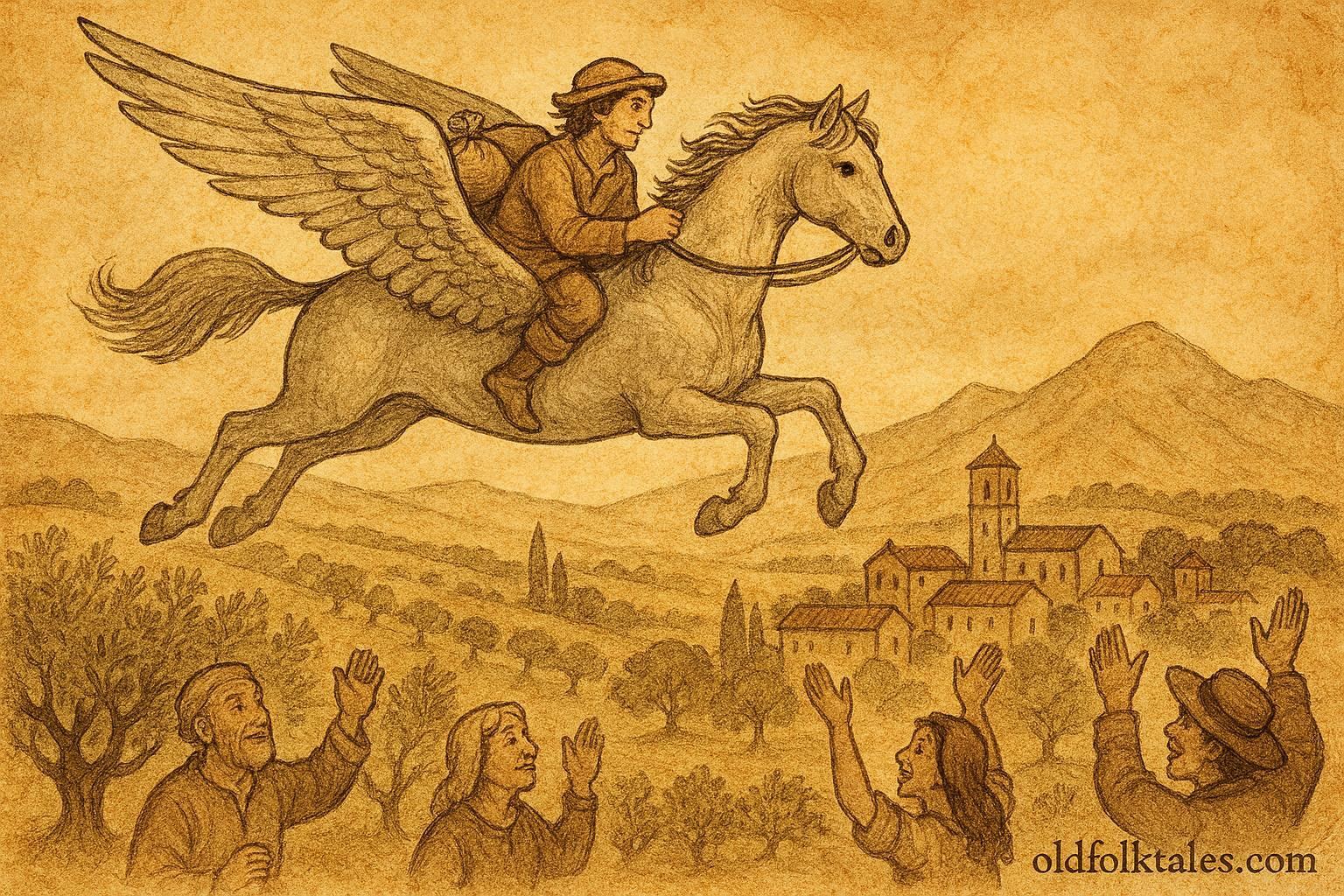
The next morning, Pietro mounted Fulmine, and together they soared above the Apennine hills. The wind whistled past Pietro’s ears, and the villagers below watched in awe as a silver streak blazed across the sky. After hours of flight, they reached the king’s fortress, perched atop a rocky plateau and guarded by soldiers armed with spears and crossbows.
The king, a man of enormous girth and greed, had been counting his grain, proud that his stores would outlast the famine. When he spotted a young boy and a horse appearing from the sky, he bellowed with rage. “Intruders! Seize them!”
Pietro held Fulmine steady and whispered, “Patience, my friend. We must be clever, not forceful.”
The horse nodded, and with a sudden flap of wings, they landed in a quiet courtyard near the king’s granary. Pietro dismounted and approached the guards humbly. “Good sirs,” he said, bowing, “I come with a gift for the king, a horse that can speak and fly.”
The guards, dazzled and unsure, escorted Pietro and Fulmine to the throne room. The king’s eyes widened as he heard the horse speak: “Your Majesty, I can fly across the realm and perform tasks that no ordinary steed could achieve. Allow me to serve you, and I will bring riches beyond imagination.”
The king, greedy and proud, imagined all the ways he could exploit Fulmine. “Bring me grain from every corner of the kingdom,” he commanded. “And I will reward you with gold.”
Pietro bowed. “As you wish, Your Majesty,” he said, hiding a sly smile.
Over the next days, Pietro and Fulmine carried out the king’s orders, but cleverly. They took only small amounts of grain at a time, never enough to draw attention, and left behind marks that suggested the stores were overflowing. Meanwhile, Pietro used his time at the palace to observe the king’s habits, noting weaknesses in his security and his predictable greed.
One night, Pietro whispered to Fulmine, “It is time. We must return the grain to the village before the king discovers our plan.” Fulmine’s wings spread wide, and they flew under the cover of darkness, carrying sacks of precious grain back to the starving villagers.
When the villagers awoke the next morning, they found sacks of grain at the edge of the fields, enough to plant for the coming season and feed everyone through the harsh winter. They rejoiced, praising Pietro and the magical horse. Yet Pietro reminded them to stay cautious. “The king may notice,” he said, “but cleverness and speed will protect us if we act wisely.”
Indeed, when the king realized that his stores were vanishing despite careful accounting, he grew furious. “Who dares steal from me?” he roared. He summoned his soldiers and set traps across the mountains, hoping to catch the thief. But Pietro and Fulmine were too clever. They flew above the traps, used secret forest paths, and sometimes even left false trails, misleading the king’s men.
Finally, Pietro decided to confront the king directly, not with force, but with wit. He and Fulmine appeared once more in the throne room. The king, enraged, demanded, “How dare you return my grain to the villagers? You will be punished!”
Pietro bowed deeply. “Your Majesty,” he said, “this village suffers not by your fault, but by the cruelty of hunger itself. If you share even a portion of your stores wisely, you will be celebrated as a just and benevolent ruler. Refuse, and your people may lose respect and loyalty.”
The king, though greedy, feared losing his prestige. He pondered Pietro’s words, seeing the wisdom in them. “Very well,” he said reluctantly. “The grain shall be divided among those who need it. But this horse of yours… it shall serve me fully from now on!”
Pietro smiled. “As you wish, Your Majesty,” he said. And so, the king gained a marvelous steed, the village received nourishment, and Pietro’s cleverness preserved both justice and harmony.
In the years that followed, Pietro became a hero in the village. His bond with Fulmine grew, and together they aided the villagers during storms, droughts, and any time misfortune threatened. Pietro taught that courage is not only in fighting but in clever planning, in humility, and in loyalty to others. The tale of Pietro and the magic horse spread across the Apennine valleys, a story of bravery, resourcefulness, and the power of friendship between a boy and a magical creature.
Moral Lesson
This Italian folktale shows that bravery combined with cleverness and loyalty can overcome adversity. Courage alone may falter, but resourcefulness, humility, and teamwork can protect communities and restore justice.
Knowledge Check
- Who is the hero of the story?
Pietro, a poor but clever boy from a village in central Italy. - What magical creature aids Pietro?
A talking and flying horse named Fulmine. - What threat faces the village?
A famine caused by drought and a greedy king hoarding grain. - How do Pietro and Fulmine save the village?
By secretly transporting grain from the king’s stores back to the villagers, using clever tricks and careful planning. - What qualities help Pietro succeed?
Cleverness, courage, humility, resourcefulness, and loyalty. - From which region of Italy does this folktale originate?
The central Apennine region, known for its hills, forests, and small farming villages.
Source: Italian Folk Tales (1956, from earlier oral traditions)
Cultural Origin: Italy, central Apennine regions