In the eastern reaches of Belarus, where dense forests press close to narrow village paths and the wind carries old voices through birch and pine, there once stood a crossroads long feared by travelers. By day it seemed ordinary enough, a patch of open ground marked by worn tracks and leaning signposts, but by night, the place took on a darker character.
For when the moon rose high and the world grew still, a voice could be heard there.
It was not the voice of any living person, nor the cry of an animal. It was thin, hollow, and sorrowful, rising from the earth itself. Those who passed near the crossroads whispered that a skull lay there, half-buried in the soil, and that it sang after sunset, lamenting, warning, or accusing, none could say for certain.
Some claimed it foretold death. Others said it cursed those who listened too closely. Fear spread, and villagers avoided the place after dark, even if it meant long detours through forest and marsh.
At last, word of the singing skull reached a household where three brothers lived together after their father’s death. Each brother was grown, yet each was known for a different nature.
The eldest was cautious to the point of fear. He valued his own safety above all else and avoided risk whenever possible.
The second was harsh and quick-tempered. He believed strength ruled the world and that mercy was a weakness best abandoned.
The youngest was quiet and thoughtful. He listened more than he spoke and treated others, people and creatures alike, with patience and care.
When the brothers heard of the skull, curiosity stirred among them.
“Someone should learn the truth,” said the eldest, though his voice wavered.
“If it sings, it can be silenced,” said the second, clenching his fist.
“If it sings,” said the youngest, “then perhaps it has something to say.”
They agreed to go together to the crossroads and face the mystery that troubled their land.
The Eldest Brother’s Trial
They reached the crossroads as dusk settled into night. The forest darkened, and the wind moved restlessly among the trees. As the moon climbed, the sound rose, clearer now, a mournful chant drifting upward from the ground.
The eldest brother went first.
At the edge of the clearing, he halted. The song seemed to wrap around him, chilling his blood. His courage faltered. Though he strained his eyes, the darkness pressed close, and every shadow seemed alive.
“This is no place for the living,” he whispered.
Before his brothers could stop him, he turned and fled, running back toward the village without looking behind him. His fear closed his ears to the song and his heart to its meaning.
He did not return.
The Second Brother’s Trial
The second brother scoffed at the elder’s retreat.
“Fear makes fools,” he said, drawing closer to the sound.
He found the skull easily enough, white and smooth, resting upon the earth as though deliberately placed there. As the skull sang, its empty sockets seemed fixed upon him.
Anger flared within the second brother.
“If you trouble the living,” he snarled, “you deserve no mercy.”
He struck the skull with a stick, then kicked it hard across the clearing. The song stopped at once, replaced by a heavy silence.
Satisfied, the second brother turned away. Yet as he walked, his steps grew slow, his chest tight. Before he reached the forest’s edge, he fell to the ground, lifeless, his cruelty answered with swift consequence.
The Youngest Brother’s Trial
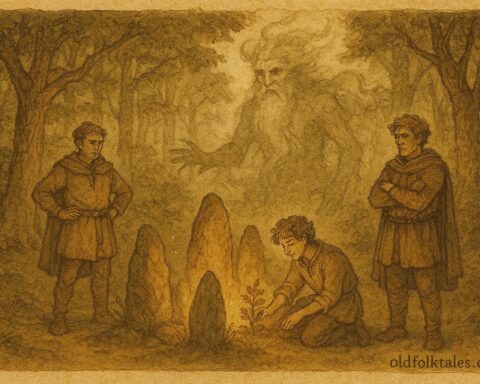
The youngest brother stood alone.
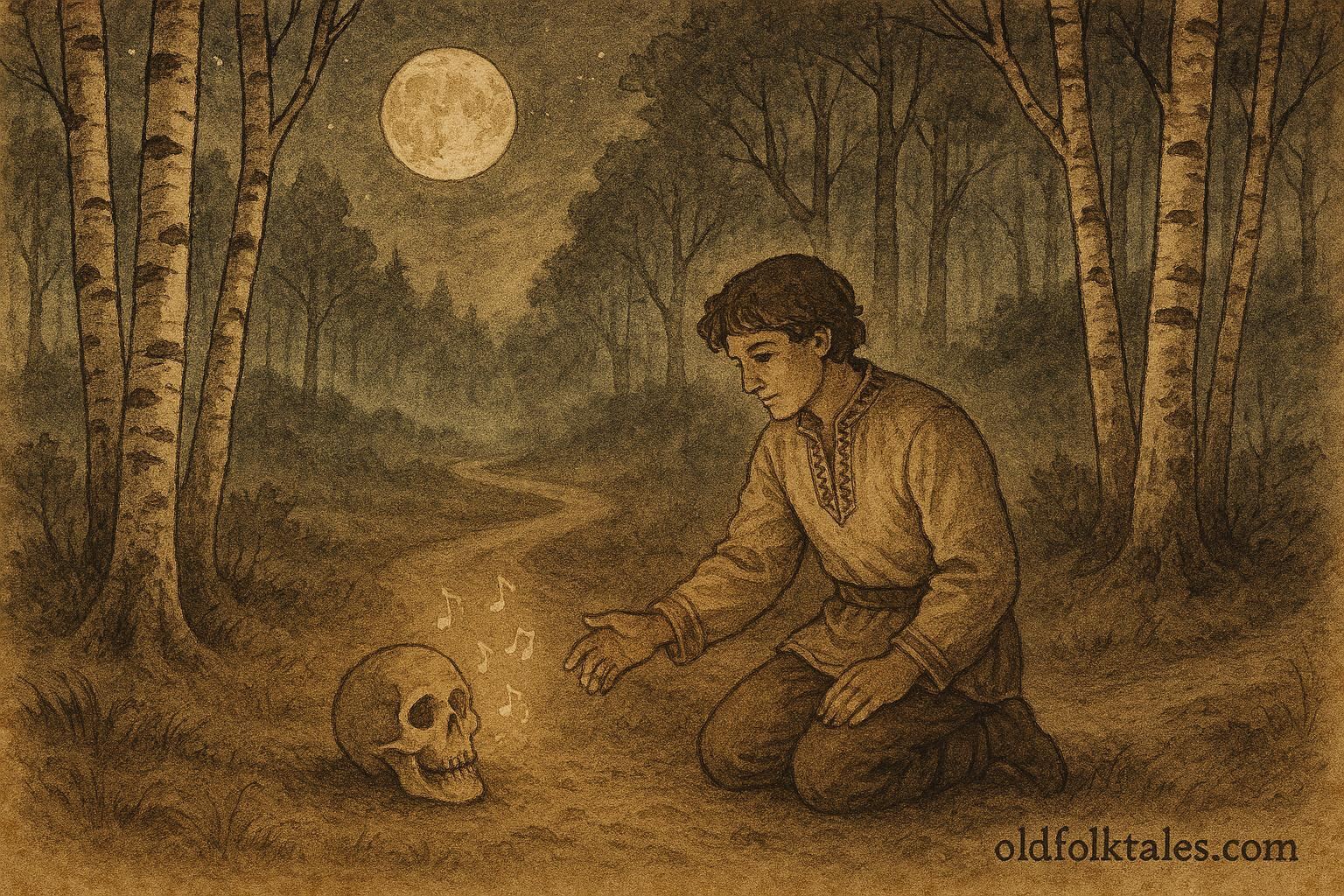
The song began again, softer now, trembling like a wounded thing. He approached without haste and knelt before the skull, neither fearful nor angry.
“Why do you sing?” he asked quietly.
The skull’s voice changed. No longer merely a song, it became words, thin but clear. It spoke of a life ended unjustly, of betrayal and violence, of bones left unburied and a soul denied rest. It sang because it had been forgotten. It lingered because no one had shown it kindness.
The youngest brother listened without interrupting.
Moved by compassion, he lifted the skull gently and carried it to consecrated ground. There, he buried it with care, marking the place and offering a prayer, not for reward, but for peace.
As the final clod of earth fell into place, the night grew still.
The singing ceased forever.
Justice and Release
At dawn, the youngest brother returned to the crossroads. The clearing was silent, ordinary once more. Fear had lifted from the land.
When he returned to the village alone, the truth of what had happened became clear. The eldest brother lived, but his fear had cost him honor. The second brother’s cruelty had ended his life. Only the youngest, guided by compassion, had brought peace.
From that day on, the crossroads was no longer avoided. Travelers passed freely, and the tale of the singing skull was told not as a warning of ghosts, but as a lesson for the living.
Moral Lesson
The story teaches that fear abandons truth, cruelty invites destruction, but compassion brings justice and release. Only those who listen with empathy can heal the wounds left by violence and neglect.
Knowledge Check
-
Why did the skull sing at night?
Because its spirit was restless, denied burial and justice. -
What did the eldest brother’s failure represent?
Cowardice and refusal to face truth. -
Why did the second brother die?
His cruelty toward the skull brought immediate consequence. -
How did the youngest brother succeed?
Through compassion, patience, and respect for the dead. -
What cultural belief does the story reflect?
That improper burial leaves spirits unrested in Slavic folklore. -
What is the central lesson of the tale?
Compassion redeems, while fear and violence destroy.
Source: Collected by Pavel Shein, Belarusian Folk Legends (1896)
Cultural Origin: Eastern Belarusian oral storytelling tradition