In the deep forests of Belarus, where ancient pine trees stretch toward gray winter skies and snow covers the earth in quiet silence, there once stood a small wooden village surrounded by wilderness. The villagers who lived there had long shared the land with wolves, foxes, elk, and owls, understanding that the forest was both their protector and their teacher.
In those parts, wolves were not only feared hunters of the night, they were also respected as wise creatures of the wild. Many elders believed wolves understood the secrets of the forest better than any human could.
But no one expected that one night, the wolves themselves would speak.
A Silent Winter
It was the coldest winter the village had seen in many years.
The snow had fallen heavily for weeks, burying fences, roofs, and forest trails beneath thick white drifts. The wind whistled through the frozen trees like a distant song, and smoke rose from the chimneys of the village huts as families gathered around warm fires.
Food was scarce, but the villagers were used to hardship. Hunters had returned with a few rabbits and a small deer, and the women preserved every scrap of meat carefully.
That evening, the villagers gathered inside the largest wooden house to share stories and warm themselves against the bitter cold.
Among them sat Mikola, an old hunter who had spent his entire life wandering the forests. His beard was white as frost, and his eyes held the quiet wisdom of someone who had listened to the woods for many decades.
As the fire crackled, Mikola suddenly raised his hand.
“Listen,” he said softly.
Everyone fell silent.
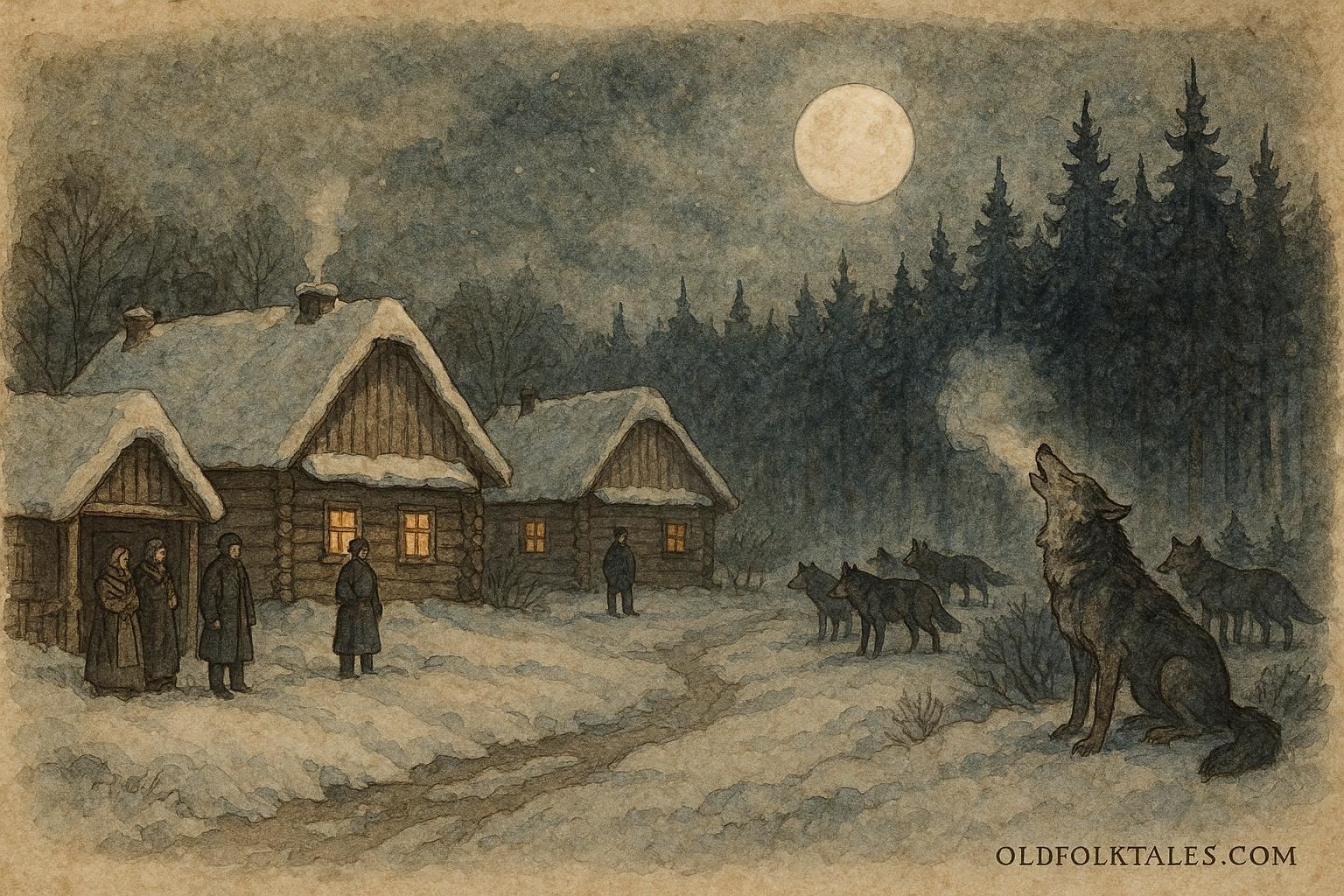
Outside, beyond the village fence, wolves were howling.
But something about the sound was… different.
Voices in the Snow
At first, the villagers assumed it was the usual chorus of wolves calling to one another in the forest.
Then one of the younger men frowned.
“Did you hear that?” he whispered.
The howling had changed.
Between the long cries came something impossible, words.
Faint, distant, but unmistakably human voices carried through the icy air.
“Before dawn… the ice will break…”
Another voice followed.
“Leave the low ground… the river will rise…”
The villagers looked at each other in shock.
Some crossed themselves nervously. Others laughed in disbelief.
“Wolves do not speak,” one man scoffed.
“Perhaps the wind is playing tricks on your ears,” another said.
But Mikola stood slowly and walked to the door.
The Old Hunter’s Understanding
Mikola opened the wooden door and stepped into the freezing night.
The moon hung low above the forest, casting silver light across the snow-covered fields. Beyond the village fence, several wolves stood watching silently.
Their breath rose like smoke in the cold air.
And then one wolf lifted its head and spoke again.
“The ice… the river… danger before dawn…”
The words were strange and rough, as if spoken by voices not meant for human speech.
Mikola felt a chill run through him, not from the cold, but from understanding.
He returned inside quickly.
“The wolves are warning us,” he said firmly.
The room burst into laughter.
“You’ve spent too many years alone in the forest,” one villager joked.
But Mikola shook his head.
“The river north of the village is frozen. If the ice breaks during the night, the flood will sweep through the valley.”
A few villagers grew uneasy.
Spring floods sometimes came suddenly when warm air melted mountain snow.
“But it is winter,” someone argued.
Still, the wolves’ voices continued outside.
“Leave the low ground… move before dawn…”
A Divided Village
The villagers soon divided into two groups.
Some trusted the old hunter’s wisdom.
Others mocked the idea that wolves could deliver warnings.
“It is only superstition,” the younger men insisted.
But Mikola spoke calmly.
“Animals hear the earth long before we do. Wolves travel the forests and rivers every night. If they sense danger, we should listen.”
Finally, a handful of families decided to follow his advice.
They gathered their belongings, loaded their sleds, and moved to higher ground on a nearby hill.
Others refused to leave their warm homes.
“Let the old man chase ghost stories,” one farmer said with a laugh.
And so, the village waited.
The Breaking of the Ice
The night grew colder and darker.
The wolves’ voices faded into the forest.
For a while, everything was silent.
Then, just before dawn, a deep rumbling sound rolled across the valley.
At first it was distant.
Then it grew louder.
CRACK.
The frozen river had begun to break.
Large slabs of ice collided with one another as rushing water burst through the weakened surface. Within minutes, the river overflowed its banks and surged toward the low valley where the village stood.
Those who had moved to the hill watched in horror as icy water rushed through the streets.
Wooden fences collapsed.
Barn doors tore free.
And the river swept through the lower houses like a roaring storm.
The Morning After
When the sun rose, the valley looked very different.
The floodwaters slowly receded, leaving behind broken fences, frozen mud, and damaged homes.
Those who had stayed in the village struggled to save what they could.
Thankfully, most had managed to escape the worst of the water during the night, but many belongings were lost.
The families on the hill returned to help their neighbors rebuild.
But the lesson of the wolves was never forgotten.
The Return of the Wolves
That evening, as the villagers worked together to repair the damage, Mikola walked quietly to the edge of the forest.
There, watching from between the trees, stood a small group of wolves.
For a moment, man and animals simply observed one another.
Then one wolf lifted its head and gave a low, peaceful howl before disappearing into the forest shadows.
They did not speak again.
They did not need to.
The message had already been heard.
A Lesson Passed Through Generations
From that winter onward, the people of the village paid closer attention to the forest around them.
They listened to birds, watched animal migrations, and respected the quiet signals nature provided.
And whenever wolves howled outside the village at night, no one laughed anymore.
They listened carefully.
Because sometimes, the forest speaks.
And only the wise are willing to hear it.
Moral Lesson
The Night the Wolves Spoke teaches that nature often sends warnings before disaster strikes. Wisdom comes from listening—to the land, to animals, and to those whose experience allows them to understand what others overlook.
Knowledge Check
1. Where does the story take place?
In a forest village in Belarus.
2. What unusual event occurs one winter night?
Wolves speak in human-like voices outside the village.
3. Who understands the warning?
An old hunter named Mikola.
4. What disaster do the wolves warn about?
A river flood caused by breaking ice.
5. What happens to those who listen to the warning?
They move to higher ground and avoid the flood.
6. What lesson does the story teach?
Respect nature and listen to wisdom, especially from elders.
Source: Recorded by Evdokim Romanov, Belarusian Ethnographic Materials, 1891
Cultural Origin: Belarusian forest folklore from Belarus