In a fertile valley between low rolling hills and wide wheat fields, where stone farmhouses clung to the earth as firmly as the people who lived in them, there once lived a poor peasant girl whose name history never bothered to record. In the villages of Lombardy and Emilia, such girls were plentiful, and their lives rarely changed from one generation to the next. They rose before dawn, worked until dusk, and learned early that silence was safer than standing out.
But this girl was different.
She lived with her widowed father in a small house at the edge of cultivated land. Their possessions were few: a wooden table smoothed by years of use, a hearth blackened by smoke, and a single cow that provided milk enough to keep them alive. What they lacked in wealth, the girl made up for in attentiveness. She listened carefully when others spoke. She observed disputes without interrupting. She asked questions, not foolish ones, but quiet questions that reached the heart of things.
Her father, a simple man, often shook his head at her sharp replies and said, “You think too much for a girl born to the soil.” She only smiled and continued her work.
Not far from their village stood the court of a king known throughout the region for his fondness for riddles and judgments. He believed intelligence to be the truest measure of worth, yet he trusted it only when it appeared among the nobility. Peasants, in his mind, were meant to labor, not to reason.
Fate, however, delights in contradiction.
One season, a dispute arose between the king and the peasant girl’s father. While plowing a field near the royal lands, the old man uncovered a heavy iron mortar buried deep in the soil. The king claimed it as his own, declaring that anything found in the earth belonged to the crown. The father, fearful but stubborn, insisted it was his by right of labor.
Summoned before the king, the old man stood trembling. When asked to explain himself, he stammered and contradicted his own words. The king laughed and prepared to rule against him.
That night, the daughter listened patiently as her father recounted the hearing. When he finished, she said calmly, “You answered poorly because you were afraid. Return tomorrow and say this: if the king claims the mortar because it came from the earth, then he must also claim its pestle, which must still be growing underground.”
Her father stared at her in disbelief but obeyed.
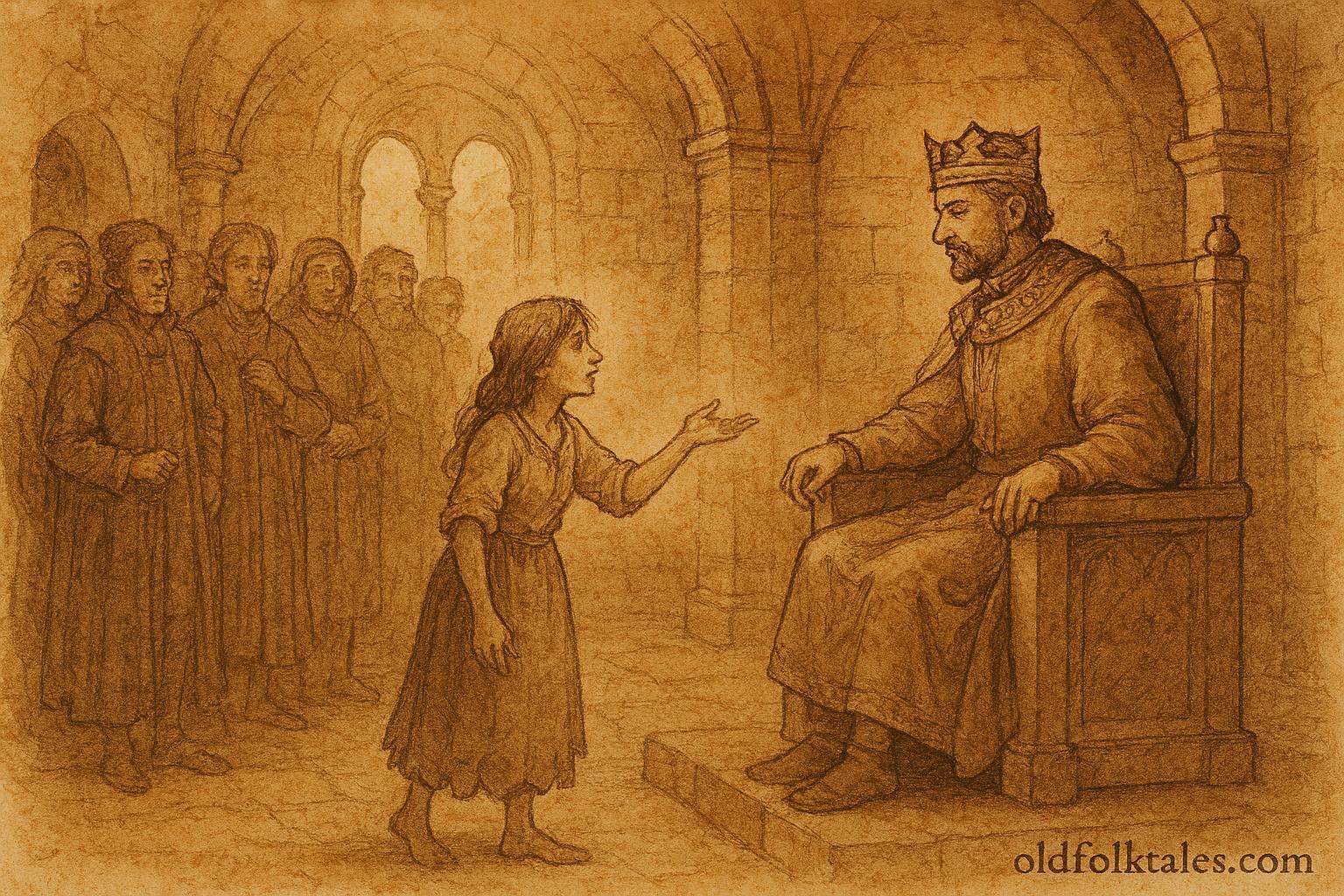
The next day, when the king heard the reply, his laughter ceased. He understood at once that the words were not the old man’s own. Curious and annoyed, he demanded to know who had spoken them. When the truth was revealed, the king ordered that the girl be brought before him.
She arrived dressed plainly, her hair covered, her eyes lowered in respect.
“You are clever,” the king said. “Let us see how clever.”
He gave her a challenge meant to humiliate: she must come to court neither naked nor clothed, neither walking nor riding, neither alone nor accompanied.
The courtiers smirked, certain the peasant girl would fail.
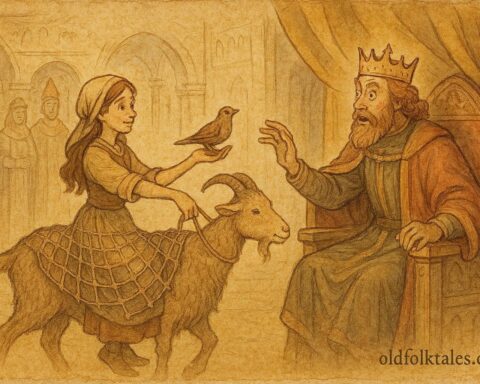
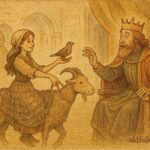
On the appointed day, she appeared wrapped in a fishing net, neither naked nor clothed, standing with one foot on a goat dragged beside her, neither walking nor riding, carrying a sparrow in her hand, neither alone nor accompanied.
Silence fell over the court.
The king, astonished, laughed openly this time, not in mockery, but in admiration. From that day on, he summoned her whenever disputes arose that confounded judges and nobles alike. With quiet logic and an unshakable sense of fairness, she resolved conflicts over land, inheritance, and broken agreements. She listened more than she spoke and never favored rank over truth.
In time, the king took her as his wife, elevating her to queenship. Yet even in silk and gold, she remained unchanged. She continued to advise with humility, reminding the king that wisdom does not grow from power, but from listening.
And thus, a peasant girl proved that intelligence needs no title, and justice no crown.
Moral Lesson
True wisdom is not inherited through wealth or rank but earned through humility, careful thought, and fairness. Intelligence guided by integrity can reshape destiny without abandoning one’s roots.
Knowledge Check
1. Who is the Clever Peasant Girl in Italian folklore?
She is a poor but intelligent young woman who uses wisdom and logic to solve problems that nobles and judges cannot.
2. What role do riddles play in the story?
Riddles test intelligence and reveal that wisdom can come from unexpected places.
3. What does the king symbolize in the folktale?
The king represents authority that initially underestimates wisdom outside noble birth.
4. How does the story address social mobility?
It shows that intelligence and fairness can elevate someone beyond their social class.
5. Why is humility important in the tale?
The girl’s humility ensures her wisdom remains just and uncorrupted by power.
6. What cultural values does the story reflect?
Northern Italian values of fairness, reason, and respect for quiet intelligence.
Source: Italian Folktales by Italo Calvino (1956)
Cultural Origin: Northern Italy (Lombardy–Emilia region)