In a small Finnish village surrounded by dark spruce forests and silver lakes, there lived a farmer known less for his strength than for his sharp tongue. His fields were modest, his house simple, but his mind was quick as a winter wind cutting across frozen marshland. Like all proper Finnish households, his farm lacked only one essential thing: a sauna.
Now, in those parts, a sauna was not a luxury. It was where children were born, where the sick were healed, where the dead were washed, and where weary souls found rest after long days of labor. A house without a sauna was not quite a home.
The farmer had gathered timber. He had chosen a place near a stream. But building a proper sauna required time, skill, and more strength than he cared to spend alone. As he stood scratching his beard one twilight evening, he muttered aloud:
“If only someone would build it for me.”
A voice answered from behind the pine trees.
“Someone might.”
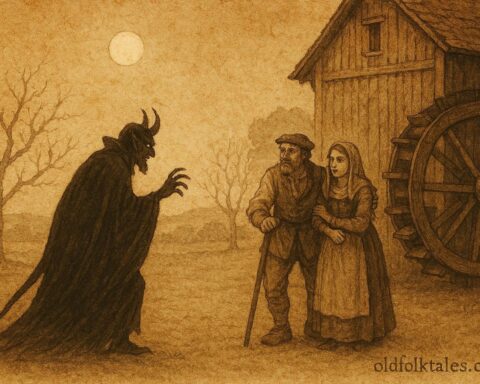
The farmer did not startle. In rural Finland, one learns not to show fear too quickly. He turned slowly and saw a figure stepping from the shadows — tall, dark, and smiling with too many teeth.
It was the Devil.
Now, the Devil in Finnish tales is not always the roaring lord of fire from sermons. Sometimes he walks the woods like a wandering stranger, ready to bargain, trick, or boast. He enjoys contests of wit as much as he enjoys tempting souls.
“You want a sauna,” said the Devil smoothly. “I could build you the finest one in the region. Tight beams. A stone stove that holds heat all night. Steam thick as fog on the lake.”
The farmer nodded thoughtfully. “And what would you want in return?”
The Devil’s eyes gleamed. “Only what you own but cannot see.”
The farmer pretended to ponder this deeply. He scratched his head and sighed.
“Very well,” he said at last. “Build it first. We’ll settle the matter afterward.”
The Devil agreed. After all, what could a simple farmer possibly mean by such a phrase?
The Building of the Sauna
Work began at once.
Through the night, the forest rang with the sound of chopping. Trees fell cleanly. Logs were squared and stacked with impossible speed. The Devil moved like smoke and thunder, hammering, lifting stones, carving joints that fit so perfectly no blade could slide between them.
The farmer watched from a distance, nodding approvingly.
By dawn, the structure stood firm and proud. Thick pine logs locked together. A chimney stone fitted with expert care. Inside, wide benches rose along the walls, and the great kiuas, the stone stove, sat ready to hold heat for hours.
It was, without question, the finest sauna the village had ever seen.
The Devil wiped his hands. “There. Now, as agreed, I shall take what you own but cannot see.”
The farmer leaned against the doorway casually.
“Of course,” he said. “Take it.”
The Devil paused.
“You do not resist?”
“Why should I?” said the farmer calmly. “You are welcome to my shadows.”
The Devil blinked.
“My… what?”
“My shadows,” said the farmer. “I own them. I cannot see them unless the sun shines just right. They belong to me, but I cannot hold them. Surely that is what you meant?”
The Devil’s face darkened like a brewing storm.
“That is not what I meant.”
“But those were your words,” the farmer replied gently. “You wanted what I own but cannot see. I own my shadow. I cannot see it now, for it is cloudy. You may have it.”
The Devil growled.
“I meant your soul.”
“Ah,” said the farmer innocently. “But that is not what you said.”
In Finnish folklore, words matter. Contracts matter. The Devil, bound by his own phrasing, could not easily undo the bargain.
He tried again.
“Very well,” he snarled. “If not your soul, then I shall take something else. We agreed I would build you a sauna. Let us share it. I shall claim what is hottest within it.”
The farmer nodded. “That seems fair.”
The Devil grinned. At last, something certain.
The First Heating
They filled the stove with logs and lit the fire. Flames roared. Stones glowed red. Smoke curled from the chimney into the pale northern sky.
When the time came, the farmer poured water over the heated stones.
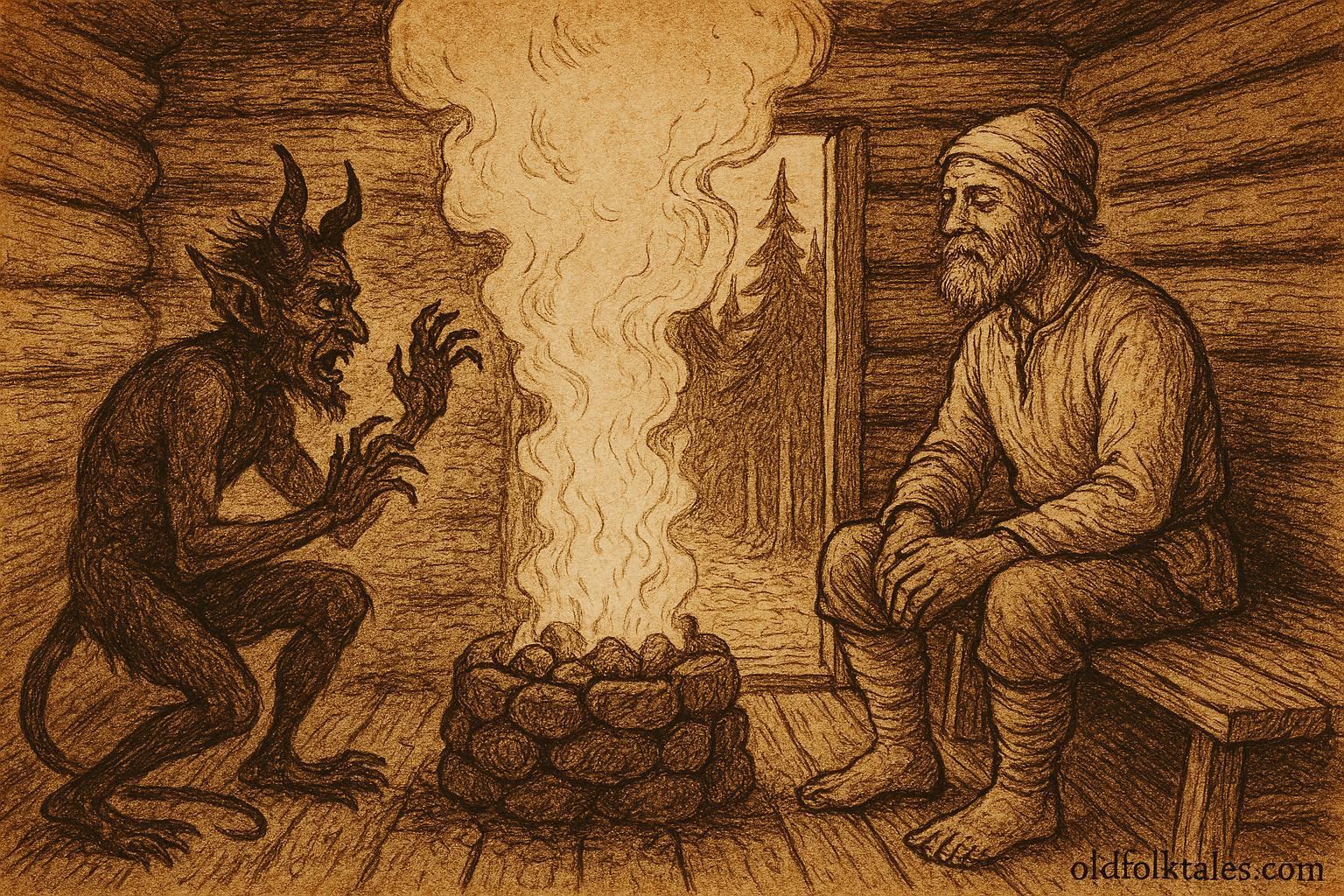
Steam exploded upward in a great white cloud, löyly, the living breath of the sauna.
The Devil leapt eagerly toward the stove.
“What is hottest belongs to me!” he declared triumphantly and grabbed the glowing stones.
At once he howled.
For though the stones were hot, the true heat in a Finnish sauna lies in the steam itself, rising, enveloping, burning deeper than flame.
The farmer calmly sat on the bench, letting the steam roll across his skin, serene as a man bathing on a summer evening.
The Devil dropped the stones and jumped backward, scorched and furious.
“You tricked me again!”
“No,” said the farmer evenly. “You claimed what was hottest. You chose poorly.”
The Devil stomped, smoke rising from his fingers.
“I demand another bargain!”
The farmer folded his arms.
“Very well. One last.”
The Final Trick
“Next time,” said the Devil, “I shall claim what is beneath the stove.”
The farmer smiled faintly.
“As you wish.”
When the sauna was heated again, the Devil rushed inside and reached beneath the kiuas, expecting perhaps hidden gold, embers, or some secret source of power.
Instead, he found only ash and soot, the remnants of burnt wood.
He pulled his blackened hands out coughing.
The farmer poured another ladle of water on the stones. Steam rose thick and powerful.
“The heat is above,” he said mildly.
The Devil, now thoroughly humiliated, understood that brute strength would not win this contest.
“You peasants,” he muttered, backing toward the door. “You cling to your words and your fire.”
The farmer shrugged.
“We cling to what keeps us warm.”
With a flash of sulfurous smoke, the Devil vanished into the forest.
The Sauna Stands
The sauna remained.
Villagers soon heard the story. They came to admire the craftsmanship and laugh at the Devil’s defeat. Some shook their heads in disbelief. Others nodded knowingly. After all, in Finland, even the Devil must respect a properly built sauna.
The farmer never boasted. He simply enjoyed his evenings of steam and quiet reflection.
And if, on certain nights, a strange wind rustled the trees beyond the bathhouse walls, he would only smile and toss another ladle of water onto the stones.
For in the end, it was not strength, nor wealth, nor fear that preserved his home, but careful words and a clear mind.
Moral Lesson
This Finnish folktale reminds us that intelligence and careful speech are stronger than brute force. Evil often relies on intimidation, but wisdom, restraint, and clarity protect what truly matters. In a culture where the sauna represents purity, life, and spiritual balance, the story teaches that everyday knowledge and tradition are powerful safeguards against deception.
Knowledge Check
1. What is the main lesson in “The Devil Builds a Sauna” Finnish folktale?
The story teaches that cleverness and precise language can defeat evil, emphasizing intelligence over strength.
2. Why is the sauna important in Finnish folklore?
The sauna represents purification, healing, community life, and spiritual reflection in Finnish rural culture.
3. How does the farmer trick the Devil?
He uses carefully worded agreements, allowing the Devil to trap himself through literal interpretation of his own bargains.
4. What role does folk Christianity play in the tale?
The Devil appears as a supernatural trickster figure, reflecting Christian moral influence blended with rural folklore traditions.
5. Why does the Devil fail despite his power?
He underestimates human intelligence and becomes bound by his own careless promises.
6. What cultural values does this Finnish folktale reflect?
It highlights practicality, humility, respect for tradition, and the sacred role of the sauna in everyday life.
Source: Suomalaisia Kansansatuja by Eero Salmelainen, 1852.
Cultural Origin: Finnish rural oral folklore.