In the far northern lands of ancient Finland and Karelia, where the forests stretched endlessly and the winds carried whispers of old magic, there lived a young hero named Lemminkäinen. He was known far and wide, not only for his striking presence and bold spirit but also for his restless nature and sharp tongue.
Lemminkäinen feared little, respected few, and believed deeply in his own strength. Where others paused to think, he rushed forward. Where others listened, he spoke. And though his courage was admired, it was often shadowed by recklessness.
It was this very nature that set him on a dangerous path, one that would take him to the very edge of life and beyond.
One day, tales reached Lemminkäinen’s ears of a maiden of extraordinary beauty who lived in the distant North, in the cold and powerful land of Pohjola. She was known as the Maiden of the North, and many had sought her hand, yet none had succeeded.
To Lemminkäinen, this was not a warning, was a challenge.
Without hesitation, he resolved to win her.
Ignoring the quiet concerns of those around him, and brushing aside the unspoken dangers that surrounded Pohjola, he prepared himself for the journey. His heart burned with ambition, and his mind was fixed only on victory.
But there was one person who saw clearly what he could not, his mother.
Lemminkäinen’s mother was wise and deeply attuned to the unseen currents of fate. She had raised her son with care, watching his strengths grow alongside his flaws. When she learned of his intention to travel to Pohjola, a shadow fell over her heart.
She warned him.
She spoke of dangers that lay beyond the northern lands, of trials that no man should face lightly, and of forces that could not be overcome by strength alone. Her voice carried both love and fear, but Lemminkäinen would not listen.
Confident in himself, he dismissed her concerns.
To him, the journey was simple: go north, win the maiden, and return victorious.
And so, despite his mother’s pleas, he set out.
The journey to Pohjola was long and filled with silent warnings. The forests grew darker, the air colder, and the land itself seemed less welcoming. Yet Lemminkäinen pressed on, undeterred.
When he finally arrived, he found that winning the Maiden of the North was no simple task.
The mistress of Pohjola, who ruled the land with wisdom and authority, did not grant her daughter’s hand freely. She set before Lemminkäinen a series of challenges—tasks meant to test not only strength but also patience, skill, and wisdom.
But Lemminkäinen, driven by pride, approached these tasks with the same reckless confidence that had brought him there.
Among the trials, one stood above all others in danger and consequence.
He was commanded to journey to the underworld and confront a terrible force that dwelled there, a task that no ordinary man could survive. It required not just courage, but caution, humility, and understanding of the unseen.
Still, Lemminkäinen accepted.
Without fully grasping the weight of what lay ahead, he descended toward the dark and silent realm where the river of death flowed, a place feared by all, where life and spirit were separated.
The river was no ordinary water. It marked the boundary between worlds, a place where even the bravest souls hesitated.
But Lemminkäinen did not hesitate.
As he approached the river, danger revealed itself.
The forces that guarded the underworld were not blind, nor were they easily deceived. Lemminkäinen, bold and unguarded, became their target. In that shadowed place, his confidence was no shield.
He was struck down.
The hero who had journeyed so far, who had spoken so boldly and acted so fearlessly, was overcome. His body was destroyed and cast into the river, broken into pieces and carried away by its dark current.
The quest had ended, not in triumph, but in silence.
Far away, in her home, Lemminkäinen’s mother felt it.
She did not see it with her eyes, but she knew.
A sudden stillness came over her, a deep and unshakable knowing that something terrible had happened to her son. Her heart tightened, and grief began to rise, but she did not surrender to it.
Instead, she acted.
Guided by love and determination, she set out on a journey of her own, a journey far more difficult than any her son had taken.
She traveled across vast lands, seeking knowledge of what had become of Lemminkäinen. She questioned the winds, listened to the whispers of the earth, and followed the faint traces of his path.
At last, she learned the truth.
Her son had fallen in the underworld, his body lost within the river of death.
But where others would have accepted this as the end, she refused.
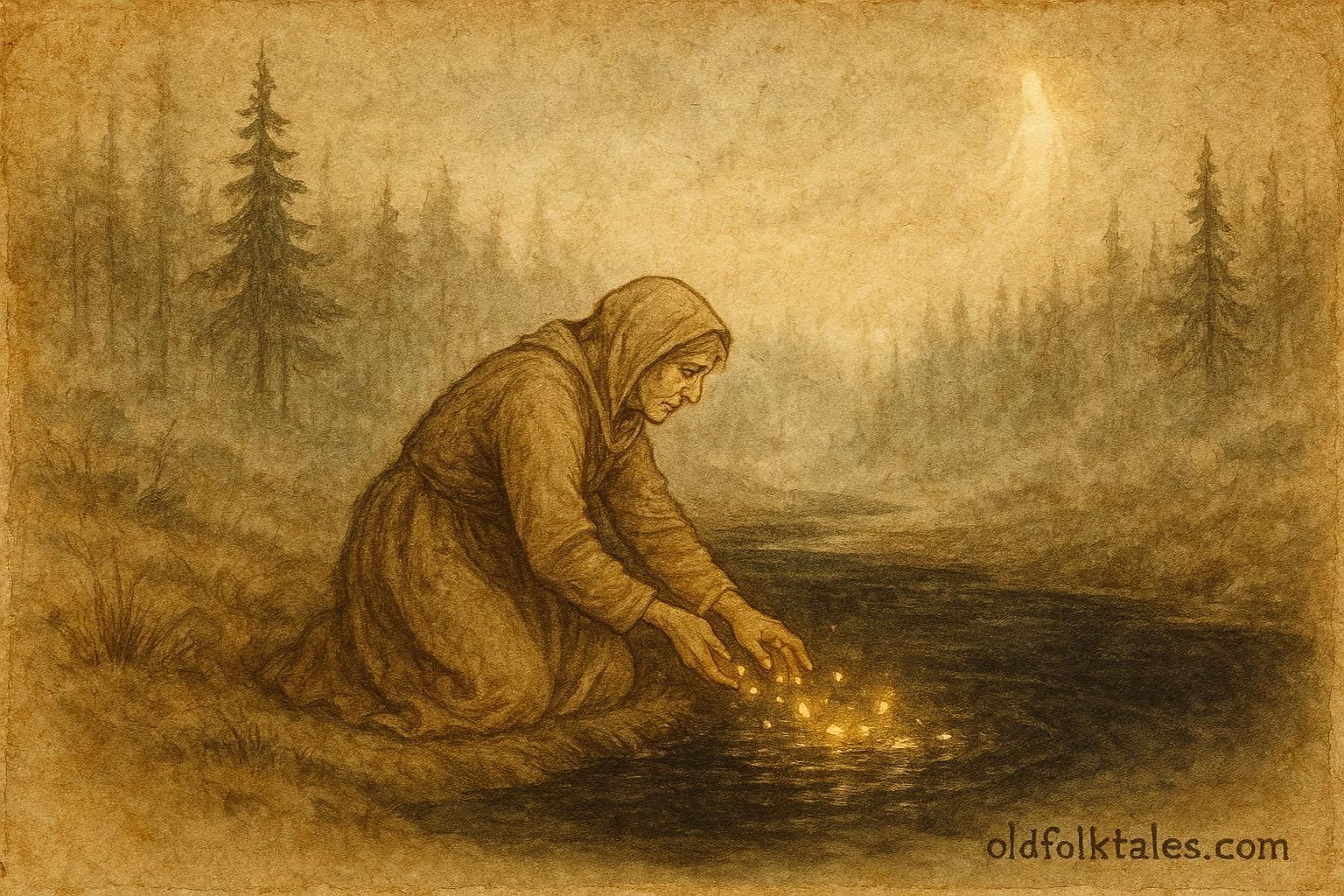
When she reached the river, she did not turn away.
The waters were dark and forbidding, filled with the remnants of what had been lost. Yet she stood firm, driven by a love that knew no fear.
Carefully, patiently, she began her task.
Piece by piece, she gathered what remained of her son. From the depths of the river, she recovered each fragment, refusing to leave even the smallest part behind. It was a painstaking process, one that demanded both strength and unwavering focus.
The world around her seemed to hold its breath as she worked.
Once she had gathered all that she could, she began the work of restoration.
With care and devotion, she reassembled her son’s body, fitting each piece back into its place. But this alone was not enough.
Life had to be returned.
Calling upon ancient knowledge and powerful forces, she sought the means to restore what had been lost. Through her determination and her deep connection to the natural and spiritual worlds, she succeeded.
Lemminkäinen stirred.
Breath returned. Strength returned. Life returned.
The hero who had fallen in arrogance was brought back, not by his own power, but by the unwavering love of his mother.
When Lemminkäinen rose again, the world was no longer the same.
He had faced death. He had been broken and remade. And though his spirit remained strong, the weight of what had happened could not be ignored.
His reckless quest had come at a great cost.
The journey that began with pride ended with a lesson, one written not in victory, but in loss, sacrifice, and renewal.
The tale of Lemminkäinen lived on among the people of Finland and Karelia, told as both a story of adventure and a warning.
It spoke of the dangers of arrogance, of the limits of strength without wisdom, and of the power of love that can reach even into the darkest places.
And above all, it honored a mother whose devotion overcame death itself.
Moral Lesson
This Finnish folktale teaches that reckless pride can lead to destruction, but love, especially a mother’s devotion, has the power to restore what is lost. True strength lies not only in courage, but in wisdom and humility.
Knowledge Check
- Who is Lemminkäinen in Finnish mythology?
Lemminkäinen is a bold and impulsive hero from the Kalevala, known for his courage and recklessness. - What quest does Lemminkäinen undertake?
He sets out to win the Maiden of the North by completing dangerous tasks in Pohjola. - How does Lemminkäinen die in the story?
He is killed in the underworld and his body is cast into the river of death. - Who brings Lemminkäinen back to life?
His devoted mother gathers his body and restores him through determination and knowledge. - What is the main theme of Lemminkäinen’s story?
The story highlights the consequences of arrogance and the power of love and sacrifice. - What does the underworld river symbolize in the folktale?
It represents death, transition, and the boundary between life and the afterlife.
Source: Kalevala (1835 / 1849)
Cultural Origin: Finnish / Karelian folklore