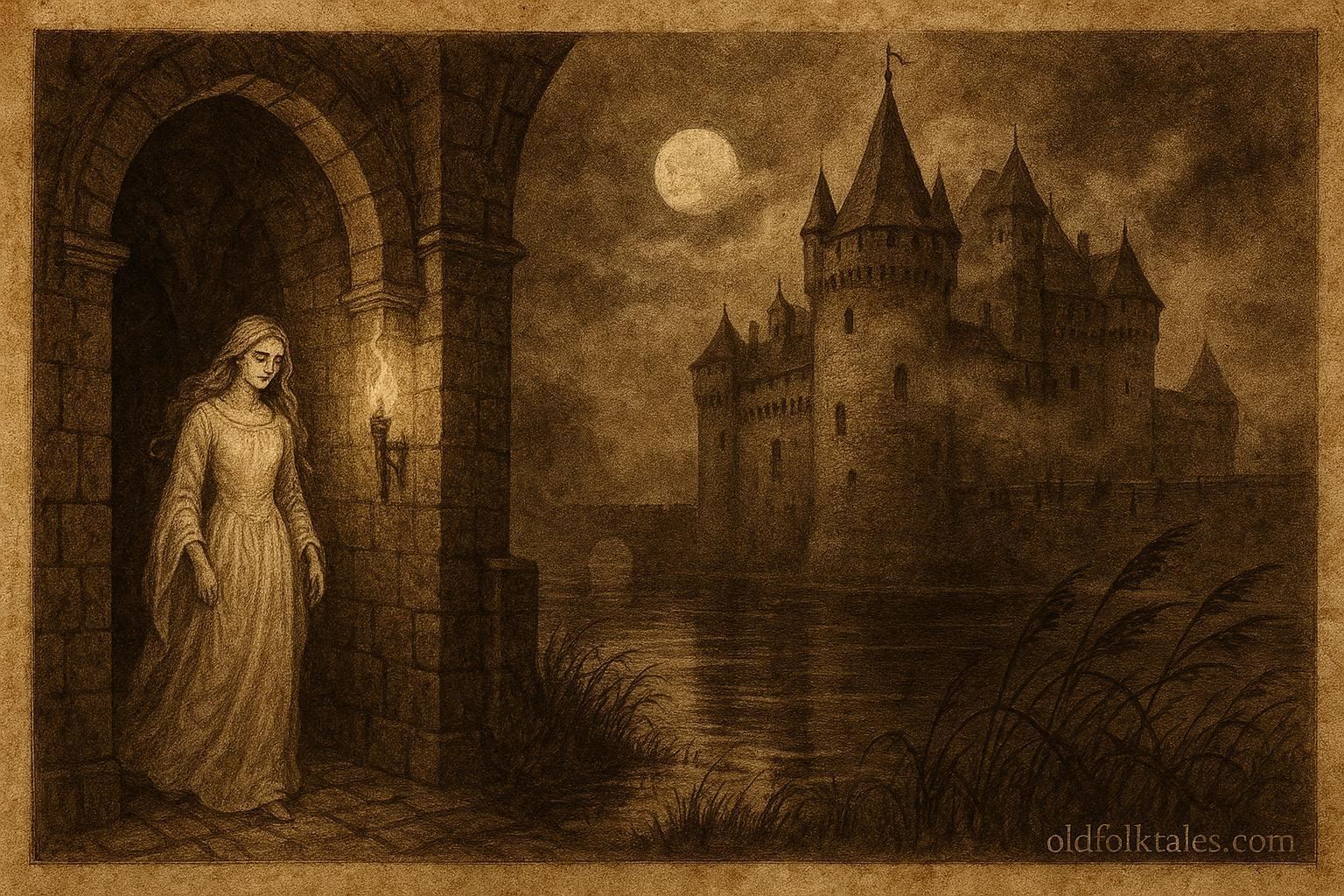
Along the quiet waters where the River Vecht meets the former Zuiderzee stands the formidable silhouette of Muiderslot. Its round towers rise from the marshy earth like watchful sentinels, and its stone walls have endured sieges, storms, and centuries of human ambition. By day, it appears a monument to medieval power. By night, when wind moves across the reeds and the tide whispers against the foundations, another story awakens, one carried in hushed voices through generations. They speak of the White Lady.
No one agrees on her true name. Some say she was a countess. Others insist she was the daughter of a powerful lord. A few claim she was a bride who never reached her wedding altar. Yet all agree on one thing: she walks the corridors of Muiderslot when sorrow gathers like a coming storm.
Journey into the charm of British wit and Irish wonder through centuries of folk tradition
The Bride from the North
In the seventeenth century, when the Dutch Republic was rising in wealth and influence, Muiderslot was no mere relic of the past. It was a residence of standing and refinement. Noble families passed through its halls; alliances were forged there; fortunes were decided over candlelit feasts.
Among those who came to dwell within its walls was a young noblewoman from the north, fair-haired, reserved, and possessed of a quiet intelligence that unsettled those who underestimated her. She had been promised in marriage to the lord of Muiderslot, a man twice her age whose lands required strengthening through alliance.
The match was practical. It was honorable. It was entirely devoid of affection.
Still, the young woman fulfilled her duty. She arrived at the castle in a gown of ivory silk, stepping across the drawbridge as bells rang in celebration. The wind caught her veil, lifting it briefly as though in warning.
From the beginning, she felt the weight of the castle, not merely its stone, but its memory. Muiderslot had seen imprisonments and betrayals in centuries past. Its walls remembered raised voices and broken oaths. She would later learn that such places never forget.
A Heart Divided
The lord of Muiderslot was not cruel, but neither was he kind. His concerns were political, financial, territorial. He valued obedience. He expected silence.
Within weeks of her arrival, the young bride discovered how alone she truly was.
Yet not entirely.
Among the castle’s retainers was a knight, learned, soft-spoken, and fiercely loyal to his master. He had ridden in distant campaigns and had returned with scars both visible and unseen. Where others saw only a servant of the household, she saw a man capable of thought, of poetry, of restrained sorrow.
Their first conversations were innocent, discussions of books in the modest castle library, of the shifting tides beyond the walls, of the paintings that adorned the great hall. But loneliness is a fertile soil. What began as courtesy deepened into understanding.
Understanding became attachment.
Attachment became love.
They were not reckless. They were not foolish. They met only in passing glances, in fragments of speech exchanged in corridors. But castles are vessels of rumor. Stone carries whispers farther than any road.
It was not long before suspicion reached the lord’s ears.
The Night of Accusation
On a winter evening, when frost clung to the ramparts and the moat had begun to crust with ice, the lord summoned his wife to the great hall. Torches burned low. The servants had been dismissed.
He accused her not with evidence, but with wounded pride.
The knight was seized before dawn.
Some say he was executed at once. Others claim he was imprisoned within the castle itself, confined to a chamber whose narrow window overlooked the sea. What is certain is this: he was never seen again.
The young noblewoman pleaded her innocence, though in her heart she knew innocence had already been lost, not in deed, but in longing.
Her husband’s response was cold.
She was confined to her chambers, stripped of her attendants, watched as though she were a criminal. Days passed. Then weeks.
No trial was held. No reconciliation offered.
Only silence.
The Tower and the Fall
The end came in fog.
A thick white mist rolled inland from the water one morning, swallowing the marsh and blurring the horizon. The castle seemed suspended in nothingness. Even the guards complained of unease, for sound traveled strangely, and shapes appeared larger than life within the haze.
It was on that morning that she ascended the highest tower.
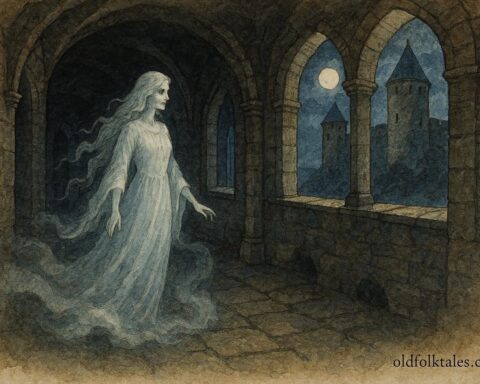
Whether she intended to flee, to pray, or to cast herself into oblivion, none can say with certainty. But a maidservant later swore she saw a pale figure standing at the parapet, hair unbound, gown shifting like a shroud in the mist.
A cry was heard.
Then nothing.
When the fog lifted hours later, there was no body below. No broken form on the stones. No sign of descent.
The lord ordered the matter buried in secrecy. Officially, his wife had “fallen ill.” The castle resumed its routines.
But routines do not erase truth.
The First Appearance
The first sighting came not long after.
A guard patrolling the inner courtyard just before dawn reported seeing a woman in white crossing from the chapel door toward the main tower. He called out, thinking her a servant wandering where she should not.
She did not respond.
Instead, she passed through the heavy oak door without opening it.
The guard resigned his post within the week.
Over time, others saw her.
A pale figure in corridors long after midnight. A faint shimmer at the turn of a staircase. The rustle of silk where no wind moved.
She did not shriek. She did not rattle chains.
She walked.
And always, her face was sorrowful.
A Harbinger of Misfortune
As years turned into decades, the legend deepened.
It was said that whenever she appeared clearly, when her form was not merely glimpsed but unmistakable, misfortune followed.
A child of the household would fall gravely ill.
A financial venture would collapse.
A fire would break out in a nearby village.
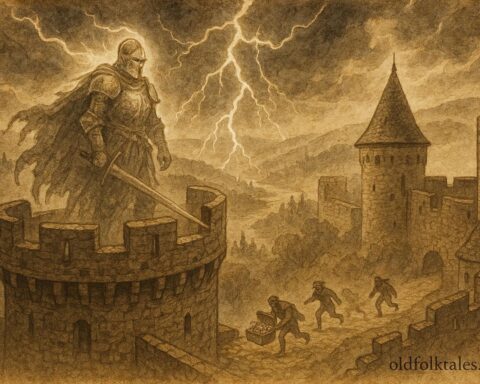
Most chilling of all, before a period of political upheaval that threatened the region, multiple witnesses reported seeing her standing upon the battlements, gazing toward the sea as though awaiting something inevitable.
Thus she became more than a ghost. She became a warning.
Not of random tragedy, but of consequences long set in motion.
The Castle Remembers
Historians may dismiss such accounts as superstition. They point to drafts in old buildings, to imagination stirred by candlelight. They argue that every ancient fortress accumulates tales of wandering spirits.
And yet Muiderslot’s story persists.
Visitors have claimed to feel sudden cold in otherwise warm rooms. Guides speak carefully of a “presence” near the tower staircase. More than one restorer working alone after dusk has reported the sensation of being observed, not with malice, but with profound sadness.
The White Lady does not terrify.
She mourns.
Some believe she remains because justice was never done, because her name was erased, her story suppressed to preserve reputation. Others say she lingers not for herself, but for those who repeat the errors of pride and jealousy that destroyed her life.
In this telling, she is not bound by vengeance.
She is bound by memory.
What Her Story Teaches
Legends endure because they hold truth deeper than record books.
The White Lady of Muiderslot embodies more than a tragic romance. She reflects the cost of suspicion unchecked by compassion. She reveals how honor without mercy becomes cruelty. She reminds us that power exercised without understanding breeds ruin.
Most of all, she stands as a quiet testament to the consequences of silence.
Had truth been spoken openly, had jealousy been confronted with humility, the towers of Muiderslot might hold no restless spirit.
Instead, when wind passes through its corridors at night, one may imagine a pale figure walking with measured steps, neither fully of this world nor entirely removed from it.
Not seeking revenge.
Only remembering.
Explore the wit and wisdom of Western Europe, where humor and virtue often go hand in hand
Moral Lesson
Unchecked jealousy and wounded pride can destroy what honesty and compassion might have preserved. When truth is silenced, sorrow lingers long after those responsible are gone.
Knowledge Check
1. Where is the White Lady said to appear?
At Muiderslot in Muiden, North Holland.
2. What event is believed to have caused her haunting?
Her tragic fate following accusations of betrayal within the castle.
3. How does she differ from typical ghost legends?
She does not act violently but appears as a sorrowful warning before misfortune.
4. What themes define the legend?
Betrayal, sorrow, historical memory, and warning apparitions.
5. During which historical period did the legend likely originate?
Around the 17th century, preserved through oral Dutch tradition.
6. What does her appearance symbolize?
The lasting consequences of jealousy, injustice, and unresolved grief.
Source: Regional Dutch ghost lore; later collected in folklore anthologies.
Cultural Origin: Muiden, North Holland, Netherlands (c. 17th century oral tradition).