Long ago, in the age when the Tuatha Dé Danann walked the green hills of Ireland as kings and warriors, there lived three brothers, Brian, Iuchar, and Iucharba, the sons of Tuireann. They were bold, swift in battle, and proud of their strength. Yet pride and old rivalries would lead them into a deed from which there could be no escape.
Among the Tuatha Dé Danann was Cian, son of Dian Cécht, a warrior of great renown and the father of Lugh Lámhfhada, the many-skilled god whose spear never missed its mark. Between Cian and the sons of Tuireann there lingered a bitterness born of past enmity. Though open war had not broken out between them, suspicion and resentment lived quietly beneath the surface.
One day, the three brothers set out together, armed and ready for whatever fate might bring. As they traveled across the rolling plains of Ireland, they saw Cian in the distance. He too recognized them, and knowing well the danger that stood before him, he sought to avoid them. With swift magic, Cian transformed himself into a pig and joined a nearby herd grazing peacefully upon the land.
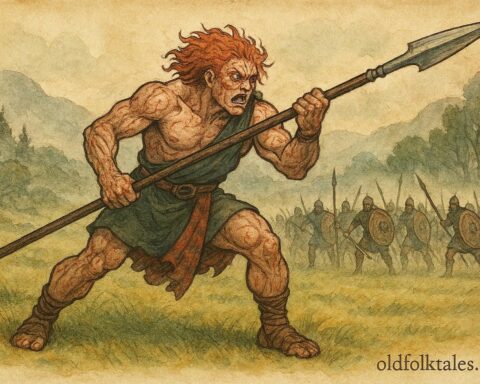
But Brian, the eldest and keenest of the brothers, sensed trickery. There was something unnatural in the way one of the pigs moved, its eyes too knowing, its manner too cautious. Brian called upon his own power and changed himself into a hound. He pursued the disguised Cian relentlessly until he drove him from the herd.
Cornered and unable to escape, Cian resumed his true form. Standing before the three brothers, he did not plead for his life in weakness, but he spoke plainly.
“If you intend to kill me,” he said, “grant me one mercy. Let me die in my own shape, as a warrior, and not as a beast.”
They agreed. Cian stood upright, unarmed and alone, facing the sons of Tuireann. The brothers struck him down. Yet they did not slay him with blades alone. In their cruelty and haste, they crushed him with stones until life left his body. Before he died, Cian declared that the earth itself would demand justice for his blood.
To hide their crime, the brothers buried him deep in the ground and swore silence. But the earth would not hold such a secret. When Lugh later came seeking his father, he searched the land with relentless determination. At last, the ground revealed the body, rising as though compelled by truth itself.
When Lugh beheld his father’s broken form, grief gave way to a terrible calm. He carried Cian’s body to Tara, where the assembly of the Tuatha Dé Danann gathered. There, before king and noble alike, Lugh demanded justice.
He did not call for immediate death. Instead, he invoked the ancient law of éraic, the blood-fine owed for unlawful killing. When the sons of Tuireann stood before him, Lugh asked whether they would accept judgment.
They did.
Then Lugh named the price.
It was no ordinary fine. It was a list of quests so perilous, so distant, and so fraught with danger that each task alone might cost a life.
They were to bring:
-
Three apples from the Garden of the Hesperides, apples that healed wounds and never diminished.
-
The skin of a pig belonging to Tuis, king of Greece, whose hide could cure any injury.
-
A deadly spear from Persia.
-
Two horses and a chariot from the king of Sicily, steeds that could ride upon both land and sea.
-
Seven pigs from the king of the Golden Pillars.
-
A cooking spit from the women of the island of Fiancha.
-
And three shouts upon the hill of Miodhchaoin, a hill forbidden to any but its fierce guardians.
The hall fell silent as each demand was spoken. The tasks would carry the brothers across the known world and beyond. But bound by honor and law, they accepted.
Thus began their long and harrowing journey.
First, they sailed to the distant garden where the healing apples grew. The guardians of that place were fierce and vigilant. Yet Brian, bold and cunning, disguised himself and gained entrance. When deception was discovered, battle erupted. The brothers fought fiercely, wounded yet determined, and at last escaped with the three glowing apples.
From there they journeyed to Greece to claim the magical pigskin. The king would not yield it willingly. Again, Brian relied on guile and skill. In disguise, he approached the court and seized the skin, though not without facing pursuit and bloodshed before escaping across the sea.
In Persia, they secured the spear only after combat against warriors who tested their strength to its limits. In Sicily, they obtained the horses and chariot through daring strategy and speed, pursued across both land and water.
At the Golden Pillars, they fought to claim the seven enchanted pigs, each one capable of being eaten and restored whole the next day. On the island of Fiancha, they won the great cooking spit after hard battle against its guardians.
With each quest, the sons of Tuireann suffered wounds. Their strength waned. Though the healing apples and pigskin restored them again and again, exhaustion pressed heavily upon their spirits. Still, they pressed forward, driven by the weight of fate and the law they had accepted.
At last, only one task remained: to give three shouts upon the hill of Miodhchaoin.
The guardians of that hill were savage and unyielding, sworn to slay any who dared approach. The brothers knew the danger. They could have abandoned the final task and fled into exile, but honor forbade it.
“We have accepted the price,” said Brian. “We will see it fulfilled.”
They climbed the hill.
The battle that followed was brutal. Surrounded and overwhelmed, the brothers fought with all the strength left in their weary bodies. They shouted once. They shouted twice. And with their final breath of courage, they shouted a third time.
But their wounds were mortal.
Barely alive, they returned to Ireland and laid the treasures before Lugh at Tara. The éraic had been paid in full.
They asked only one mercy, that Lugh would allow them to use the healing pigskin to mend their wounds.
Yet Lugh refused.
“The price is paid,” he said. “Justice has been satisfied.”
The brothers returned to their father, Tuireann, and told him all that had happened. Grief-stricken, Tuireann begged Lugh for mercy, but the god would not relent. Soon after, the sons of Tuireann died from their wounds, and their father’s sorrow was said to have broken his heart.
Thus, was justice fulfilled, not by swift vengeance, but by a burden so great that it consumed those who bore it.
And so, the tale of the Children of Tuireann remains a solemn reminder that violence, even when born of rivalry, demands a price beyond measure.
Moral Lesson
The Children of Tuireann teaches that every act carries consequence. Honor demands accountability, and justice, though lawful, may still bring sorrow. Vengeance and pride lead to suffering, and even courage cannot undo a wrongful deed.
Knowledge Check
1. Who were the Children of Tuireann?
They were Brian, Iuchar, and Iucharba, three warrior brothers of the Tuatha Dé Danann in Irish mythology.
2. Why did Lugh demand a blood-fine from them?
Because they killed his father, Cian, and under ancient Irish law, a blood-fine (éraic) was required for unlawful killing.
3. What was the purpose of the magical apples and pigskin?
They had healing powers, restoring wounds and preserving life during the brothers’ dangerous quests.
4. What is the significance of the hill of Miodhchaoin?
It was the final and deadliest task, symbolizing the unavoidable consequences of their crime.
5. What themes define this Irish folktale?
Retribution, honor, fate, sacrifice, and the heavy cost of justice.
6. From which tradition does this story originate?
It comes from the Irish Mythological Cycle, preserved in medieval Irish manuscripts.
Source: Adapted from the Irish myth as recounted in Atlantis and the Antiquity of Ireland (1861) by Eugene O’Curry, based on 12th-century Irish manuscript tradition.
Cultural Origin: Irish (Mythological Cycle), Ireland.