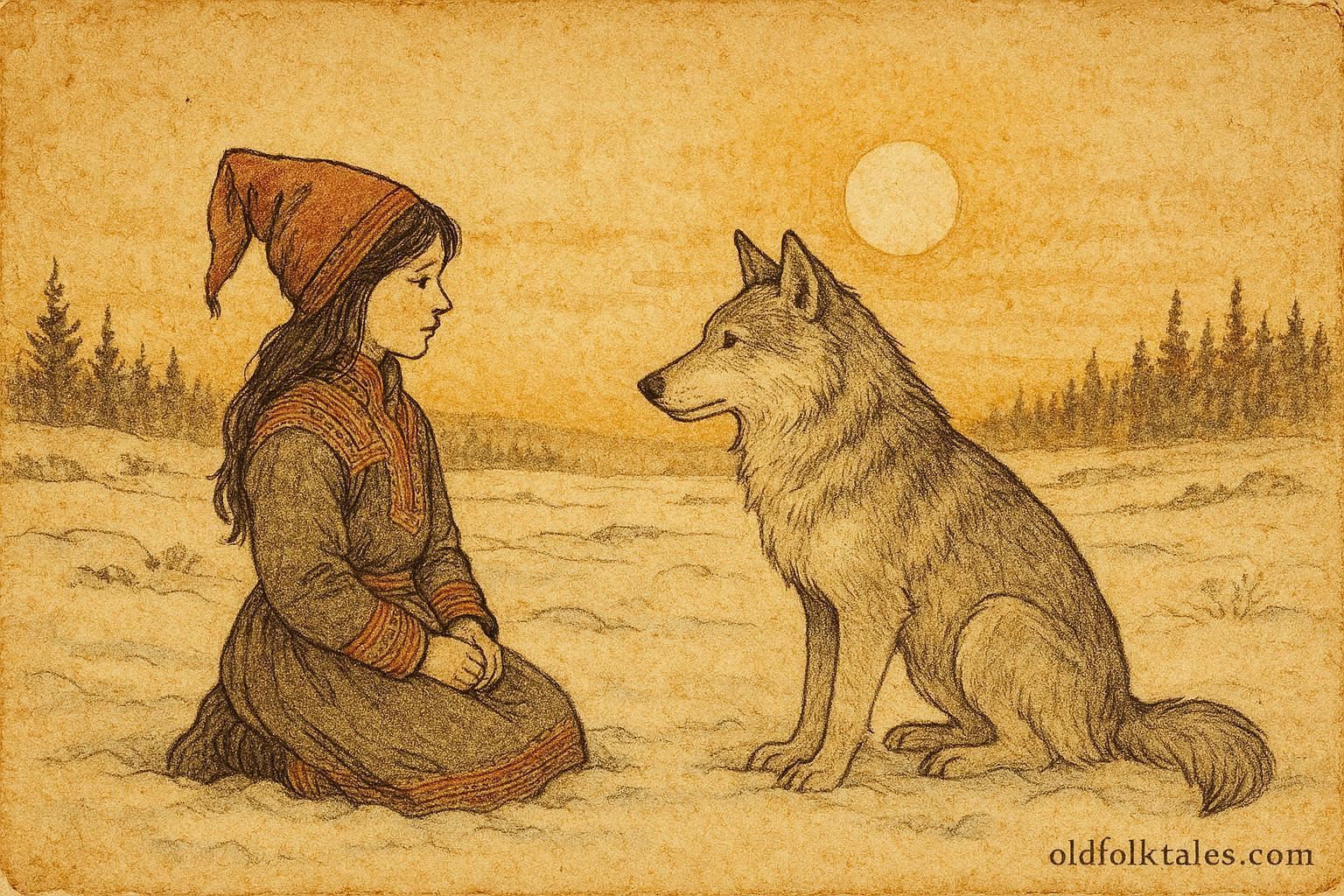
In the remote reaches of Lapland, where snowfields stretch like endless mirrors beneath the shimmering midnight sun, the people whispered of a wolf unlike any other. It was said to roam the tundra, its fur as silver as frost and its eyes alight with an unnatural fire. This was no ordinary predator; the gods themselves had cursed it for reasons lost to time, and it now carried the weight of divine anger. The wolf’s howl, haunting and melodic, echoed across the endless summer night, warning villagers and reindeer herders alike to respect the boundaries of nature.
For generations, the Sámi people told stories of the wolf to children around flickering hearth fires, cautioning that no one, no matter how brave, could calm it, except for one pure-hearted soul, one child whose courage was matched by empathy and respect for the natural world. To approach the beast with greed, fear, or malice was to invite disaster; to approach with compassion, however, could restore balance between humans and wild animals, and even bring the wolf relief from its eternal curse.
Among the Sámi families living near a braided river that shimmered like molten silver in the midnight sun, there was a girl named Aila. She was quiet and thoughtful, with eyes the color of the sky reflecting the northern lights. Unlike other children who played heedlessly in the tundra, Aila spent her time observing the creatures around her, the reindeer, the foxes, and the birds that glided silently over the snow-dusted pine trees. She listened to their movements, understood their needs, and respected their space. Her grandmother often said, “Aila, your heart sees what others do not. Perhaps that will one day be needed by the spirits themselves.”
One midsummer evening, as the sun hovered low on the horizon, spilling gold across the snow, a deep, resonant howl stirred Aila from her rest. The villagers grew uneasy, for the wolf’s appearance was always followed by misfortune: scattered reindeer, overturned sleds, and frightened children. Despite the fear that gripped the village, Aila felt a strange pull in her heart. She sensed not just anger in the wolf, but sorrow, as if the beast’s soul ached under the burden of the gods’ curse.
Guided by instinct, she wrapped herself in a thick reindeer-hide cloak, took a small bundle of food, and followed the sound of the howl across the frozen meadows. The wolf’s cries grew louder, echoing across the snow-laden hills, until Aila found herself in a clearing where the sunlight was soft, golden, and unbroken by night. There, standing atop a ridge, was the wolf. Its fur gleamed with an unearthly light, its eyes glowing amber, and every muscle in its body was taut with tension.
Aila did not speak at first. She knelt at the edge of the clearing and waited, letting her calm presence become a shield. Slowly, the wolf approached, its steps silent despite the crunch of frozen grass beneath its paws. She offered a piece of dried fish, laying it gently on the snow. The wolf sniffed, then stepped back, its muscles coiled as though expecting betrayal. Aila whispered softly, telling the wolf of her respect for the creatures of the tundra, of the harmony her people sought with nature, and of the desire to ease the burden of the gods’ punishment.
Hours passed, yet the wolf did not attack. Instead, it circled her cautiously, as if testing the sincerity in her voice, the truth in her heart. Finally, it lowered its head and nuzzled her hand. The snow around them glimmered under the unyielding sun, and in that golden light, a subtle warmth seemed to spread through the wolf’s fur. The child’s compassion had touched something deep within the creature, a spark of forgotten gentleness, suppressed under the weight of divine wrath.
The wolf howled once more, but this time it was different: less a cry of anger, more a song of relief. The villagers, who had followed at a respectful distance, watched in awe as the wolf’s fiery eyes softened, the silver coat seeming to glow with a gentler hue. For the first time in generations, the midnight sun did not reveal a creature of rage, but a guardian of the land, reconciled to both its wild instincts and the humans who shared the tundra.
Aila returned home that night, carrying no treasure but the quiet satisfaction of having done what many thought impossible. The wolf, now calm, retreated to the distant hills, and its howl became a signal of protection rather than threat. From that summer onward, the villagers noted that the reindeer stayed closer to the rivers, crops flourished in hidden gardens, and the harmony of the land seemed subtly restored. Aila’s courage and empathy had not only saved her people but had healed a creature cursed by forces beyond mortal understanding.
Moral Lesson
True courage is not the strength to fight but the heart to understand and empathize. Compassion and purity of intent can bridge the divide between humans and the wild, restoring balance and healing even the most ancient curses.
Knowledge Check
1. Who is the only one capable of calming the cursed wolf?
A pure-hearted child whose courage and empathy are genuine.
2. Why was the wolf cursed in Sámi folklore?
By the gods, as a consequence of offenses lost to time, symbolizing divine wrath and the need for balance.
3. How does Aila approach the wolf?
With patience, humility, and respect, offering food and soft words of empathy.
4. What natural phenomenon is central to the story?
The eternal midnight sun of Lapland, symbolizing both challenge and illumination.
5. What does the wolf’s softened howl symbolize?
Reconciliation between humans and nature, and relief from divine punishment.
6. What broader theme does the story illustrate?
Empathy, courage, and the importance of living in harmony with the natural world.
Source: Finnish Sámi folktale, Finland. Collected in Lapin Kansansatuja by Edwin Holmqvist, 1890s.
Cultural Origin: Sámi and Lapland oral tradition.