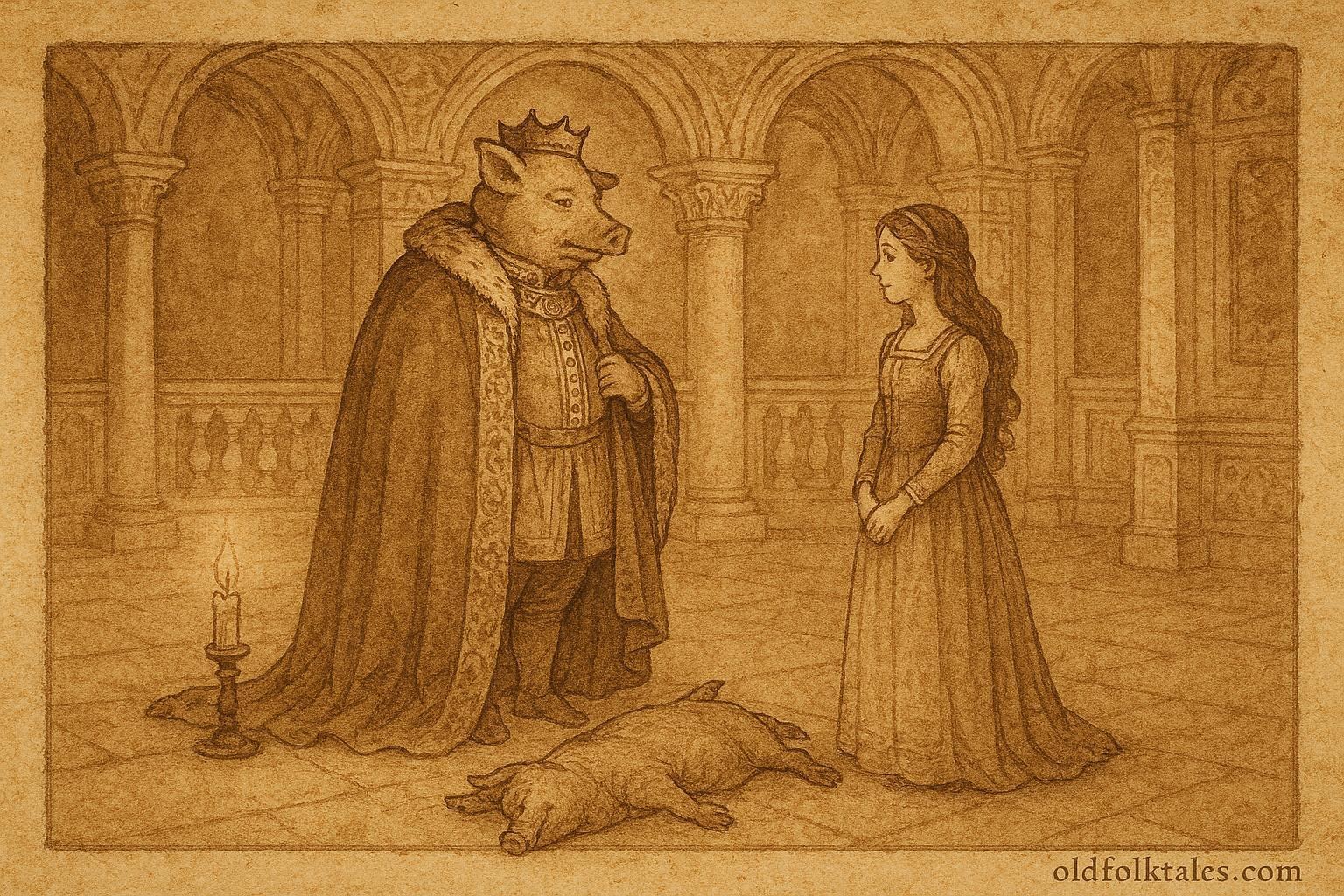
Long ago, in a prosperous kingdom in Northern Italy, where marble towers reflected in winding canals and banners fluttered above terracotta rooftops, there ruled a king and queen of great dignity. Their lands were fertile, their people industrious, their court filled with music and poetry. Yet within the royal chambers there lingered a quiet sorrow: the king and queen had no child.
Years passed in anxious waiting. Physicians were summoned, prayers were whispered in candlelit chapels, and offerings were made in hope. At last, after long anticipation, the queen conceived. The kingdom rejoiced. Bells rang from church towers, and citizens prepared for celebration.
Discover the moral heart and wild spirit of the north through timeless Nordic storytelling
But when the child was born, joy turned to stunned silence.
The infant was not like other children. He bore the form of a pig.
His skin was pink and bristled; his nose was round and snouted. Courtiers gasped. Servants whispered behind trembling hands. The queen wept, not from shame, but from confusion and fear for her son’s future. Only the king, though shaken, commanded silence.
“He is my son,” the king declared. “And he shall be raised as a prince.”
Thus began the strange life of the child who would come to be known as Re Porco, the Pig King.
A Prince Unlike Any Other
Though he bore the outward form of a pig, the young prince quickly proved he possessed remarkable intelligence. He listened carefully to tutors, learned languages with ease, and absorbed philosophy, music, and history with astonishing skill. His mind was sharp; his speech articulate and refined.
He spoke not with grunts, but with eloquence.
Court scholars, initially reluctant to instruct him, found themselves astonished by his wit and thoughtful insight. Ministers who had once pitied the king now bowed respectfully before the prince’s perceptive questions.
Yet outside the palace walls, whispers persisted.
Children mocked the idea of a pig prince. Noble families quietly speculated about succession. Some suggested hiding him away. Others advised seeking mystical cures. But the king refused all such counsel.
“He is royal in mind and spirit,” the king insisted. “And royalty is not measured by flesh.”
As Re Porco matured, so too did his awareness of the kingdom’s judgment. He saw the guarded looks of ambassadors and heard laughter carried faintly through corridors. Though dignified, he felt the ache of isolation.
Still, he bore himself with grace.
A Desire for Marriage
When he reached manhood, Re Porco approached his father.
“Your Majesty,” he said calmly, “I wish to marry.”
The king stared in disbelief.
“My son,” he replied gently, “no princess would consent to such a union. It would invite ridicule.”
Re Porco’s eyes remained steady. “Then seek not a princess, but a noble family willing to honor their word.”
After much hesitation, the king sent emissaries across the realm. At last, a respected nobleman, though hesitant, agreed to offer his eldest daughter in marriage, persuaded by promises of wealth and royal favor.
The wedding was arranged swiftly.
The young bride, pale with fear but bound by obedience to her father, entered the palace trembling. Though Re Porco treated her with courtesy and tenderness, she could not overcome her terror. She avoided his gaze and shuddered at his touch.
One night, unable to bear her fear and shame, she fled the chamber.
By morning, she was found dead beneath the palace window, having thrown herself into the courtyard below.
The kingdom fell into scandal and mourning.
Re Porco withdrew into silence, but he did not grow bitter.
A Second Attempt
Time passed. The king, fearing the stability of the realm without heirs, urged his son to consider another marriage.
Reluctantly, another nobleman agreed to give his middle daughter in marriage. This bride, though braver than her sister, could not hide her revulsion. She endured the ceremony, accepted the jewels, and attempted to fulfill her role.
But she too could not overcome her fear.
When night fell and she was alone with the Pig King, she screamed and struggled, accusing fate of cruelty. In panic and despair, she too ended her life.
The court was shaken. Whispers grew darker.
Some called the prince cursed. Others claimed enchantment.
Yet Re Porco remained patient.
The Third Daughter
At last, a third nobleman, poorer than the others, agreed to present his youngest daughter. Unlike her sisters, she listened quietly when told of her future husband.
“If he is cruel,” she asked, “does he harm those who serve him?”
“No,” her father admitted. “He is known to be wise and gentle.”
“Then I shall honor my word,” she replied.
Her name was often spoken simply as the youngest daughter, though her strength lay not in title but in temperament. She entered the palace neither with trembling nor arrogance, but with thoughtful calm.
During the wedding feast, she observed her husband closely. Though his body was that of a pig, his posture was noble, his voice composed. When he addressed her, he did so with respect.
That night, as candles dimmed and silence settled over the chamber, she did not recoil.
Instead, she spoke.
“My lord,” she said softly, “if this form is your burden, I will share it.”
Re Porco looked at her long and carefully.
“You are not afraid?”
“I fear cruelty and falsehood,” she answered. “But I see neither in you.”
For the first time, the Pig King felt something greater than patience, he felt hope.
The Revelation
As the story is told in the Venetian literary tradition, a strange secret lay hidden beneath the prince’s outward form.
Each night, when darkness fell and the world quieted, Re Porco removed his pigskin as one removes a cloak. Beneath it stood a handsome young man of regal bearing.
He had been born under enchantment, though no one knew by whom or why, and only unwavering loyalty and acceptance could break the spell.
One evening, when he believed his wife asleep, he shed the pigskin. But she had remained awake, watching.
She beheld not a beast, but a noble man.
At dawn, instead of recoiling, she approached him gently.
“I know who you are,” she whispered.
Rather than burn the skin in haste or act from impulsive triumph, she waited. She honored his secret.
Days later, when trust had fully blossomed between them, she revealed her knowledge and pledged her loyalty openly.
At that moment, through patience, faith, and mutual respect, the enchantment dissolved.
The pigskin fell away forever.
Before the astonished court, Re Porco stood revealed in true human form: tall, dignified, radiant with the nobility that had always resided within him.
The kingdom gasped, not merely at his appearance, but at the lesson made visible.
A Kingdom Transformed
Celebration swept through the palace. Bells rang once more, this time without uncertainty. The youngest bride was honored for her courage and steadfast heart.
The king wept openly.
“My son,” he said, embracing him, “you were always royal.”
Re Porco, now fully restored, ruled beside his wife with wisdom and fairness. Their reign was remembered not for spectacle, but for justice and compassion.
The people who had once mocked learned humility. Those who had judged by outward form reconsidered their own hearts.
And thus, the story of Re Porco endured in Northern Italy, passed through generations as both wonder and warning.
Moral Lesson
True nobility resides in character, not appearance. Patience, loyalty, and the willingness to see beyond outward form reveal hidden worth and break even the strongest enchantments.
Knowledge Check
-
Who is Re Porco in the Italian folktale?
He is a prince born in the form of a pig who possesses intelligence and royal character. -
What literary work records The Pig King?
It appears in Le piacevoli notti by Giovanni Francesco Straparola (1550–1553). -
Why do the first two brides fail in the story?
They cannot overcome fear and rejection of outward appearance. -
How is the enchantment broken in The Pig King?
Through patience, loyalty, and genuine acceptance by the third bride. -
What central theme defines Re Porco?
Inner worth surpasses outward form. -
What cultural tradition does this tale belong to?
The Venetian literary tradition of Northern Italy during the Renaissance.
Source: Le piacevoli notti by Giovanni Francesco Straparola (1550–1553), Venice.
Cultural Origin: Northern Italy (Venetian literary tradition).