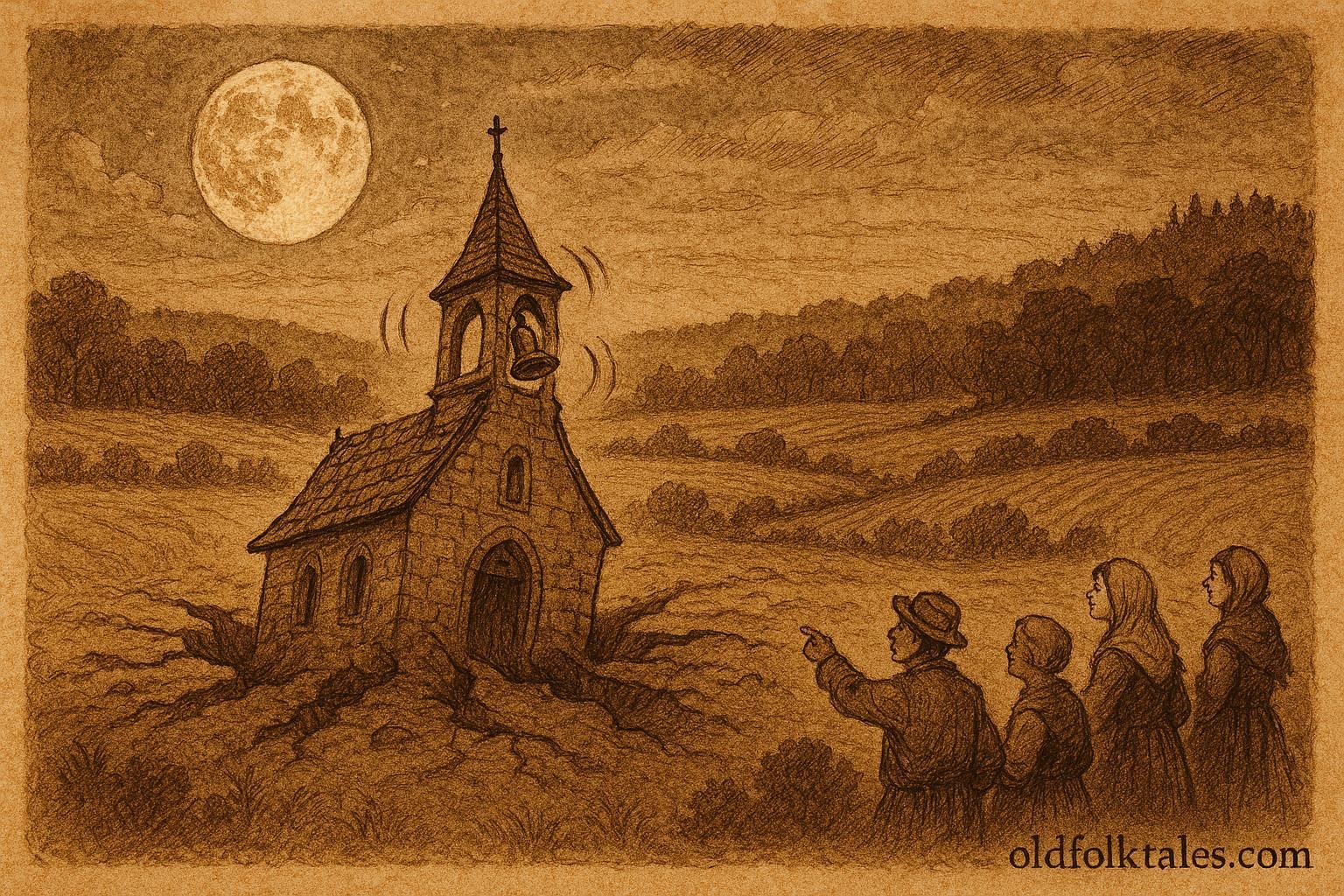
In the quiet countryside of Echternach, where forests stretch across gentle hills and rivers wind slowly through fields, old legends linger in the evening air. The people of the region have long believed that the land itself remembers the past. Beneath the soil, beneath the roots of ancient trees and the moss-covered stones of abandoned paths, echoes of forgotten places still remain. Among these legends, one of the most mysterious is the story of the Hidden Bells of St. Willibrord. Villagers say that on certain silent nights, when the wind has stilled and the moon glows faintly over the hills, strange bell chimes rise softly from beneath the earth. Their sound is distant, solemn, and haunting, like a voice from a buried past.
Those who hear the bells know that they are not ordinary sounds. They belong to a chapel that once stood proudly above the ground, long before it vanished beneath the soil.
The Chapel on the Hill
Many centuries ago, near the abbey town of Echternach, there stood a small chapel dedicated to the revered missionary Saint Willibrord. The chapel was not grand like the abbey churches of great cities, but it held deep importance for the villagers who lived nearby.
The stone building stood on a small rise above the surrounding fields. Its walls were simple, its wooden doors weathered by years of wind and rain. Yet within its humble walls were sacred relics and a bell tower whose clear ringing could be heard across the countryside.
Each morning and evening, the chapel bells rang to call the faithful to prayer. Farmers paused in their fields, travelers removed their hats, and villagers crossed themselves as the sound drifted over the land.
The chapel’s caretakers were entrusted with an important responsibility. They maintained the sacred building, protected its relics, and ensured that the bells rang faithfully each day.
For many years, this duty was carried out with devotion and humility.
The Slow Rise of Greed
Over time, however, the caretakers of the chapel changed. A new generation took responsibility for the building and its sacred treasures. At first, they followed the traditions faithfully, but gradually their devotion weakened.
Instead of viewing their role as a sacred duty, they began to see the chapel’s offerings and gifts as a source of personal wealth.
Pilgrims traveling through the region often left coins, candles, or small valuables as offerings of gratitude or prayer. The caretakers were meant to use these gifts for the upkeep of the chapel and the support of the poor.
But temptation grew stronger than humility.
The caretakers began to keep the offerings for themselves. Repairs to the chapel were delayed, the stone walls slowly cracked, and the wooden beams of the roof weakened under neglect.
The bells still rang, but less often. Their sound became irregular, as though the sacred rhythm of the place had been disturbed.
The villagers noticed the change, but many felt powerless to intervene.
The Final Warning
One evening, as the sun sank behind the forests and shadows stretched across the fields, a wandering pilgrim arrived at the chapel. His cloak was worn, and his face showed the signs of long travel.
He asked the caretakers for shelter and a place to pray.
The men, irritated by his appearance and unwilling to share their provisions, turned him away. They mocked his ragged clothing and closed the chapel doors before he could step inside.
The pilgrim paused at the threshold and looked at the chapel with quiet sorrow.
Then he spoke words that the caretakers would never forget.
He warned that sacred places must be guarded with humility and reverence. Greed and neglect, he said, would bring consequences that no earthly wealth could prevent.
But the caretakers laughed at him.
They believed their authority over the chapel was secure.
The Night the Earth Opened
That same night, a strange stillness settled over the countryside near Echternach.
The wind stopped blowing. The animals in the fields grew restless, and the air seemed heavy with an unspoken tension.
Shortly after midnight, the ground beneath the chapel began to tremble.
At first, the shaking was slight, like the passing rumble of distant thunder. But it grew stronger, rattling the chapel walls and causing dust to fall from the ceiling beams.
The caretakers awoke in confusion.
Before they could escape the building, the earth beneath the chapel began to sink.
Slowly at first, then more rapidly, the ground opened as though swallowing the structure whole. The stone walls cracked, the tower leaned, and the chapel descended into the earth.
The bells rang wildly as the tower collapsed downward, their desperate sound echoing across the night.
Then, just as suddenly as it had begun, the trembling stopped.
The chapel was gone.
Where it had once stood, there remained only a hollow depression in the ground.
The Bells Beneath the Earth
When the villagers arrived the next morning, they found the hill strangely quiet.
The chapel had vanished completely, leaving no trace but disturbed soil and broken grass. The caretakers had disappeared along with it.
People whispered that the earth itself had delivered a judgment.
Yet the most mysterious part of the legend was still to come.
On certain nights, especially when the air was still and the moon shone faintly through the clouds, villagers began to hear something unusual.
From beneath the ground came the soft, distant sound of bells.
Not loud or triumphant like the bells of living churches, but gentle and sorrowful, as though echoing from a hidden chamber deep below the earth.
The villagers believed that the bells of the lost chapel still rang beneath the soil.
A Warning Remembered
Generations passed, and the fields near Echternach continued to grow crops and sustain life.
But the legend of the hidden chapel remained strong among the people.
Parents told their children the story of the bells beneath the earth. Travelers walking near the old hill sometimes paused in silence, listening for the faint chime said to rise from the ground on quiet nights.
The story became more than a tale of a vanished building.
It was a reminder.
A reminder that sacred duties must be honored, that greed can destroy even the most revered places, and that humility is the foundation of true devotion.
Even today, some say that if you walk through the countryside near Echternach on a calm night and listen carefully, you may hear the faint echo of bells ringing beneath the soil, an ancient warning preserved in the land itself.
Moral Lesson
The legend of the Hidden Bells of St. Willibrord teaches that sacred responsibilities must never be treated lightly. Greed and neglect can destroy even the most revered places, while humility and reverence preserve what is truly valuable. The quiet bells beneath the earth remind us that memory and moral lessons endure long after buildings disappear.
Knowledge Check
1. Where does the legend of the Hidden Bells of St. Willibrord take place?
Near Echternach in the countryside of Luxembourg.
2. Who was the chapel dedicated to?
The chapel honored Saint Willibrord, a revered missionary in the region.
3. Why did the chapel sink into the earth according to the legend?
Its caretakers became greedy and neglected their sacred duties, bringing divine punishment.
4. What mysterious phenomenon occurs after the chapel disappears?
Villagers claim they can hear the chapel bells ringing beneath the earth on quiet nights.
5. What themes are present in this Luxembourg legend?
Divine punishment for greed, reverence for sacred spaces, and memory preserved through folklore.
6. What does the sound of the hidden bells symbolize?
A lasting warning that sacred responsibilities must be honored with humility and faith.
Source: Nicolas Gredt, Sagenschatz des Luxemburger Landes (1883)
Cultural Origin: Echternach region, Luxembourg