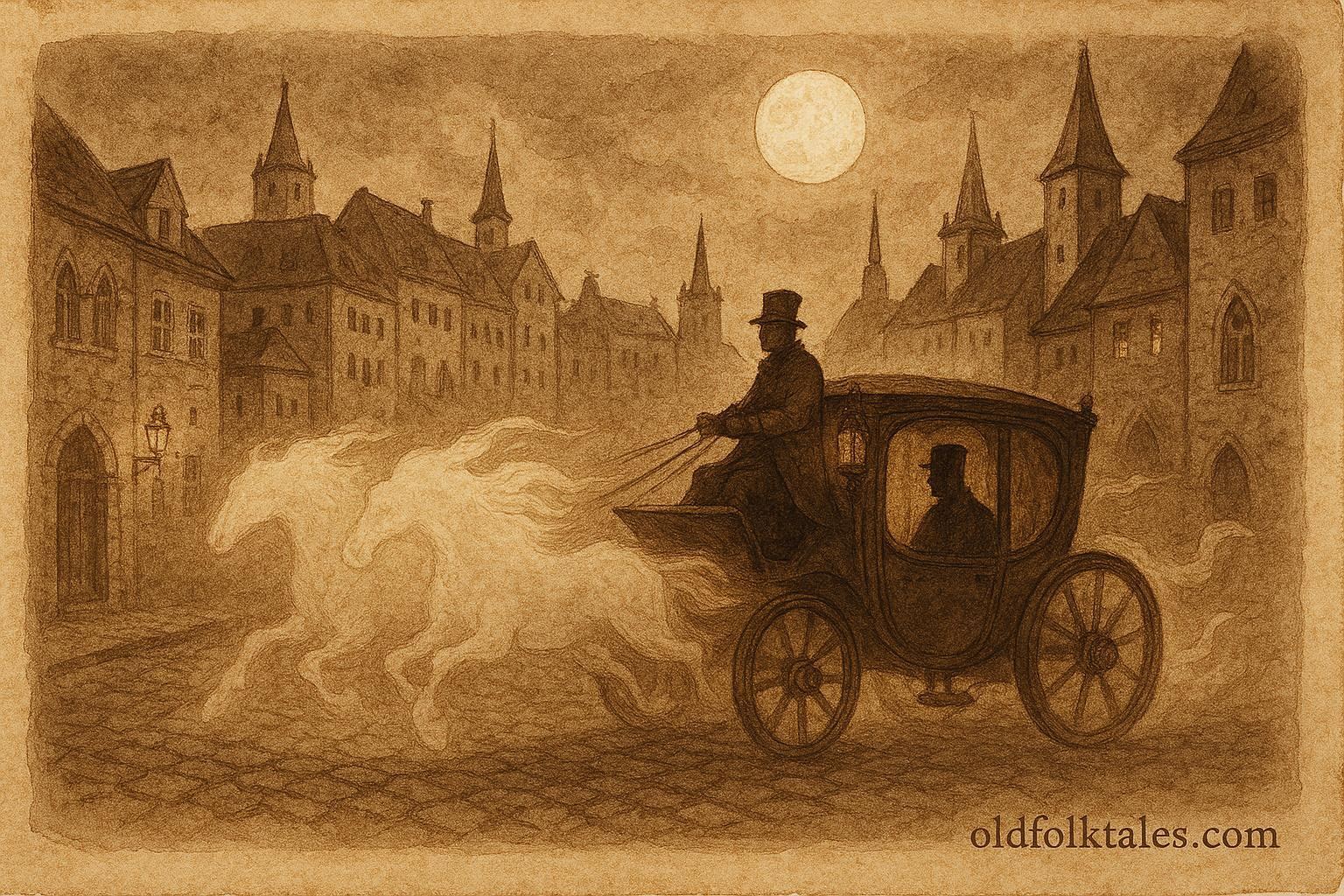
In the winding stone streets of Luxembourg City, where ancient walls rise above deep valleys and narrow alleys twist between centuries-old buildings, the past never truly fades. The city’s fortifications, towers, and cobbled paths have witnessed countless stories, some heroic, some tragic, and some that linger in the shadows between legend and memory. Among the most mysterious of these legends is the tale of the Phantom Coach of Luxembourg City.
Long after the taverns close and the streets fall silent, when the moon casts pale light across the stone walls, some residents claim to hear a distant rumble echoing through the empty roads.
It sounds like wheels racing over cobblestones.
And those who have heard it say the same thing: a ghostly carriage passes through the sleeping city, drawn by invisible horses and driven by a silent coachman whose passenger is a spirit that cannot find peace.
The Nobleman of the City
Many years ago, when Luxembourg City was governed by noble families and powerful officials, there lived a wealthy nobleman whose influence extended across the region.
His mansion stood proudly near the heart of the city, its tall windows overlooking busy markets and crowded streets. Servants attended to his needs, and his carriage, an elegant vehicle drawn by fine horses, was known throughout the city.
Yet despite his wealth and position, the nobleman was not loved by the people.
He ruled his lands with harsh authority, imposing heavy demands upon those who lived under his control. Farmers struggled to meet his expectations, merchants feared his anger, and servants whispered quietly of his temper.
The nobleman believed that power gave him the right to command without mercy.
And so, he rode through the city streets each day in his grand carriage, rarely acknowledging the people who moved aside to let him pass.
The Carriage of Authority
The nobleman’s carriage became a symbol of his presence.
When its wheels rolled across the cobblestones and its horses’ hooves echoed through the streets, people stepped aside quickly. The coachman guided the vehicle with precision, while the nobleman sat within, observing the city with cold indifference.
The carriage appeared at markets, along the city gates, and beside the great stone walls that guarded Luxembourg from enemies.
To some, the vehicle represented wealth and power.
To others, it represented injustice.
For every time the carriage passed, someone remembered the nobleman’s harsh commands or unfair judgments.
The Night of the Final Ride
One evening, as dark clouds gathered above the city and the wind moved restlessly through the streets, the nobleman ordered his carriage prepared for a late journey.
Despite warnings of an approaching storm, he insisted on traveling through the city and beyond the gates.
The coachman hesitated, uneasy about the weather and the strange mood that hung over the night. But the nobleman would not listen.
The horses were harnessed, the carriage doors closed, and the vehicle set off through the narrow streets.
Thunder rolled across the sky as rain began to fall, turning the cobblestones slick beneath the horses’ hooves.
Witnesses later claimed that the carriage raced through the streets faster than usual, its wheels striking sparks against the stones as it turned sharply around corners.
Then, somewhere beyond the city’s silent gates, the sound of the carriage vanished.
By morning, neither the nobleman nor his coachman could be found.
The First Midnight Ride
The disappearance became the subject of rumor throughout Luxembourg City.
Some said the carriage had crashed during the storm. Others believed the nobleman had fled after angering powerful rivals.
But several weeks later, something happened that changed the story forever.
Late one night, a watchman walking along the quiet streets heard the unmistakable sound of wheels racing over cobblestones.
At first, he thought a traveler had arrived after the gates were closed.
Yet when he looked toward the road, he saw something impossible.
A carriage was speeding through the empty street—but no horses were visible.
The vehicle seemed to glide through the darkness, its wheels turning rapidly while a silent coachman held invisible reins.
Inside the carriage sat a shadowy figure.
Before the watchman could speak, the carriage vanished around a corner, leaving only the fading echo of its wheels.
The Ghostly Coach Returns
After that night, others began reporting similar sightings.
Residents living along narrow streets claimed to hear the phantom carriage racing past their homes at midnight.
Guards standing watch near the city gates spoke of distant wheels echoing through the darkness, even though the roads were empty.
Those who glimpsed the carriage described the same chilling sight: a ghostly vehicle drawn by unseen horses, guided by a coachman whose face remained hidden.
And within the carriage sat a figure dressed like a nobleman, staring silently ahead.
Some believed the restless spirit belonged to the cruel nobleman who had vanished during the storm.
Unable to escape the memory of his unjust actions, his spirit was said to wander the city forever.
A Warning in the Night
As the years passed, the story of the Phantom Coach became part of the city’s folklore.
Parents warned children not to wander the streets at midnight.
Travelers arriving late sometimes paused outside the gates, listening carefully for the sound of wheels on stone.
And those who heard the phantom carriage often said the same thing: the sound carried a strange urgency, as though the spirit inside the coach was searching endlessly for something it could never reach.
Some believed the nobleman’s spirit was attempting to escape the consequences of his actions.
Others believed he was seeking redemption for the injustices he had committed.
But whatever the truth, the phantom carriage continued its silent journey through the city’s memory.
Echoes of the Past
Today, Luxembourg City is a modern capital filled with life and activity. Yet its ancient streets still hold the echoes of centuries gone by.
Visitors walking through the old quarters sometimes hear guides recount the legend of the ghostly carriage that once raced through the midnight streets.
And occasionally, on particularly quiet nights, when the city is still and the moonlight touches the cobblestones, someone claims to hear a distant rumble.
The faint sound of wheels racing through empty streets.
Whether it is wind, imagination, or something older and more mysterious, the legend endures.
For in Luxembourg City, history is never truly silent.
Discover the timeless charm of French, Dutch, and Belgian stories filled with cleverness and heart
Moral Lesson
The legend of the Phantom Coach of Luxembourg City reminds us that power must be exercised with justice and compassion. Those who abuse authority may leave behind consequences that linger long after their lives end. The restless carriage symbolizes the idea that actions echo through history, and that fairness and humility are essential virtues.
Knowledge Check
1. Where does the legend of the Phantom Coach take place?
The story originates in Luxembourg City.
2. What is the phantom coach said to carry?
It carries the restless spirit of a nobleman who once abused his power.
3. What unusual feature does the ghostly carriage have?
It is pulled by invisible horses and driven by a silent coachman.
4. When do people usually hear or see the phantom coach?
Most sightings occur around midnight in the quiet streets of the city.
5. What themes are present in this Luxembourg legend?
Consequences of injustice, restless spirits seeking redemption, and the lingering presence of history.
6. Which folklorist recorded this legend?
The story appears in Sagenschatz des Luxemburger Landes by Nikolaus Gredt.
Source: Sagenschatz des Luxemburger Landes by Nikolaus Gredt (1883)
Cultural Origin: Luxembourg City, Luxembourg