High in the rugged mountain range that forms the natural border between Spain and France rises one of Europe’s most ancient and formidable landscapes, the Pyrenees Mountains. Jagged peaks stretch toward the sky, their rocky slopes often crowned with snow even during the warmer months. Deep valleys wind between forests of pine and fir, and narrow paths twist along cliffs where only the most careful traveler dares to walk.
For centuries, shepherds have lived and worked among these mountains. Their flocks graze on the alpine pastures, and their lives are shaped by the rhythms of wind, snow, and changing seasons.
But the shepherds of the Pyrenees have long shared another tradition besides tending sheep.
They tell stories.
Among the most mysterious of these tales is the legend of a giant who wanders the highest peaks of the mountains.
According to the old shepherds, this giant has lived in the Pyrenees for longer than anyone can remember. Some say he is older than the villages scattered among the valleys. Others claim he has guarded the mountains since the earliest travelers first carved paths across the slopes.
The people simply call him the Giant of the Pyrenees.
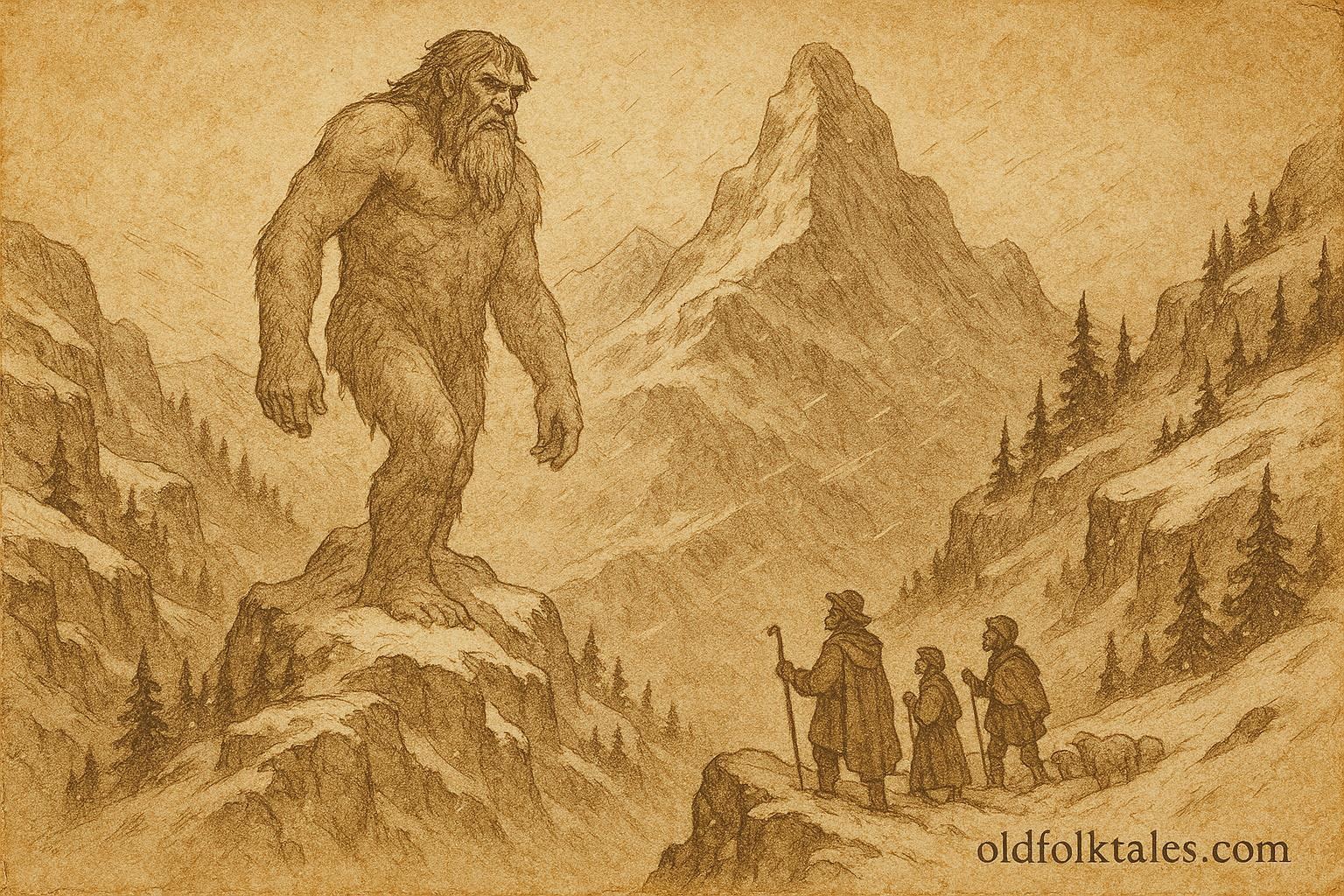
Those who claim to have seen him describe a towering figure moving silently among the snowy ridges. His shoulders are as broad as the mountain cliffs, and his footsteps echo across the valleys like distant thunder. His hair and beard are said to be as white as the winter snow that blankets the peaks.
Though terrifying in appearance, the giant is not believed to be cruel.
Instead, the shepherds say he is a guardian of the mountains themselves.
The Pyrenees are beautiful, but they are also dangerous. Storms can sweep across the peaks without warning. Snow can bury narrow trails. A single misstep along a rocky ledge can send a traveler tumbling into the deep ravines below.
For those who respect the mountains, the giant is said to offer protection.
Travelers who approach the high paths with humility sometimes claim to hear distant footsteps guiding them away from danger. Others speak of sudden changes in the wind that seem to steer them toward safer routes.
Some shepherds even tell of finding enormous footprints in fresh snow along lonely mountain passes, footprints that appeared to lead directly toward a dangerous cliff, only to turn sharply away as if someone had intervened.
When such signs appear, the shepherds nod knowingly.
“The giant is watching,” they say.
Yet the legend also carries a warning.
Those who treat the mountains with arrogance or disrespect often encounter the giant in a very different way.
Long ago, according to one story often repeated in the mountain villages, a group of travelers attempted to cross a high pass during late autumn. The villagers warned them that winter storms were already approaching and advised them to wait until spring.
But the travelers laughed.
They believed themselves strong and skilled enough to ignore the warnings of the shepherds.
“These mountains are nothing but rocks and snow,” one of them reportedly said. “We will cross them easily.”
Ignoring the advice of the locals, they set out toward the high pass.
At first their journey seemed simple enough. The sky was clear, and the air was calm. The path wound gently upward through pine forests and grassy slopes.
But as they climbed higher, the weather began to change.
Dark clouds gathered above the peaks. The wind grew stronger, whipping across the ridges with a cold, biting force. Snow began to fall in thick swirling flakes.
Soon the trail became difficult to see.
The travelers struggled to find their way as the storm grew fiercer. The wind howled across the mountains, carrying snow that blinded their vision and covered the path beneath their feet.
It was then that one of the travelers noticed something moving through the storm.
At first, it appeared to be a dark shadow against the white snow.
But as lightning flashed across the sky, the shape became clear.
A gigantic figure stood on the ridge above them.
The giant had appeared.
His enormous form towered over the travelers, his silhouette rising against the swirling clouds. The wind whipped through his long white hair as he watched the struggling men below.
The travelers froze in terror.
The giant did not speak.
Instead, he raised one massive arm and pointed toward the path they had taken earlier.
It was as if he were warning them to turn back.
But the travelers misunderstood the gesture.
Believing the giant meant to block their path, they shouted angrily and attempted to continue climbing.
Their arrogance only angered the guardian of the mountains.
The giant struck the ground with his enormous staff.
The mountains answered.
A deep rumbling echoed across the slopes as snow shifted high above them. Within moments, a small avalanche thundered down the mountainside, blocking the path ahead.
The travelers were forced to retreat, scrambling back down the trail through the snow and wind.
Only when they reached the safety of the lower valleys did the storm finally fade.
Shaken by the experience, the men realized that the giant had not tried to harm them. Instead, he had warned them to turn back before the storm grew deadly.
The shepherds who heard their story simply nodded.
“You were fortunate,” they told the travelers. “The giant punished your arrogance but still allowed you to live.”
Since that time, the legend of the Giant of the Pyrenees has been passed down from one generation to the next.
Shepherds guiding their flocks through the high pastures still speak of him when the winds blow across the peaks.
Travelers crossing the mountain passes sometimes pause to listen when distant echoes roll through the valleys.
And whenever fresh snow reveals enormous footprints along the high trails, people whisper that the guardian of the mountains is still watching.
Watching those who walk among the peaks.
Protecting those who respect the ancient power of the Pyrenees.
And reminding every traveler that the mountains are not meant to be conquered, but honored.
Moral Lesson
The legend of the Giant of the Pyrenees teaches that nature commands respect. Those who approach the natural world with humility may find protection, while arrogance toward nature often leads to danger.
Knowledge Check
1. What is the Giant of the Pyrenees in Spanish folklore?
He is a legendary mountain giant believed to guard the high peaks and ancient paths of the Pyrenees.
2. Where does this folktale originate?
The legend comes from the Pyrenees Mountains region of Aragon and Catalonia in Spain.
3. What role does the giant play in the mountains?
He protects respectful travelers and punishes those who mock the power of nature.
4. What warning did the giant give the travelers in the story?
He pointed back toward the valley to warn them that a dangerous storm was approaching.
5. What natural event stopped the arrogant travelers?
A small avalanche blocked their path and forced them to retreat.
6. What theme does the story emphasize?
The importance of humility and respect for the natural world.
Source: Adapted from Spanish folklore collected in Cuentos populares españoles by Aurelio Macedonio Espinosa, 1946.
Cultural Origin: Pyrenees Mountains (Aragon and Catalonia)