Across the towns and villages of Spain, when the sun dips below the horizon and shadows stretch long across narrow streets, a familiar warning has echoed through generations. “Duérmete, niño… que viene El Coco.” Sleep, child… or El Coco will come.
No one agrees on exactly what El Coco looks like. Some say it is tall and thin, with limbs that bend like shadows against the wall. Others claim it has no face at all, only darkness where features should be. There are those who insist it is small and silent, slipping beneath beds and hiding in corners where light dares not linger.
But all agree on one thing: El Coco comes for those who do not listen.
For most children, this warning is enough. At the sound of their mother’s voice or the whisper of the old lullaby, they pull their blankets tight and close their eyes, hoping sleep will keep the creature far away.
Yet not all children are so easily convinced.
In one quiet village, nestled among rolling hills and olive groves, there lived a child who did not fear easily.
His name was Tomás.
Tomás had heard the stories of El Coco all his life. His mother sang the lullabies, his neighbors spoke in hushed tones, and older children claimed to have seen shadows moving where nothing should be. But to Tomás, these were only stories, tales meant to frighten and control.
“I will not sleep just because of a story,” he said one evening, his voice firm with determination.
His mother looked at him with a mixture of concern and patience. “Some stories are not meant to be tested,” she warned softly.
But Tomás shook his head.
“I want to see it for myself.”
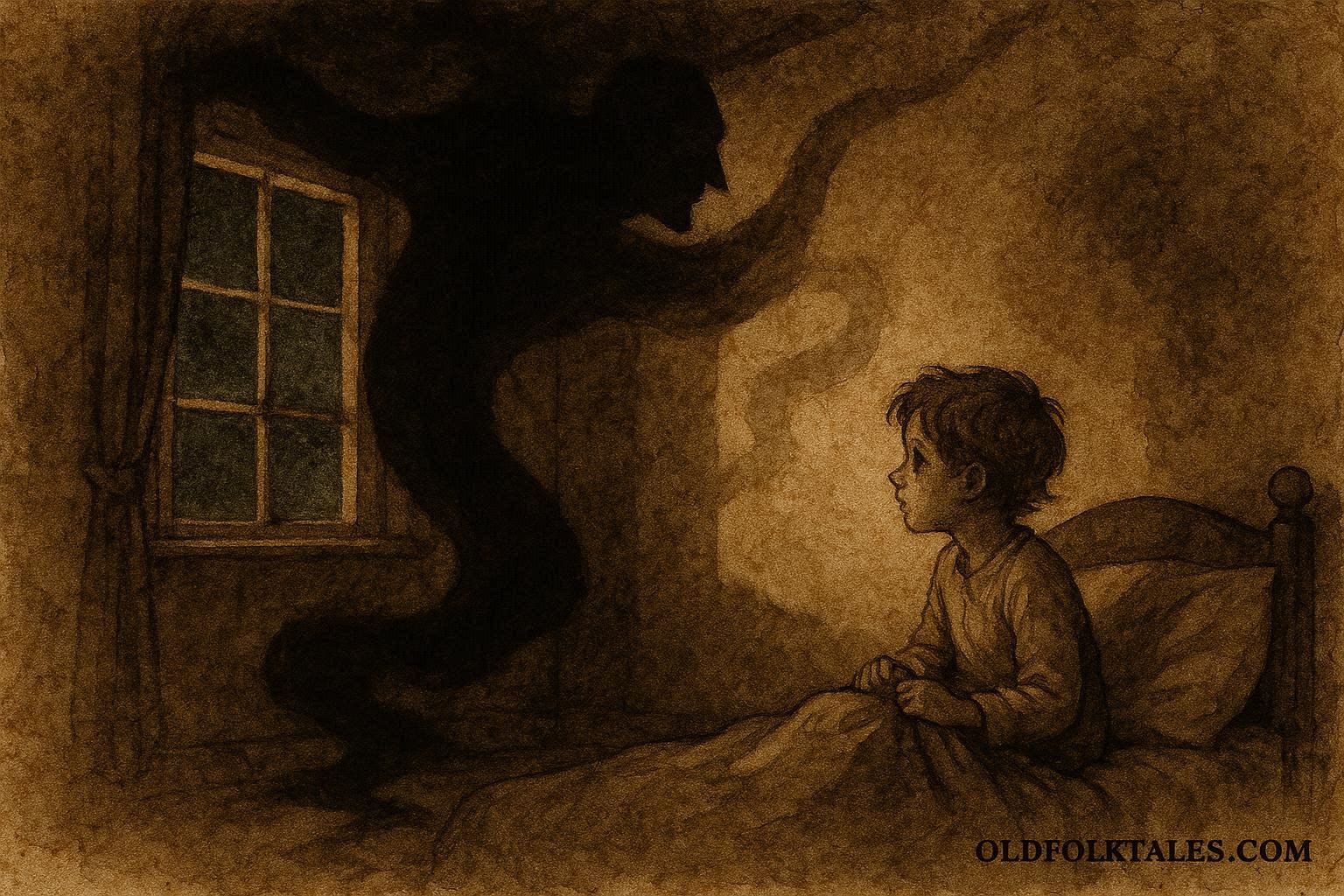
That night, as the village settled into silence and the last flickers of candlelight faded from the windows, Tomás lay awake in his bed. The room was still, the air heavy with the quiet of late hours.
At first, everything was as it had always been.
The faint glow of the moon slipped through the shutters, casting pale lines across the floor. The familiar shapes of his room, his chair, his small wooden table, rested where they always had.
But as time passed, something began to change.
The shadows grew longer.
It was subtle at first, almost unnoticeable. The corners of the room darkened, the edges of objects softened, as though the light itself was retreating.
Tomás sat up, his curiosity sharpening into alertness.
The silence deepened.
Then he heard it.
A faint sound, soft, almost like breathing.
He held his breath, listening.
There it was again.
Not the wind. Not the creak of wood.
Something else.
Tomás turned toward the darkest corner of the room, where the moonlight could not reach.
At first, he saw nothing.
Then, slowly, the darkness shifted.
It did not move like a person or an animal. It stretched, as though the shadow itself were alive. It gathered into a shape, uncertain, changing, never fully formed.
Tomás felt his chest tighten.
This was no story.
The shape grew clearer, though never solid. It seemed to watch him, though it had no eyes. Its presence filled the room, pressing against the silence like an unseen weight.
“Are you… El Coco?” Tomás asked, his voice quieter than he intended.
The shadow did not answer.
Instead, it moved closer.
Not with steps, but by spreading, its darkness reaching outward, creeping along the walls, across the floor.
Tomás felt a sudden chill.
For the first time, fear touched him.
And in that moment, something changed.
The shadow seemed to grow stronger.
It darkened, its edges sharpening, its form becoming more distinct. It loomed larger, as though feeding on the very fear that had begun to rise within him.
Tomás realized, with a clarity that struck deeper than any warning he had heard, that the creature was not simply there.
It was responding.
To him.
His heart began to race, and with it, the shadow expanded further, filling more of the room, pressing closer.
But then, through the fear, a thought broke through.
“If it grows when I am afraid…”
He swallowed, steadying himself.
“…then what happens if I am not?”
It was not easy.
Every instinct urged him to hide, to pull the blankets over his head and shut his eyes. But instead, Tomás did the opposite.
He sat up straighter.
He took a breath.
And he looked directly at the shadow.
“I am not afraid of you,” he said, his voice trembling but firm.
For a moment, nothing happened.
Then, slowly, the shadow flickered.
Tomás felt his fear rise again, but he held it back, focusing instead on the thought that had come to him, that the creature’s strength came from him, from what he allowed it to take.
“You are only as strong as I make you,” he continued.
The shadow wavered.
Its edges softened, its shape less certain.
Encouraged, Tomás stood from his bed, his feet steady despite the lingering chill in the air.
“You are not real,” he said, louder now.
“You are only fear.”
With each word, the shadow shrank.
The darkness retreated, pulling back into the corners where it had first begun. The room grew lighter, the moon’s glow reclaiming the space it had lost.
At last, the shadow was gone.
The room was silent once more.
Tomás stood there for a long moment, his breath slowing, his heart returning to its steady rhythm. The fear had not vanished entirely, but it no longer controlled him.
The next morning, he told his mother what had happened.
She listened carefully, her expression thoughtful.
“And what did you learn?” she asked.
Tomás considered her question.
“That El Coco is real,” he said slowly, “but not in the way we think.”
His mother nodded.
“And what gives it power?”
Tomás met her gaze.
“Fear.”
From that day on, the story of El Coco changed, just a little.
Parents still warned their children, still sang the lullabies passed down through generations. But now, some added a quiet lesson beneath the fear, that courage could weaken even the darkest shadow, that understanding was stronger than imagination left unchecked.
And though El Coco was never truly gone, its presence lingering in every dark corner and whispered warning, it no longer held the same power over those who understood its nature.
For in the end, the greatest fear is not what hides in the dark…
…but what we believe lives there.
Moral Lesson
Fear gains power when we give in to it, but courage and understanding can diminish even the darkest illusions.
Knowledge Check
- Who or what is El Coco in Spanish folklore?
Answer: El Coco is a shadowy creature used in stories to warn children against misbehavior. - What does El Coco represent symbolically?
Answer: It represents fear of the unknown and the power of imagination. - How does El Coco gain strength in the story?
Answer: It grows stronger when the child feels fear. - What happens when the child confronts El Coco without fear?
Answer: The creature weakens and disappears. - What lesson do parents intend with the story of El Coco?
Answer: To teach obedience, caution, and awareness of consequences. - Where does the legend of El Coco originate?
Answer: It is widespread across Spain and rooted in traditional lullabies and folklore.
Source: Referenced in early Spanish lullabies and compiled in Cuentos Populares Españoles by Antonio Machado y Álvarez (1881).
Cultural Origin: Spain.