In the vast northern lands of Finland, where forests stretched endlessly and winter ruled with quiet authority, there lived a fox known for her cleverness and a wolf known for his strength.
The land itself was not forgiving.
Snow lay deep across the ground for much of the year, and the rivers froze into silent paths of ice. Food was never easily found, and survival depended not only on strength, but on wit.
The fox understood this well.
She moved lightly through the forest, her sharp eyes always searching, her mind always working. She wasted nothing, trusted little, and survived by thinking before acting.
The wolf, however, relied on power.
He was large, strong, and feared by many creatures of the forest. When he moved, others stepped aside. When he hunted, he expected success.
Yet strength alone did not always bring him what he needed.
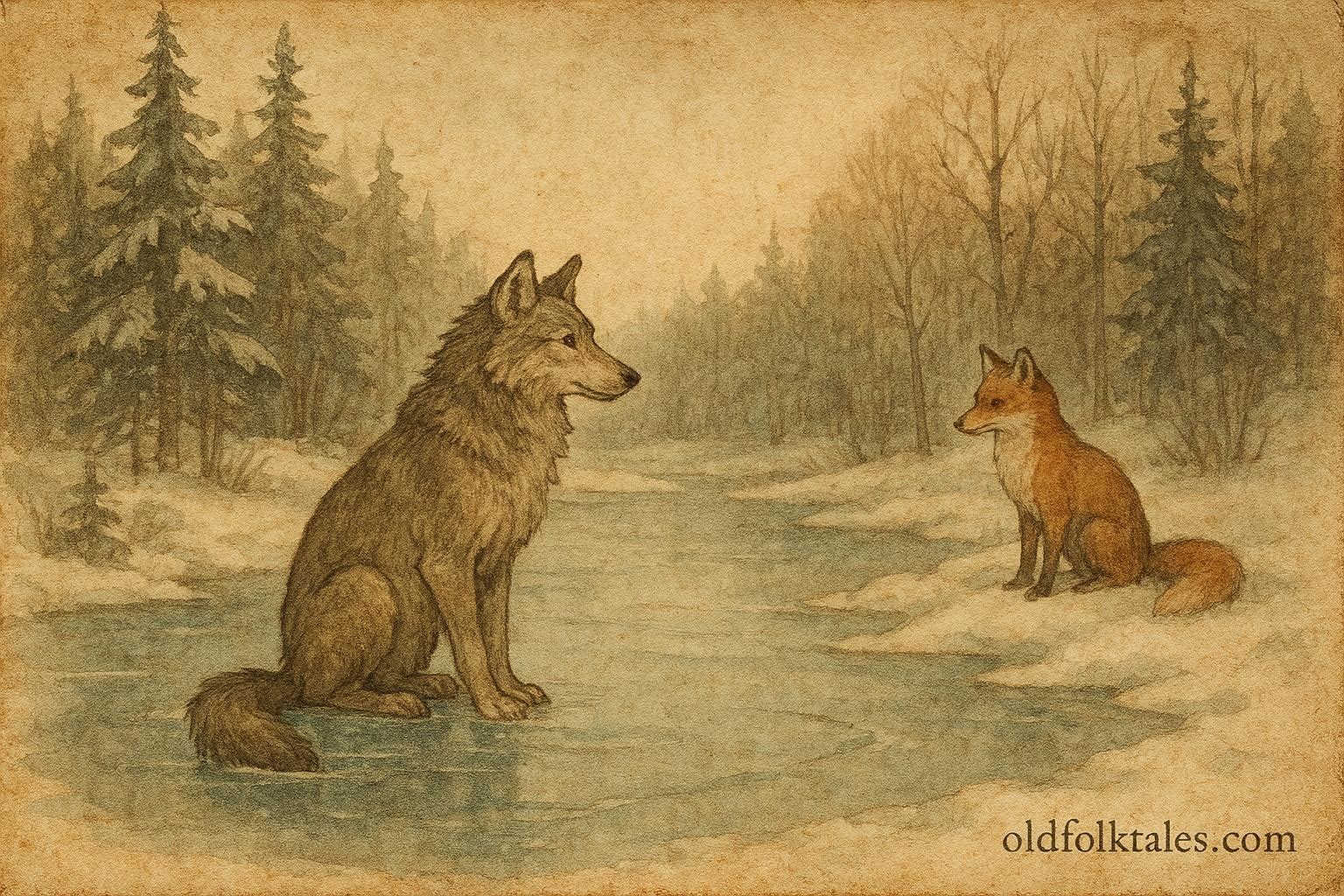
One cold day, when the air bit sharply and the snow creaked beneath every step, the wolf came upon the fox near the edge of a frozen lake.
She was crouched low, her tail wrapped around her, as though deeply focused on something.
“What are you doing?” the wolf asked.
The fox turned her head slowly, her expression calm.
“I am fishing,” she said.
The wolf frowned.
“Fishing?” he repeated. “In ice?”
The fox nodded.
“There are fish beneath the frozen water,” she said. “If one is patient, they will come.”
The wolf’s ears lifted slightly.
He had not eaten well in days.
“And how do you catch them?” he asked.
The fox tilted her head thoughtfully.
“It is simple,” she said. “You must cut a hole in the ice and place your tail into the water. Then you wait. The fish will gather, and soon they will cling to your tail.”
The wolf blinked.
“My tail?” he asked.
“Yes,” the fox replied. “But you must not move too soon. If you do, the fish will escape. You must wait until you feel the weight.”
The wolf hesitated.
It sounded strange.
But hunger has a way of quieting doubt.
“And it works?” he asked.
“It works,” the fox said calmly.
The wolf looked out over the frozen lake, then back at the fox.
“I will try,” he said.
The fox stepped aside.
“Be patient,” she added.
The wolf moved to the center of the lake and found a place where the ice was thinner. With effort, he broke through, creating a hole that opened to the dark water below.
Then, as instructed, he lowered his tail into the icy depths.
At first, nothing happened.
The cold crept upward, biting and sharp.
The wolf shifted slightly.
“Do not move,” the fox called from the shore. “You must wait.”
The wolf clenched his jaw and remained still.
Time passed.
The cold grew deeper, more intense.
Still, he waited.
“I feel something,” he called after a while.
The fox’s voice carried lightly across the ice.
“Good,” she said. “That means the fish are gathering. Wait a little longer.”
The wolf obeyed.
But what he felt was not fish.
The water around his tail had begun to freeze.
Slowly, steadily, it hardened, trapping his tail within the ice.
When at last the wolf decided he had waited long enough, he tried to pull away.
But he could not.
His tail was stuck.
He pulled harder.
The ice held firm.
Panic rose within him.
“Fox!” he called. “I cannot move!”
The fox watched from the edge of the lake, her eyes bright.
“You must pull harder,” she said.
The wolf strained with all his strength.
At last, with a sudden force, he broke free.
But as he did, pain shot through him.
He stumbled back, realizing too late,
His tail was gone.
The fox turned away, her steps light upon the snow.
“Next time,” she said, “do not trust so easily.”
The wolf stood trembling, anger rising to replace his shock.
“You tricked me!” he shouted.
But the fox was already gone.
Days passed, and the wolf, though wounded, did not forget.
His hunger returned, and with it, his desire for revenge.
One evening, he came upon the fox again.
This time, she was near a farmhouse, moving quietly among the shadows.
“What are you doing now?” the wolf demanded.
The fox looked at him calmly.
“I am gathering food,” she said.
The wolf narrowed his eyes.
“You will not trick me again.”
The fox gave a small, knowing smile.
“Then do not follow,” she said.
But the wolf did.
The fox slipped into the farmhouse through a small opening, returning moments later with food in her mouth. She moved quickly, efficiently, taking only what she needed.
The wolf, seeing this, grew impatient.
He pushed forward, trying to enter as she had.
But he was larger.
Less careful.
No sooner had he entered than a loud noise broke the silence.
The farmer awoke.
The wolf froze.
Then came shouting.
Footsteps.
The wolf turned to flee, but it was too late.
He barely escaped, chased out into the cold night, his pride wounded once more.
From a distance, the fox watched.
“You move without thinking,” she said. “And you trust without understanding.”
The wolf lowered his head.
He was strong.
But strength had not saved him.
In time, the forest continued as it always had.
The fox survived, as she always did, through patience, observation, and careful thought.
The wolf, though still powerful, carried the marks of his mistakes.
And the story of their encounters spread among the creatures of the forest, not as a tale of cruelty, but as a lesson.
That in a world shaped by harsh conditions and constant challenge, it is not strength alone that ensures survival,
But the ability to think, to question, and to act with care.
Moral Lesson
Cleverness and patience often succeed where strength fails. Those who act without thinking or trust blindly may suffer the consequences of their own pride and greed.
Knowledge Check
1. How did the fox trick the wolf at the frozen lake?
She told him to fish with his tail, causing it to freeze in the ice.
2. Why did the wolf believe the fox’s advice?
His hunger and pride made him trust her without questioning.
3. What happened when the wolf tried to escape the ice?
He pulled free but lost his tail in the process.
4. How did the fox behave differently from the wolf?
She acted with patience, caution, and intelligence.
5. What mistake did the wolf make at the farmhouse?
He acted impulsively and was nearly caught by the farmer.
6. What is the main theme of the story?
Intelligence and careful thinking are more valuable than brute strength.
Source: Finnish Folk Tales (1960)
Cultural Origin: Finnish rural oral storytelling traditions