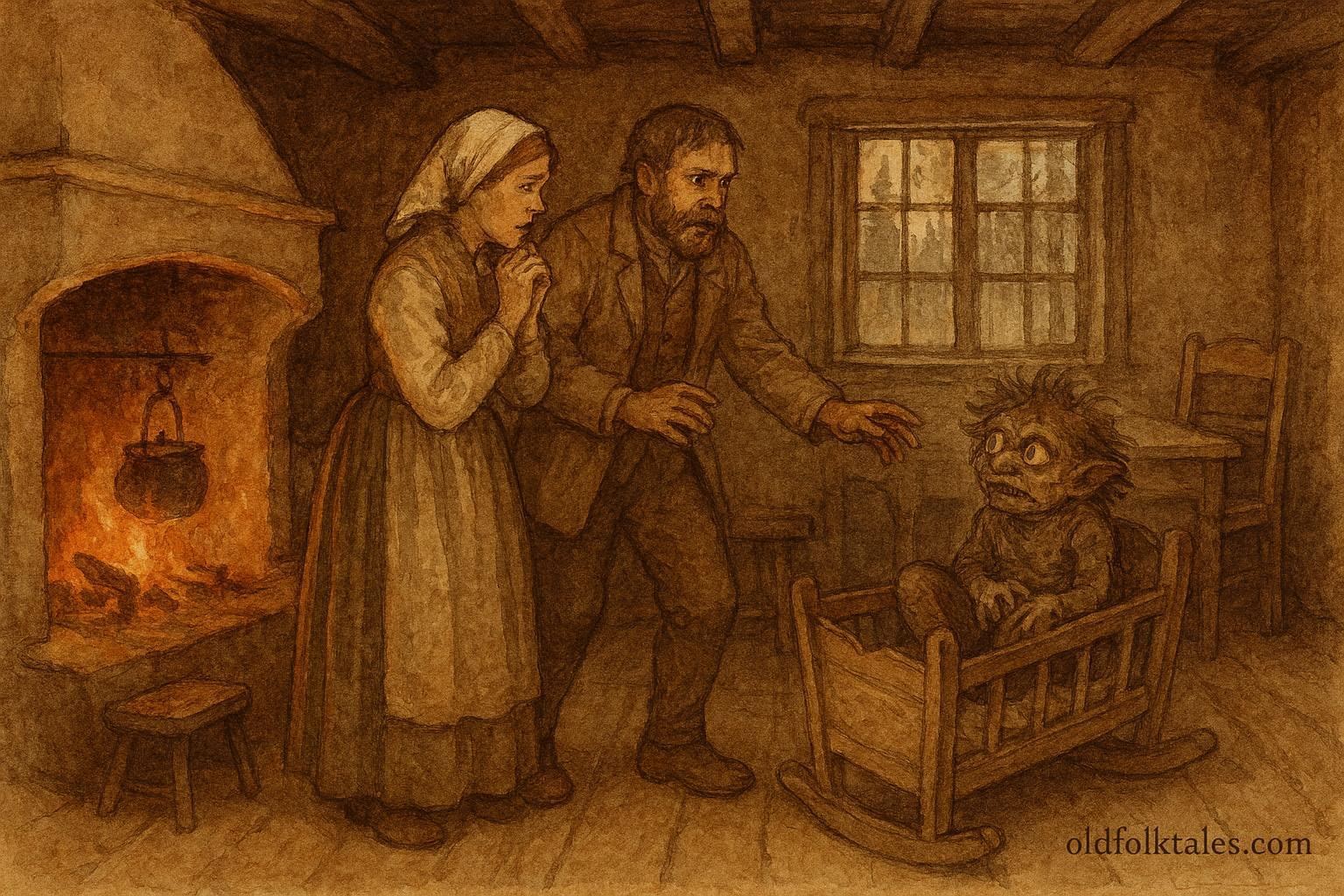
In a small Swedish village, surrounded by dark pine forests and the slow, silver flow of lakes, there lived a humble couple with a single child. Their cottage, built of sturdy timber with a thatched roof, sat at the edge of the woods, where sunlight dappled the moss-covered ground and birds sang in the morning mist. Life was simple, yet the home was full of love, warmth, and laughter, at least until one chilling morning.
The mother awoke to a silence that seemed unnatural. The usual morning giggles of her child, the patter of tiny feet across the floor, were absent. Instead, she found her son sitting quietly in his small wooden chair, staring blankly at the fire. His face was pale, and his movements were strangely stiff.
“Oh, he is not himself,” the mother whispered, clutching her apron. “Something has changed.”
The father, who had been tending the hearth, approached cautiously. He looked at the child’s wide, unblinking eyes, at the strange stillness in his posture, and felt a chill crawl up his spine. “I fear… it may be a changeling,” he murmured.
In their village, it was whispered among elders that trolls sometimes stole human children, leaving behind one of their own. These changelings, though they resembled human children, were strange, often misbehaving, pale, or unusually quiet. Parents who were clever and cautious might detect the deception and, through wit and courage, reclaim their child.
The couple observed their child closely. He no longer laughed at small joys, no longer asked for bread or milk with his usual eagerness. His voice, once bright and clear, now carried a hollow tone. The mother noticed that, when spoken to, he often tilted his head unnaturally, as if listening to some unseen master. Each day confirmed their growing dread: their child had been replaced.
“We must act carefully,” the father said one evening, his eyes scanning the flickering firelight. “The trolls are clever, and we must be cleverer. We cannot allow our son to remain in their grasp.”
The mother nodded, determination hardening her features. “Then we must learn the tricks of the elders. We must outwit whatever has taken him, for love is stronger than fear.”
For days, the couple prepared. They consulted old neighbors, who spoke of strange signs and subtle tricks to expose a changeling: sudden loud noises, unusual tasks, and tests of endurance or wit that no human child would fail, but a troll child could not withstand.
One morning, the mother began the first test. She placed a bowl of porridge on the table, as usual, and a bright, hot iron poker near it, hidden slightly under a cloth. “Eat, my child,” she said calmly. The changeling approached, eyes darting suspiciously. It reached for the porridge but hesitated at the sight of the iron. The mother’s voice was soft, almost coaxing. “Do not fear. Eat, and all shall be well.”
The creature recoiled, shrieking in a strange, hollow tone that was not the sound of her child. Its form shimmered faintly in the morning sunlight, revealing, for a fleeting moment, grotesque features unlike any human. The mother’s heart pounded. The first clue was confirmed, the changeling was indeed of troll origin.
The father joined her that night, bringing with him a small mirror. Together, they devised a clever plan: a sequence of provocations designed to force the changeling to reveal itself fully. The next morning, they set the stage. The hearth was made bright with glowing embers, the basin of water stood at the center of the floor, and various objects, an old wooden spoon, a torn ribbon, a piece of straw, were carefully placed to invite play.
The changeling entered the room, its eyes darting nervously. It avoided the water basin, shivered at the heat of the fire, and sniffed at the objects as though unsure what to do. The mother clucked softly. “Do not worry, little one. It is just play.”
The creature could not resist the straw. It picked it up and attempted to weave it into an imaginary basket, its movements stiff and unnatural. The father made a sudden loud noise, striking the poker against the hearth, sending a shower of sparks into the air. The changeling shrieked, revealing its troll-like features in fear: long, sharp fingernails, a crooked mouth, and eyes that glimmered red in the firelight.
The parents remained calm, restraining the creature only with their wit and authority. “Return what is ours,” the father commanded firmly, “or the forest will not hide you from us.”
The changeling trembled, hissing and writhing, as if caught in a trap it could not escape. Then, with a final screech, it vanished in a sudden puff of greenish smoke, leaving a faint scent of moss, wet soil, and something foul.
In its place, the real child appeared. He blinked, rubbed his eyes, and smiled up at his parents, unaware of the peril he had been in. Tears of relief streamed down the mother’s cheeks as she scooped him into her arms.
The village soon heard of the couple’s cleverness. Neighbors gathered to listen as the father recounted the methods they had used, how patience, observation, and intelligence had defeated the troll’s deception. The elders nodded in approval, and even the local priest murmured blessings, for the child’s safe return was a triumph of vigilance and love over dark magic.
In the days that followed, the family took extra precautions. They hung charms above the door, kept the hearth warm and bright, and made gentle offerings to the forest, acknowledging both its beauty and its dangers. Yet, the fear of changelings did not dominate their lives. Instead, they carried the quiet pride that comes from having outwitted cunning forces through courage and cleverness.
The child grew strong and cheerful once more, his laughter ringing through the cottage and spilling into the surrounding forest. Villagers learned a lesson as well: the forest could be full of mysteries, and vigilance and wisdom were as vital as bravery. Parents would tell their children stories of changelings and clever parents, ensuring the knowledge was passed down, so that no family would be caught unaware by the tricks of trolls or spirits.
And so, in that small Swedish village, between lakes and forest paths, the family thrived. Their love for each other, their cleverness, and their unwavering attention to the strange and unknown preserved their home from misfortune. The tale of the changeling became part of local lore, a story of cunning, parental devotion, and the triumph of human intelligence over supernatural trickery.
Moral Lesson
Love, vigilance, and cleverness are powerful forces against deception and danger. Intelligence and observation, combined with parental care, can overcome even the most cunning threats.
Knowledge Check
1. What is a changeling in Swedish folklore?
A child substituted by a troll’s offspring, often showing unnatural behavior.
2. How did the parents first suspect something was wrong?
Their child’s odd silence, stiffness, pale complexion, and unusual reactions indicated a changeling.
3. What tricks did the parents use to expose the troll child?
They used sudden loud noises, tasks involving familiar objects, and startling sparks from a glowing poker to provoke a reaction.
4. How did the changeling reveal itself?
The troll shrieked and displayed grotesque features when startled and manipulated.
5. Why is wit emphasized in the story?
It allows the parents to protect their child without resorting to violence, showing intelligence can overcome supernatural cunning.
6. What is the story’s central theme?
Parental vigilance, cleverness, and love triumph over the unknown and deceptive forces.
Source: Gunnar Olof Hyltén-Cavallius & George Stephens, Swedish Folk-Tales and Legends (1844)
Cultural Origin: Swedish folklore (rural beliefs about trolls and spirits)