In a distant Swedish kingdom, where rolling meadows met dense forests and sparkling lakes, there lived a princess who had not laughed in many years. Her eyes, though bright, carried a shadow of melancholy, and her smile had vanished from the castle entirely.
The king, her father, grew increasingly worried. He summoned doctors, jesters, and entertainers from all corners of the realm, yet none could lift her spirits. The princess would listen politely, nod at their efforts, but not a single giggle escaped her lips.
“Bring me someone who can make her laugh,” the king commanded one evening, “for if she cannot find joy, neither shall the kingdom.”
Men of rank and fortune tried their hand. They performed dances, sang songs, and told tales of valor and wit. But the princess remained unmoved, her expression calm and distant, as though the laughter of the world belonged to everyone else but her.
Among the crowd, there came a young man, humble, plain in dress, and unknown to the nobles. He had neither wealth nor title, only a curious mind and a spirit that sought to observe the world with amusement rather than pride.
When the king’s herald asked what he could do, the young man bowed low. “I wish only to try, Your Majesty,” he said.
The courtiers laughed among themselves. “A commoner?” they whispered. “Does he think he can succeed where lords and princes have failed?”
But the king allowed it, for he had grown desperate, and he hoped that even a simple attempt might stir the princess’s heart.
The young man entered the grand hall. At first, he did nothing. He simply walked with exaggerated care across the polished floors, his feet wobbling as if he were uncertain of gravity itself. The princess raised a curious eyebrow, but she did not smile.
Then he did something remarkable. He carried a large basket upside down upon his head, pretending it was a crown. He bowed to invisible attendants, staggered dramatically, and mumbled solemnly about imaginary ceremonies. The nobles tittered, unsure whether to be embarrassed or amused.
Yet the princess’s face remained composed.
The young man paused, then shook his head as though disappointed with himself. “Perhaps this will not suffice,” he said.
Suddenly, he produced a small mirror and placed it on the floor. He looked into it, made faces so absurd that even the most staid noble could hardly contain a chuckle—he stretched his eyes, puffed out his cheeks, and pretended to argue with his own reflection.
Still, the princess’s lips did not curve.
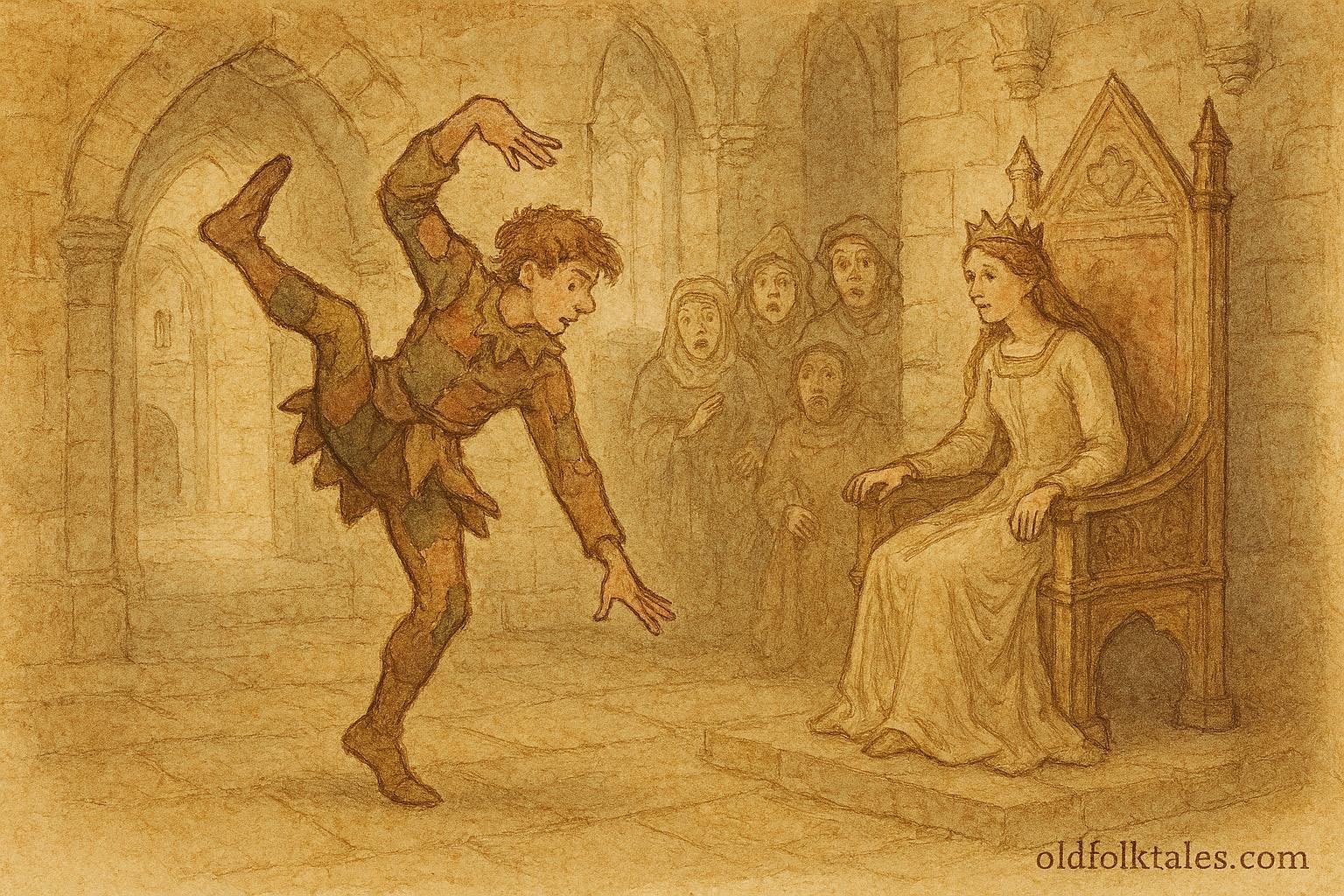
He was undeterred. Slowly, he gathered scraps of cloth from the hall, a discarded ribbon, a glove, a torn sleeve, and began to dress himself in a patchwork costume that looked as though a child had assembled it in play. Then, flailing his arms and hopping on one foot, he performed a clumsy dance that seemed to defy all coordination.
For the first time, the princess’s gaze softened. She blinked in disbelief, but the laughter did not yet come.
The young man knelt and pretended to wrestle with the invisible air, shouted a dramatic apology to the ceiling, and even whispered secret conversations to the chandelier as though it were a guest of honor.
Finally, he stumbled backward onto a small pile of cushions, pretending to faint, only to spring up suddenly and shout, “The princess has saved me from boredom!”
Something shifted. A small giggle escaped from the princess. She covered her mouth in astonishment, afraid yet delighted by her own reaction. The young man, seeing the success, exaggerated even further, tumbling across the floor, pretending the carpets had sprouted legs, and arguing with invisible cats that were chasing him around the hall.
The giggles grew louder, then blossomed into full laughter. The princess laughed until tears of joy streamed down her cheeks. The sound was like music in the hall, clear, light, and enchanting. Even the nobles could not resist smiling at the contagious joy.
The king, overwhelmed with relief, rose from his throne. “You have done what none could achieve,” he said to the young man. “You have brought laughter to my daughter. She is happy once more, and your cleverness has won her heart.”
The young man bowed humbly, and the princess approached him. In her eyes was gratitude, warmth, and recognition of the cleverness and courage it had taken to reach her.
From that day forward, the princess was known not only for her beauty but for her joyful spirit. And the humble young man, once dismissed by nobles, became her companion and partner, celebrated for his wit, creativity, and heart.
The kingdom itself seemed brighter, for the laughter of the princess spread like sunlight through the corridors, gardens, and villages beyond the castle walls. All were reminded that joy could be found in the most unexpected of places, and that cleverness and kindness often outshine wealth and title.
Moral Lesson
True worth is not measured by status or wealth but by creativity, courage, and the ability to bring joy. Humor and ingenuity can overcome sorrow and transform hearts.
Knowledge Check
1. Why does the princess refuse to laugh?
She carries deep melancholy and has remained unmoved by all attempts of nobles and entertainers.
2. Who succeeds in making the princess laugh?
A humble young man, unknown to the court, using cleverness and absurd humor.
3. What techniques does the young man use to entertain her?
Exaggerated movements, absurd costumes, playful interactions with objects, and unexpected antics.
4. What does the princess’s laughter symbolize?
Healing, joy, and the transformative power of creativity.
5. How does the story challenge ideas of social status?
A lowly commoner, rather than nobles or princes, achieves what the powerful cannot.
6. What is the main theme of the folktale?
Cleverness, humor, and humility triumph over sorrow and convention.
Source: Gunnar Olof Hyltén-Cavallius, Swedish Folk Tales and Legends (1844)
Cultural Origin: Swedish folklore