Long ago, in a kingdom of rolling hills, emerald forests, and glistening rivers in northern Italy, there lived a young prince whose life was marked by both privilege and kindness. He was admired by his people for his gentle heart, his fairness, and the courage he showed even in the smallest of tasks. Yet, as is often the case in tales of old, his virtuous nature drew the envy and wrath of those who sought to wield power through fear and malice.
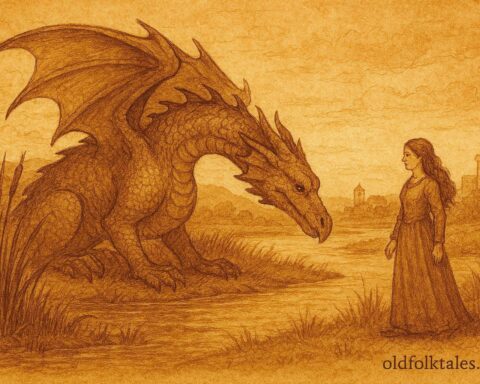
Among these envious figures was a wicked enchantress, a woman whose heart had long grown bitter and cruel. Her eyes, dark as storm clouds, could pierce through castles and cottages alike, discerning the hearts of the pure. One fateful night, driven by jealousy of the young prince’s virtue and the love the people bore him, she cast a terrible spell. With a whispered incantation, the prince was transformed into a magnificent green serpent, his golden crown replaced by emerald scales that glimmered in the moonlight.
Though his form had changed, his mind remained clear, and he remembered every detail of his life as a prince, the laughter of the children, the songs of the birds in the garden, the tender warmth of his mother’s hands. Yet now, bound to a body that slithered and hissed, he could no longer speak with his human voice nor move freely among his people. He retreated to the deepest part of the palace garden, a labyrinth of thorned hedges and flowering vines, where he could hide from the eyes of men and women who might harm or exploit him.
Time passed, and the kingdom mourned the disappearance of their beloved prince. News of the curse spread across the northern lands, reaching even the ears of distant princes and princesses, each wondering how they might lift such a dreadful enchantment. Yet the enchantress, confident in her magic, had left a single, almost imperceptible clue: only an act of true love, performed with courage and a pure heart, could restore him.
In a neighboring kingdom, a young princess named Isabella heard these tales. She was celebrated for her intelligence, her calm bravery, and the generosity with which she treated all creatures, whether human or animal. Isabella’s compassion was renowned; she tended to injured birds, healed stray animals, and often traveled alone into the forests, listening to the rustling leaves and observing the patterns of nature. When she heard of the green serpent, she felt a strange pull at her heart, a sense that she was somehow meant to encounter him.
She rode to the prince’s kingdom, traveling through snowy mountain passes and along rivers that shimmered like molten silver. At night, she slept beneath the stars, guided by intuition and the tales of villagers who pointed her toward the palace garden. Finally, she arrived at the palace, now a silent and eerie place where hedges had grown wild and statues seemed to watch with frozen eyes. She entered the garden cautiously, noting the shimmer of green scales among the shadows.
The serpent spoke, not in words, but through gestures, the tilt of his head, and a deep, soulful gaze. Isabella, though startled at first, sensed the presence of a human mind within the creature. She did not shrink or turn away. Instead, she approached with gentleness, offering a hand in friendship. She listened to the whispers of the wind, which seemed to carry the serpent’s plea for trust, and she saw in his eyes the reflection of a noble and kind soul trapped by malice.
Over the days, Isabella and the green serpent formed a delicate bond. She tended to the garden, bringing fresh water and herbs, singing soft songs, and telling stories of her own life and kingdom. She spoke to the serpent as she would to any companion, with patience and kindness. Slowly, the prince began to trust her, recognizing that this young princess’s courage was not born of arrogance or curiosity alone but of genuine care.
However, the enchantress’s curse was not easily undone. She watched from afar, furious that her magic might be broken. She sent illusions, threats, and phantom terrors to drive Isabella away, but the princess remained steadfast. She would not be intimidated, for she knew that love required bravery, and that true love often demanded endurance beyond fear. Night after night, she ventured into the garden, facing phantoms that hissed and shadows that twisted into frightening forms, yet never faltering in her mission.
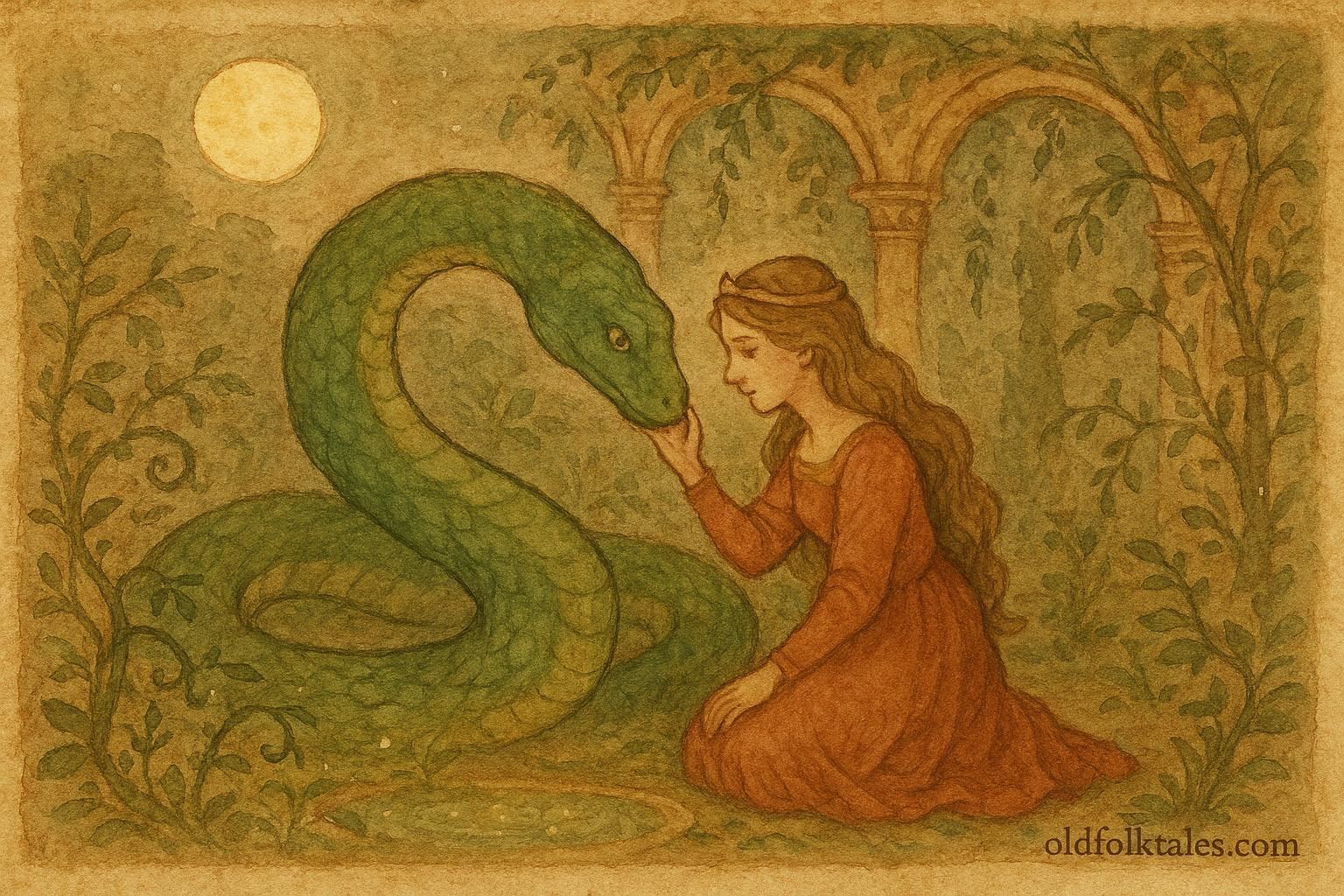
One moonlit evening, the serpent revealed the final challenge. A pool of enchanted water lay at the heart of the garden, guarded by vines that could ensnare the unwary and stones that burned like fire when touched. To break the spell, Isabella had to place her hand upon the serpent’s head while uttering words of courage and truth, trusting completely in the bond they had formed.
Isabella, though trembling, approached the pool. She remembered the many acts of kindness that had guided her life, the times she had nursed an injured bird, shared her food with the hungry, or spoken a comforting word to a lonely soul. Drawing upon this courage, she knelt before the serpent, touched his head, and spoke with a voice steady yet full of compassion:
“I see the soul within you, and I honor it. By my courage and love, I break the bonds that imprison you, not for reward, but because what is noble must be cherished.”
At that moment, a radiant light poured forth from the serpent’s emerald scales. The hedges trembled and the vines retreated, the stones cooled, and the pool’s surface glowed like liquid crystal. The green serpent began to change: scales dissolved into flesh, eyes brightened into their natural hue, and the prince’s golden crown appeared once more upon his head. Isabella watched, heart pounding, as the man she had come to trust and respect stood before her fully restored, human once more.
The kingdom rejoiced at the prince’s return. Tales of Isabella’s bravery spread, and the two were celebrated not only for their titles but for the courage, patience, and compassion that had triumphed over dark magic. The prince, grateful beyond words, acknowledged that it was Isabella’s unwavering trust and selfless love that had freed him, teaching all who witnessed the miracle that appearances could deceive and that inner virtue and bravery held the true power.
Yet the story emphasizes not just the breaking of a spell but the lasting impact of their deeds. The prince and Isabella worked together to heal the lands that had suffered under the enchantress’s malice, rebuilding gardens, offering aid to villagers, and protecting the forests. They taught that courage and kindness, when combined, could overcome both the seen and unseen dangers of the world. Even the enchantress, observing from a distance, seemed to soften, realizing that malice and envy could never extinguish the power of true goodness.
Generations later, children in northern Italy still recount the tale of the green serpent. They learn that true love is not merely about affection but about courage, patience, and seeing the worth within another being. They are reminded that bravery often comes with quiet, daily acts, offering kindness to the weak, standing firm in the face of fear, and persisting when challenges seem insurmountable. The story teaches that the strongest magic is not in curses or spells but in compassion, trust, and the perseverance to act rightly.
Moral Lesson
True love and courage are expressed through compassion, patience, and trust. Appearances can be deceiving, but bravery, loyalty, and kindness can overcome adversity and transform lives.
Knowledge Check
1. Who was transformed into a serpent in the tale?
A young prince, cursed by a wicked enchantress due to envy and malice.
2. What was required to break the curse?
An act of true love combined with courage and compassion from a princess.
3. How did Isabella show her bravery?
By facing illusions, threats, and the dangers of the enchanted garden to reach the serpent.
4. What qualities of Isabella were essential to the prince’s restoration?
Patience, trust, kindness, and courage.
5. What lesson does the tale teach about appearances?
That appearances can be deceptive, and true worth lies in character and inner virtue.
6. Which region of Italy does this folktale originate from?
Northern Italy, where stories of enchantment and heroism are woven into local folklore.
Source: Italo Calvino, Fiabe Italiane, 1956
Cultural Origin: Italy, Northern regions