In the ancient city of Coimbra, where the Mondego River flows quietly beneath stone bridges and the hills echo with the weight of history, there unfolded one of the most tragic and enduring love stories in all of Portugal.
It was a tale not merely of romance, but of power, fear, and the heavy hand of destiny, a story in which love burned so fiercely that even death could not extinguish it.
Discover the moral heart and wild spirit of the north through timeless Nordic storytelling
Prince Pedro, heir to the Portuguese throne, was a man of intense spirit and deep feeling. Though born into royalty, he was not easily governed by courtly expectations or political calculations. His heart, once stirred, was not one to yield.
It was in the royal court that he first beheld Inês de Castro.
She had come as a lady-in-waiting to Pedro’s lawful wife, a noblewoman chosen not by love but by alliance. Inês was of noble Galician blood, her beauty quiet yet striking, her presence marked by grace and intelligence. There was something in her bearing that drew attention, not loudly, but with a quiet, undeniable force.
From their first meeting, an unspoken bond formed between Pedro and Inês. What began as glances across candlelit halls soon grew into whispered conversations, and from there into a love that neither could deny.
But theirs was a love forbidden.
The court watched closely, and whispers spread quickly through the corridors of power. This was no harmless affection, it was a threat. Inês, though noble, was not of a lineage acceptable for a future queen of Portugal. Worse still, her family connections raised fears of foreign influence over the kingdom.
King Afonso IV, Pedro’s father, grew deeply troubled.
To him, the matter was not one of love, but of stability. A prince could not be ruled by his heart when the fate of a nation hung in the balance. The presence of Inês at court became a source of tension, her influence seen not as gentle but dangerous.
Still, Pedro would not be swayed.
Even after the death of his wife, when his attachment to Inês became more open, he refused to abandon her. Their love deepened in defiance of the court’s disapproval, and together they found moments of peace away from the ever-watchful eyes of the palace.
They lived for a time in Coimbra, where the gardens and riverbanks bore witness to their devotion. There, amidst the quiet beauty of the land, they built a life that felt almost untouched by the intrigues of the court.
But peace, in such a story, is never lasting.
The king’s advisors, fearing the growing influence of Inês and her family, pressed Afonso IV to act. They spoke of threats to the crown, of instability, of the dangers of allowing such a union to stand. Again and again, they urged him to remove the source of the problem.
At last, the king made a decision that would echo through history.
While Pedro was away, Inês remained in Coimbra with her children. It was there, in a place that had once felt safe, that the king’s orders were carried out.
Men were sent.
What followed was swift and merciless. Inês, unarmed and unprotected, was seized. Though she pleaded, not for herself, but for her children, the sentence had already been decided.
She was killed.
The news reached Pedro like a storm breaking upon still waters.
Grief consumed him, followed swiftly by a fury that could not be contained. The love he had carried in life now transformed into something equally powerful in loss. He swore vengeance, not as a prince bound by duty, but as a man whose heart had been torn from him.
When Pedro ascended to the throne as king, he did not forget.
His reign began with a reckoning.
Those responsible for Inês’s death were hunted down. Justice, as Pedro saw it, was not swift but deliberate. He ensured that their punishment matched the weight of their crime, that the court itself would witness the consequences of betrayal.
But vengeance alone was not enough.
Pedro sought something greater, something that would defy the finality of death itself.
He declared that Inês had been his lawful wife, secretly married during her lifetime. Whether this claim was believed by all mattered little; it was his truth, and as king, he had the power to make it known.
Then came the act that would forever bind their names together in legend.
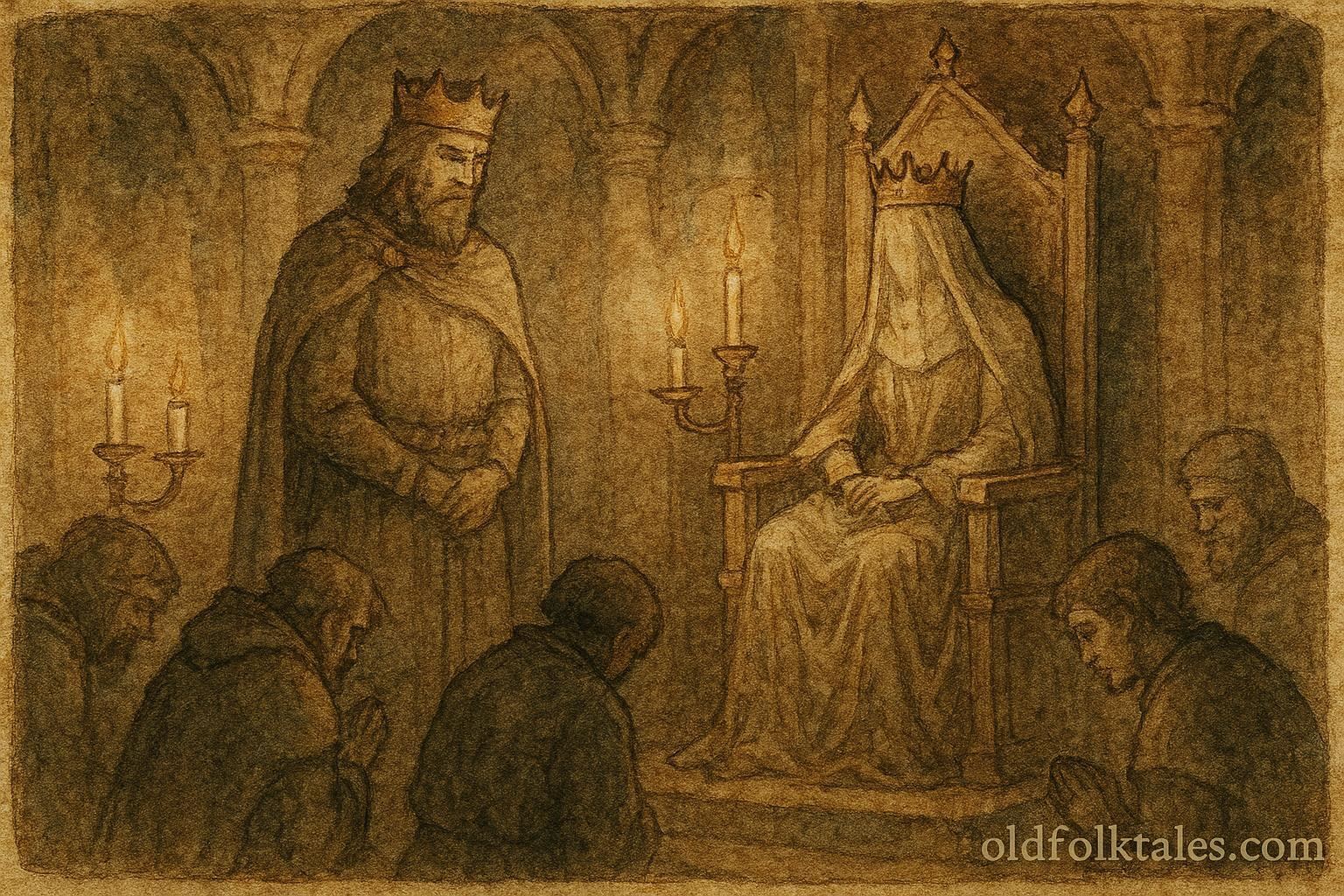
Pedro ordered that Inês be recognized as queen of Portugal, even in death.
Her body, laid to rest, was brought forth and given the honors of royalty. According to the most enduring version of the tale, the court was commanded to pay homage to her, to kneel before her as they would before a living queen.
It was an act both solemn and unsettling, a declaration that love, once given, could not be undone by death or decree.
Inês was then placed in a tomb of great beauty, her resting place adorned with carvings that told the story of their love and its tragic end. Pedro ensured that his own tomb would stand beside hers, positioned so that, as legend holds, they would face one another when the final judgment came.
Thus, even in eternity, they would not be parted.
The story of Pedro and Inês spread far beyond Coimbra, carried through generations as a tale of passion and sorrow, of love that refused to yield to the forces of power and fear.
In the quiet gardens by the Mondego, where their footsteps once echoed, visitors still speak of their story. The wind through the trees seems to carry whispers of their names, and the river flows on, as it did then, unchanged, yet forever marked by what it has witnessed.
For in the end, theirs was not a love defeated by tragedy, but one transformed by it.
A love remembered.
A love that endured.
Moral Lesson
True love, when deeply rooted, can transcend even death, but when power and fear overshadow compassion, tragedy often follows. Love must be protected, not suppressed.
Knowledge Check
- Who were Pedro and Inês in Portuguese history and folklore?
Answer: Prince Pedro of Portugal and Inês de Castro were lovers whose tragic story became a legendary tale. - Why was their love considered forbidden?
Answer: Their relationship threatened political stability and royal expectations, making it unacceptable to the court. - Who ordered the death of Inês de Castro?
Answer: King Afonso IV, influenced by his advisors. - What did Pedro do after becoming king?
Answer: He avenged Inês’s death and declared her queen, even after her passing. - What is the symbolic meaning of crowning Inês after death?
Answer: It represents love’s power to transcend death and defy societal constraints. - Where does this legend originate?
Answer: Coimbra, Portugal, and is immortalized in Portuguese literature.
Source: Adapted from Os Lusíadas by Luís de Camões (1572).
Cultural Origin: Coimbra, Portugal.