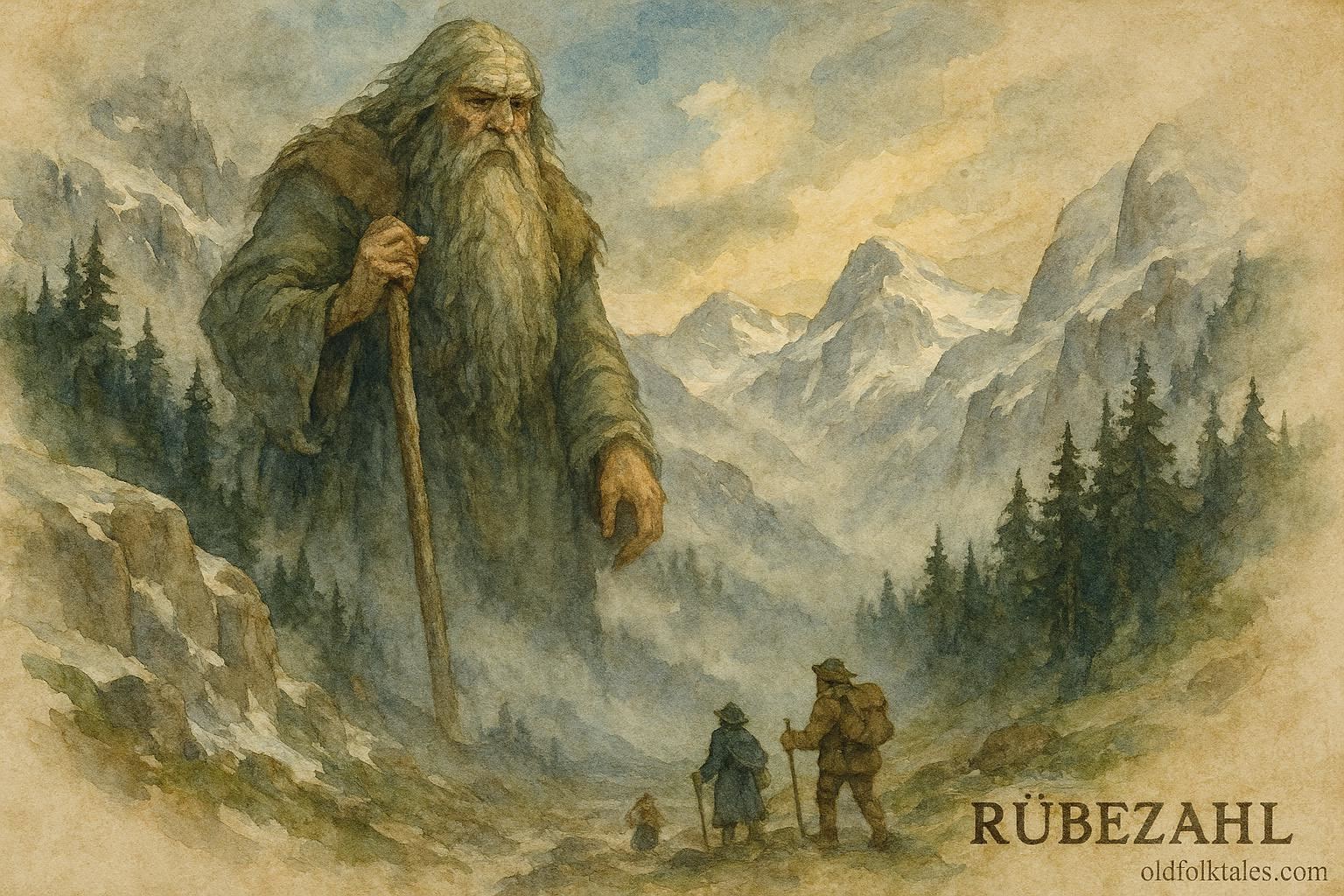
High in the mist-shrouded peaks of the Alps, where jagged rocks pierce the clouds and pine forests sway in endless wind, there dwelled a spirit of the mountains known as Rübezahl. Few could say with certainty whether he was friend or foe, for his mood shifted as swiftly as the mountain weather. Some called him a giant, others a wizard, but all agreed he was a being of immense power, deeply tied to the peaks, valleys, and hidden corners of the Alps.
The villagers who lived in the shadow of these mountains spoke of him in hushed tones. They said that Rübezahl could appear to travelers as a kindly guide, offering shelter or advice, but he could just as easily lead the arrogant astray, hiding them among crags or leaving them to wander in endless snowstorms. His justice was as swift as it was unpredictable.
One spring morning, a poor but honest woodcutter set out along a winding mountain path. He had come to gather timber for the village, hoping to provide firewood for the long winter yet to come. Though he was weary from weeks of labor, he carried a cheerful spirit, greeting the birds and murmuring thanks for the beauty of the morning sun.
As he walked deeper into the forested slopes, the air grew colder, and a thin mist wrapped itself around the trees. Suddenly, he heard a voice behind him, soft and musical.
“Good morning, traveler,” it said.
The woodcutter spun around and saw a man standing among the pines. He was tall, cloaked in the colors of the mountains, with hair the color of storm clouds. His eyes sparkled with mischief and wisdom alike.
“I am Rübezahl,” the man said, “guardian of these mountains. Where do you go, and what brings you here?”
The woodcutter bowed respectfully. “I come to gather timber for my village. I mean no harm to the mountains, and I only seek what is necessary.”
Rübezahl’s eyes gleamed. He smiled faintly, and a strange warmth entered the clearing. “Then I will help you,” he said, and with a wave of his hand, paths opened that had been hidden by brambles and rocks. The woodcutter found himself moving with ease, as if the mountain itself were guiding his steps.
He worked all morning, chopping and gathering the finest logs. When he paused to rest, Rübezahl appeared again, offering advice on which trees would renew themselves fastest and which saplings to leave untouched. The woodcutter listened carefully, grateful for the guidance.
By afternoon, the woodcutter had collected far more timber than he had imagined possible. “How can I ever thank you?” he asked.
Rübezahl chuckled. “Walk humbly through the world, honor the mountains, and respect those you meet. That is enough.”
With that, he vanished into the mist, leaving the woodcutter in awe. The man returned to his village with the timber, sharing the story of the mysterious helper who had aided him.
But not all encounters with Rübezahl were so kind.
In another valley, a boastful merchant traveled the mountains, bragging to his companions about his wealth and cunning. “No mountain spirit could trick me,” he said loudly. “I am smarter than any fool who lurks in these woods.”
The wind shifted, carrying his words up the cliffs. Rübezahl, who had been watching unseen from a ridge, smiled thinly. He decided to teach the merchant a lesson.
As night fell, the merchant and his companions found themselves lost. The path they had followed vanished, and shadows of rocks twisted strangely in the moonlight. Every attempt to retrace their steps led only to more confusion, and the mountain seemed alive with laughter.
Suddenly, Rübezahl appeared before the merchant, taking the form of a kindly old man. “Good evening, travelers,” he said, his voice warm. “Follow me, and I will show you the way.”
The merchant, eager to reach the village, followed blindly, praising the old man for his generosity. Yet the path twisted and turned, leading them in circles until dawn. When the sun rose, the merchant realized they were far from any known road, and the old man had vanished.
Rübezahl had tested his pride, and the merchant returned humbled, his arrogance diminished by the cunning spirit of the Alps.
There were tales of his humor as well. In one story, a group of villagers carried a basket of bread to share with travelers. They encountered a weary pilgrim, and Rübezahl, invisible to the human eye, decided to play a trick. He enchanted the bread so that each loaf would multiply when placed in the basket, until the villagers were struggling to carry a mountain of bread back to the village. Though initially frustrated, they eventually laughed, realizing the spirit’s playful lesson: generosity has no end if the heart is true.
Travelers learned to respect the mountains and the mysterious spirit who lived among them. Mothers told their children to speak kindly, to give thanks for shelter, and to honor those who guided them. Farmers left small offerings of bread or coins at mountain springs, asking for Rübezahl’s blessing on the coming season.
But perhaps the most remarkable tales involved those who demonstrated true humility and wisdom. One shepherd, lost in a sudden snowstorm, prayed quietly to the mountains and admitted his own mistakes. Rübezahl appeared in the form of a golden eagle, guiding him safely through the blizzard to a familiar pass. The shepherd would never forget the lesson: acknowledgment of one’s limitations and respect for forces greater than oneself could bring guidance in even the most perilous situations.
Rübezahl was also known to test kings and nobles who entered the mountains. Those who scorned the simple ways of the villagers or mocked the natural world were often tricked, embarrassed, or stranded, while those who treated the land and its people with fairness found themselves rewarded. In every story, the lesson was clear: arrogance and disrespect were never overlooked in the presence of the mountain spirit.
Though centuries passed, the legends of Rübezahl endured. Travelers who braved the Alpine passes told their children of a giant or wizard who could appear as an old man, a shepherd, or a nobleman. They spoke of his justice, his unpredictability, and the ways in which the mountains themselves seemed alive under his watchful eyes.
The duality of his nature, capable of kindness or mischief, of reward or punishment, remained central to his myth. Rübezahl represented both the beauty and the danger of the natural world: a reminder that human beings must move with humility, observe carefully, and honor the forces beyond their understanding.
Villagers and travelers alike learned that encounters with Rübezahl were never purely about fear or awe, they were about reflection. To act with greed, pride, or mockery risked humiliation or harm, while kindness, respect, and humility brought guidance, safety, and insight. In a land dominated by snow, rock, and mist, the spirit of the mountains demanded attention not through force, but through the subtleties of interaction, testing character with patience and cunning.
Even today, when the sun rises over the Alps, casting long shadows across the peaks, the people remember the tales of Rübezahl. His laughter is said to echo in the valleys when wind sweeps through the pines. Travelers pause to give a silent nod to the mountains, acknowledging the unseen guardian whose spirit embodies the unpredictable power of nature.
In the end, the stories of Rübezahl are more than legends, they are reminders of balance and justice, humility and wisdom, kindness and cunning. The mountains, eternal and indifferent, teach that one’s actions have consequences, and that respect for the unknown is as essential as skill or courage.
Moral Lesson
Rübezahl of the Alps teaches that humility, respect, and kindness toward the unknown are essential. Arrogance and mockery invite misfortune, while thoughtfulness and generosity bring guidance and reward. The natural world is both a teacher and a mirror of human character.
Knowledge Check
- Who is Rübezahl?
- A powerful, unpredictable mountain spirit of the Alps who rewards kindness and punishes arrogance.
- What regions does Rübezahl belong to?
- Austrian and broader Alpine regions, especially in folklore from Germany and Austria.
- How does Rübezahl treat humble travelers?
- He offers guidance, protection, and sometimes magical aid.
- What happens to arrogant or mocking travelers?
- They are led astray, embarrassed, or face misfortune in the mountains.
- What themes are central to this story?
- Justice, respect for the unknown, humility, duality of nature, and folklore wisdom.
- What is the symbolic role of Rübezahl?
- He embodies the power and unpredictability of nature, teaching moral lessons through interaction.
Source: Johann Karl August Musäus, Volksmärchen der Deutschen, 1782–1787
Cultural Origin: Austrian and Alpine regions