High in the Austrian Alps, where jagged peaks tear at the clouds and valleys fall away into dizzying depths, there lay a gorge so fierce that even the bravest travelers avoided it. The river below roared day and night, hurling itself against stone with relentless force, as if the mountains themselves were locked in eternal struggle.
On one side of this gorge stood a small mountain village. On the other lay pasturelands, forests, and the safest route to neighboring valleys. In summer, the crossing was dangerous; in winter, it was deadly. Many lives had been lost to slipping stones, sudden floods, and the unforgiving pull of the chasm below.
The villagers knew what they needed: a bridge.
They tried again and again to build one. Timber snapped like kindling in the winds. Stone foundations crumbled under rushing water. Each attempt ended in failure, and with every failure, hope thinned. Supplies dwindled. Trade slowed. Families faced hunger as routes closed and isolation tightened its grip.
At last, desperation settled over the village like fog.
One evening, as the sun sank behind the peaks and shadows filled the gorge, a stranger appeared at the edge of the worksite. He was well dressed, with dark eyes that gleamed strangely in the fading light. His voice was smooth, confident, and far too calm for such a perilous place.
He studied the broken beams and shattered stones and smiled.
“I can build your bridge,” he said. “Strong enough to last forever.”
The villagers exchanged uneasy glances. They did not need to ask who he was. In the Alps, such offers were never misunderstood.
The Devil had come.
He named his price plainly: the soul of the first living being to cross the bridge once it was finished.
Fear rippled through the crowd. No one spoke at first. The bargain was terrible, but so was the gorge. Without a bridge, their village would wither. Children would starve. The old would perish first.
After long debate, heavy with silence and shame, the villagers agreed.
The Devil laughed softly and set to work.
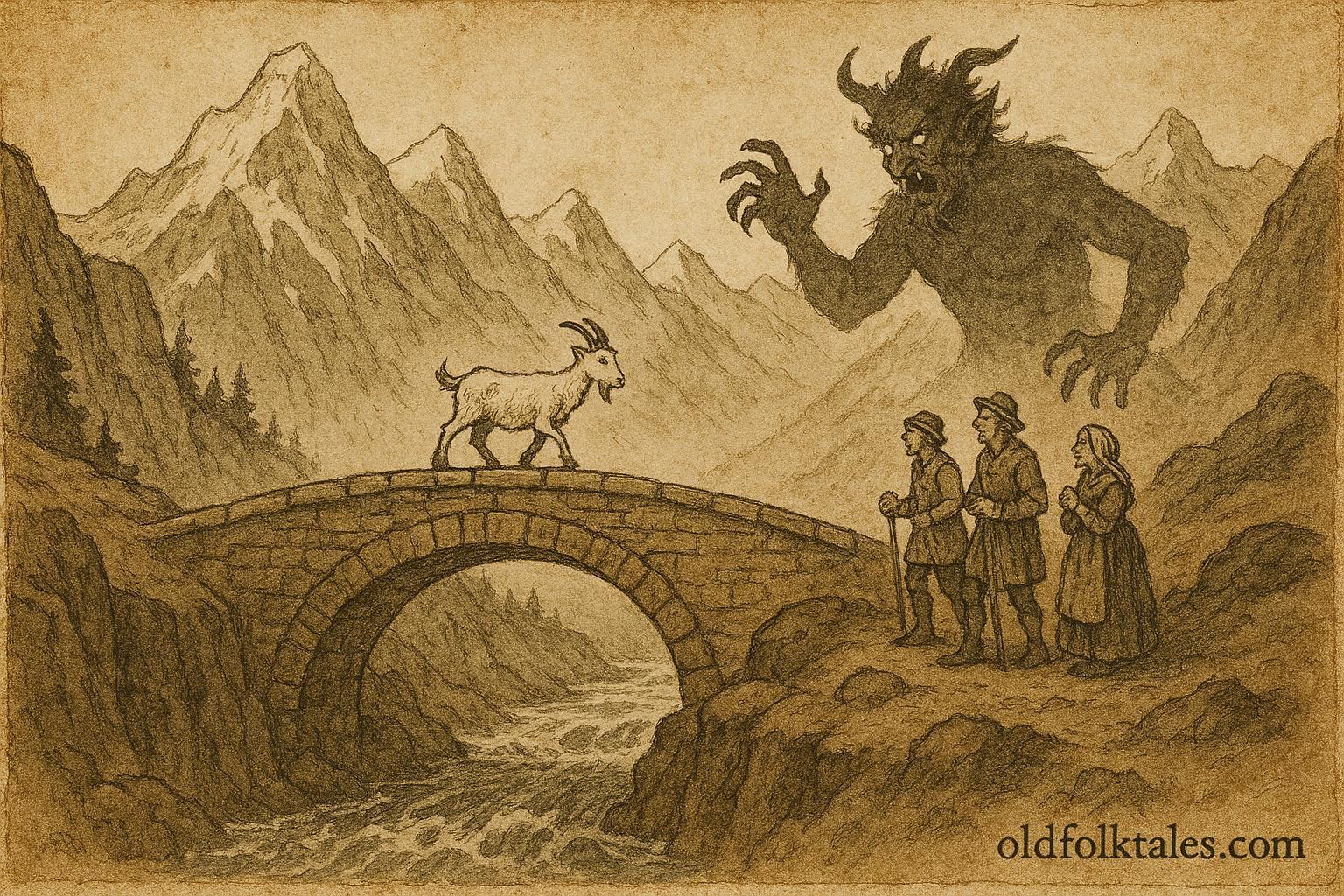
By dawn, the impossible had been done. A stone bridge arched gracefully across the gorge, its foundations rooted deep into the mountain itself. Not a crack marred its surface. Not a tremor shook its span. It stood as though it had always been there, ancient, perfect, and ominous.
The Devil returned, eager to claim his due.
“Send the first soul across,” he said.
But the villagers had not spent the night idle.
They had thought carefully, together.
From a nearby pen, they brought forth a goat: sturdy, stubborn, and very much alive. Without ceremony, they tied a rope around its neck and sent it trotting across the bridge. Hooves clattered on stone. The animal crossed safely to the other side and bleated into the mountain air.
For a heartbeat, there was silence.
Then the Devil realized he had been tricked.
His fury shook the gorge. The mountains echoed with his roar as he understood that his bargain had been honored in words, but not in spirit. He had asked for the first being. He had not said human.
Enraged, the Devil seized a massive boulder, intending to smash the bridge to pieces and drag the villagers down with it. But the mountain was no ally to him that day. The rock slipped from his grasp, tumbling into the abyss below, where it shattered uselessly against the gorge walls.
Defeated and humiliated, the Devil vanished in smoke and rage.
The bridge remained.
From that day on, the village was no longer divided. Trade returned. Families crossed safely. Generations walked that stone span, remembering both the danger that once ruled their lives and the cleverness that saved them.
The bridge came to be known as the Devil’s Bridge, not as a mark of fear, but as a reminder: evil may be powerful, but it is not always wise.
Moral Lesson
The Devil’s Bridge of the Alps teaches that intelligence, unity, and careful wording can overcome even the greatest threats. While desperation may invite dangerous bargains, shared wisdom and clever thinking can protect a community without sacrificing its humanity.
Knowledge Check
-
What is the Devil’s Bridge in Alpine folklore?
A legendary bridge built by the Devil in exchange for a soul. -
Why do the villagers make a pact with the Devil?
They cannot cross a dangerous gorge and face starvation without a bridge. -
How do the villagers outwit the Devil?
They send a goat, the first living being, across the bridge. -
What does the Devil demand in return for building the bridge?
The soul of the first being to cross it. -
What does the bridge symbolize in the story?
Human ingenuity and survival in harsh natural landscapes. -
What is the central theme of the legend?
Cunning overcoming evil through collective wisdom.
Source: Widespread Alpine legend recorded in Austrian and Swiss collections (17th–18th centuries)
Cultural Origin: Austrian Alps (shared Alpine folklore tradition)