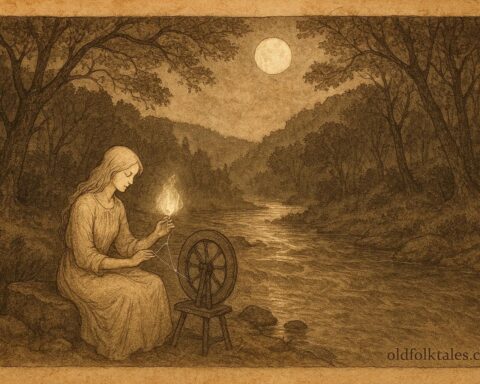
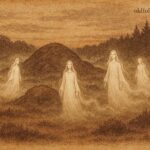
Long before Luxembourg rose as a center of power, before its walls bore the weight of history, the Alzette Valley lay quiet beneath thick forests and steep rocky cliffs. The river moved steadily through the land, carving stone with patience rather than force. Mists often drifted along its banks, softening the world and lending the valley an air of mystery. To those who lived nearby, the place felt watched, as though unseen forces lingered just beyond sight.
Count Siegfried of the Ardennes came to this land not as a conqueror, but as a seeker. He was a nobleman of ambition and foresight, searching for a place where strength, security, and opportunity could be joined. He understood that power was not merely claimed, it was rooted in the land itself. Thus, he traveled through valleys and forests, judging not only what could be taken, but what could endure.
Journey into the charm of British wit and Irish wonder through centuries of folk tradition
One day, as evening fell and the forest darkened, Siegfried came upon a spring near the cliffs above the Alzette. There, standing calmly beside the water, was a woman of remarkable presence. She appeared neither startled nor afraid, though she stood alone in the wild. Her beauty was not loud or dazzling, but quiet and compelling, marked by intelligence and serenity.
She called herself Melusina.
From the moment they spoke, Siegfried felt an unspoken bond between them. Melusina spoke with ease about the land, naming its strengths and dangers as if she had known it all her life. She described the cliffs, the river, and the surrounding valleys with precision and care, revealing a deep understanding that went beyond ordinary knowledge. Siegfried, accustomed to command and counsel, found himself listening more than speaking.
Their meetings became frequent. Affection grew naturally, without haste or coercion. Yet Melusina was not without mystery. Though warm and attentive, she maintained clear boundaries, withdrawing at certain times without explanation. When Siegfried expressed his desire to marry her, Melusina agreed, but only under one condition.
He must promise never to spy upon her during her private moments.
She did not explain why, nor did she offer reassurance beyond her word. Siegfried hesitated briefly, aware that such a condition was unusual, but his trust in her overcame his doubt. He swore to honor her request, binding himself not only by word, but by honor.
They were married, and peace followed.
Under Melusina’s guidance, Siegfried chose a rocky outcrop overlooking the Alzette as the site for a fortress. The position was strong, defensible, and commanding. Construction began swiftly, aided by Melusina’s uncanny understanding of stone and structure. The walls rose with remarkable speed and stability, as though the land itself welcomed the building.
The fortress came to be known as Luxembourg, the “little fortress,” though even then it was clear that its influence would grow.
Life within the castle was orderly and prosperous. Siegfried ruled wisely, and Melusina’s presence brought harmony to the household. Servants spoke of her fairness and intelligence, of her calm authority and quiet generosity. Yet despite this harmony, whispers began to circulate.
Melusina withdrew regularly, always alone. No one ever saw where she went or what she did during those times. Curiosity turned to speculation, and speculation to suspicion. Though Siegfried dismissed these murmurs at first, doubt slowly found its way into his thoughts.
He loved Melusina deeply, but he was human.
As time passed, the desire to know what had been forbidden grew stronger. The promise he had made began to feel less like an act of trust and more like a challenge to his authority. Fear joined curiosity: fear that something vital was being kept from him, fear that his rule rested on an unseen foundation he could not fully grasp.
At last, weakness overcame honor.
One day, when Melusina withdrew as she always did, Siegfried followed her in secret. Hidden from sight, he watched where he had sworn not to look. What he saw revealed the truth Melusina had guarded so carefully: her lower body bore the form of a serpent, marking her as a being not wholly human.
The moment of discovery was also the moment of loss.
Melusina knew at once that her trust had been broken. She did not cry out in anger, nor did she strike in revenge. Instead, sorrow marked her voice as she confronted Siegfried. She reminded him of his oath, of the fragile bond that had allowed their worlds to meet. Love, she said, could not survive without trust.
Because the promise was broken, the union could not endure.
Before Siegfried could speak, Melusina transformed fully, revealing the nature she had hidden not out of deceit, but out of necessity. With a cry that echoed through the halls of the fortress she had helped build, she vanished, some say she leapt from the cliffs, others that she dissolved into mist and water, returning to the realm from which she had come.
She was never seen again.
Siegfried was left with the castle, strong and enduring, but hollow with absence. The fortress stood as a lasting gift from Melusina, yet also as a reminder of the cost of broken trust. It is said that in times of great change, a mournful cry can still be heard near the cliffs of Luxembourg, believed to be Melusina lamenting the love she lost and the world she could never fully inhabit.
Thus, Luxembourg was founded, not only upon stone and ambition, but upon love, secrecy, and the irreversible consequences of human curiosity.
Explore the wit and wisdom of Western Europe, where humor and virtue often go hand in hand
Moral Lesson
The legend of Melusina teaches that trust is sacred, especially where boundaries exist between worlds. Curiosity without restraint destroys what love alone cannot repair.
Knowledge Check
1. Who is Melusina in Luxembourgish folklore?
A supernatural woman with a hidden serpent-like nature.
2. What promise does Count Siegfried make?
Never to spy on Melusina during her private moments.
3. Why does Melusina help build Luxembourg Castle?
She guides Siegfried using her deep knowledge of the land.
4. What causes Melusina to disappear?
Siegfried breaks his oath and spies on her.
5. What does Melusina’s departure symbolize?
The fragile bond between humans and the magical world.
6. What cultural role does this legend serve?
It explains the mythical origins of Luxembourg’s capital.
Source & Cultural Origin
Source: Nikolaus Gredt, Sagenschatz des Luxemburger Landes (1883)
Cultural Origin: Luxembourg (Alzette Valley, early medieval folklore)