In a small Austrian village surrounded by rolling fields and dark pine forests, there lived a peasant known to everyone as Old Hildebrand. Though no longer young, Hildebrand was sturdy and sharp-minded, a man who had spent his life working the soil and reading the moods of both land and people. He was neither wealthy nor powerful, but he was respected for his diligence and plain honesty.
Hildebrand had a wife who shared his household but not his loyalty. She was restless and dissatisfied, resentful of her husband’s age and simplicity. Over time, her discontent turned into bitterness, and bitterness into secret schemes. Rather than speak openly or seek peace, she chose deception.
The village parson often visited Hildebrand’s home. As a man of authority and learning, he was treated with respect, yet he was not immune to temptation. Between the parson and Hildebrand’s wife, whispers turned into knowing glances, and glances into plans. Together, they decided that Hildebrand stood in the way of their desires.
They did not dare harm him openly. Instead, they devised a trick that would remove him without raising suspicion.
One evening, Hildebrand’s wife spoke gently to him, her voice sweetened with false concern. She told him she had heard of magical laurel leaves, said to bring good fortune and protection to a household. According to her tale, these leaves could be found only in a distant place, guarded by strange customs and rituals. If Hildebrand loved her, she said, he would go and fetch them.
Hildebrand listened carefully. Though he trusted his wife, something about her eagerness troubled him. Still, he agreed, believing no harm could come from the journey.
Early the next morning, he set out with a walking staff and a small bundle of food, traveling along forest paths and country roads. As the hours passed, he reached a crossroads where he encountered a distant cousin, an older man with whom he shared blood and memory.
The cousin greeted him warmly and asked where he was going.
When Hildebrand explained his errand, the cousin’s face darkened. He shook his head and told Hildebrand the truth: the laurel leaves were a lie. The parson and Hildebrand’s wife were plotting to rid themselves of him, believing that he would never return.
Hildebrand stood silent for a long moment. His heart burned with anger, but he did not cry out or rush blindly back. Years of labor and hardship had taught him patience. Instead of despair, his mind turned toward strategy.
He thanked his cousin and turned back toward the village, but not as himself.
Along the way, Hildebrand gathered old clothes, tattered and mismatched, and smeared his face with dirt. By the time he reached home, he looked like a wandering beggar, bent and unrecognizable.
When he knocked at his own door, his wife did not know him. She eyed him with suspicion but allowed him inside when he claimed hunger and weariness. The parson happened to be there, seated comfortably, and neither recognized the disguised peasant.
Hildebrand listened as they spoke freely, believing him deaf, foolish, or harmless. They laughed openly about the trick they had played and boasted of their cleverness. Each word sharpened Hildebrand’s resolve.
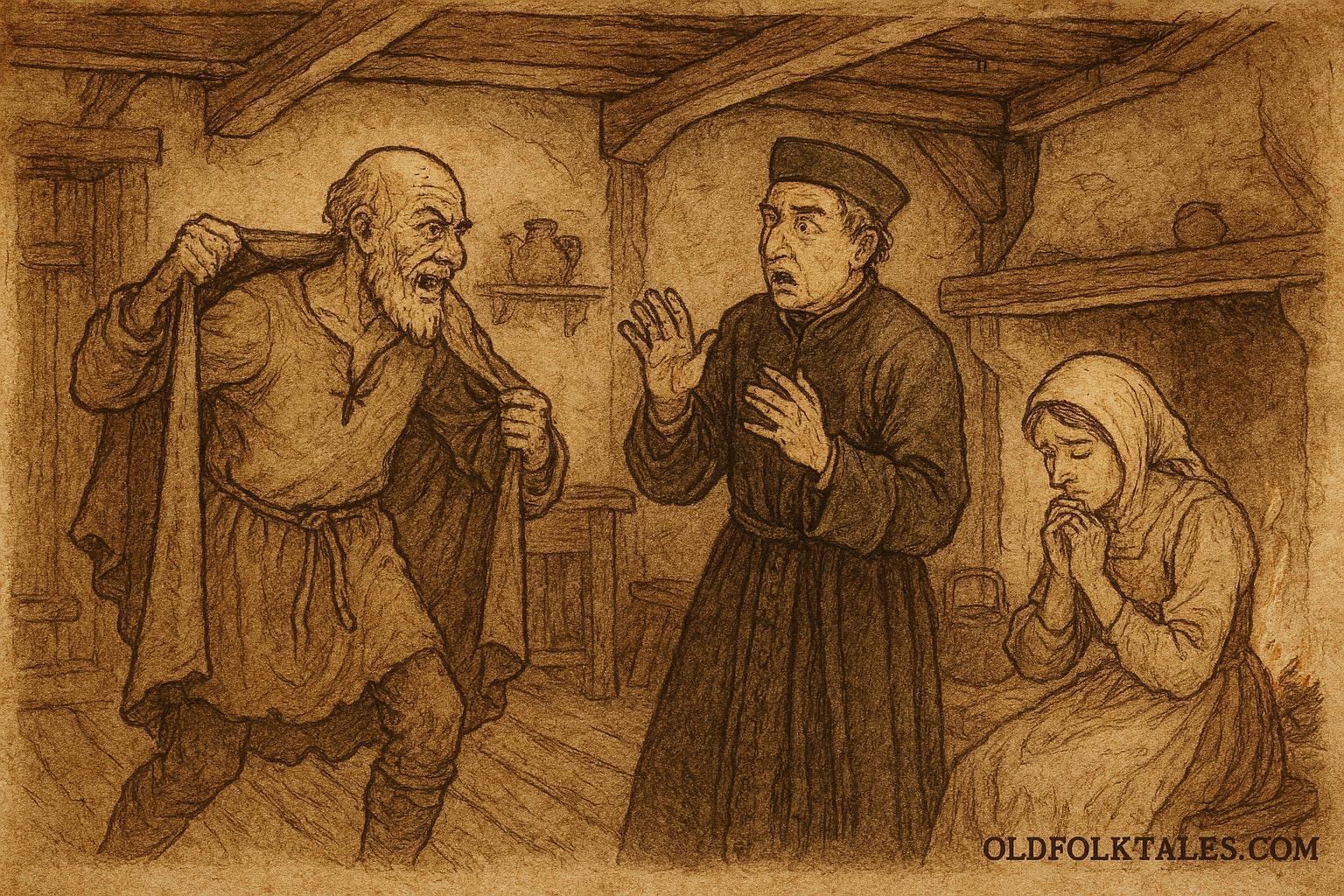
At the height of their mockery, the beggar straightened his back.
With a sudden movement, he threw off his disguise and revealed himself.
Shock froze the room.
Before either could flee or speak, Hildebrand seized a stout stick and laid into both the parson and his wife. He struck them soundly, not in blind rage, but with deliberate force, calling out their betrayal so that neighbors rushed in to see.
The village gathered quickly. Hildebrand told the full story, the false errand, the betrayal, and the plot. Faced with public shame and undeniable truth, the parson fled the village, his authority shattered. Hildebrand’s wife, exposed and disgraced, was left to bear the consequences of her actions.
Hildebrand reclaimed his home and honor. Though wronged, he had not relied on strength alone, but on wit, patience, and clarity of mind. The villagers remembered the lesson long after: cleverness, when guided by justice, can humble even those who claim power.
Moral Lesson
Old Hildebrand teaches that deception and betrayal inevitably lead to exposure. Authority and cunning cannot protect wrongdoing, and patient intelligence can overcome even deeply rooted treachery.
Knowledge Check
1. Who betrays Old Hildebrand in the story?
His wife and the local parson secretly conspire against him.
2. What false errand is Hildebrand sent on?
To fetch imaginary magical laurel leaves.
3. How does Hildebrand discover the plot?
A cousin warns him during his journey.
4. What strategy does Hildebrand use to expose the schemers?
He returns home disguised as a beggar.
5. What happens to the parson?
He is publicly exposed and forced to flee the village.
6. What core theme does the story emphasize?
Cleverness and patience overcoming betrayal and misuse of authority.
Source & Cultural Origin
Source: Brothers Grimm, Kinder- und Hausmärchen, 2nd edition (1819)
Cultural Origin: Austrian rural folk tradition