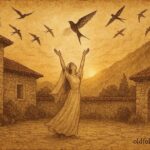
High above the meeting of rivers in northern Albania rises an ancient fortress, weathered by centuries of wind and memory. Its stones glow amber beneath the setting sun, and the people of Shkodër still speak in hushed voices of how those walls first came to stand. For they say the castle was not built by hands alone, but by sacrifice, by the courage of a woman whose name has outlived kings.
Long ago, three brothers resolved to build a great fortress on the rocky hill overlooking their homeland. The land was vulnerable, and enemies could approach from river and mountain alike. A stronghold was needed, one that would guard their people and stand as a symbol of unity and strength.
The brothers were skilled builders. From dawn until dusk, they hauled heavy stones from the riverbanks and carved blocks from the mountain’s side. Their hammers rang against rock; their voices echoed across the valley. Slowly, walls rose toward the sky.
But each morning brought despair.
When the brothers returned to their work at sunrise, they found the walls collapsed, stones scattered as though shaken loose by unseen hands. Mortar lay cracked and crumbled. Entire sections had fallen in the night. No matter how carefully they worked, no matter how firmly they set each stone, by morning their labor lay undone.
Day after day this happened.
The eldest brother muttered of curses. The middle brother spoke of hidden enemies. The youngest said little, but his heart grew heavy. They worked harder, reinforced foundations, widened the base. Still, the fortress would not stand.
Exhausted and troubled, the brothers gathered one evening beside the ruins of their labor. The sky was streaked red with twilight, and a silence hung between them that felt heavier than the stones themselves.
It was then that an old man approached.
His beard was long and white, his back bent with years, and his eyes carried a knowledge that unsettled them. He did not greet them with pleasantries. Instead, he studied the broken walls and nodded, as though confirming something long suspected.
“You build with strength,” he said quietly, “but strength alone is not enough.”
The eldest brother demanded to know what he meant. The middle brother asked if he knew who had sabotaged them. The youngest watched and waited.
The old man spoke slowly.
“No fortress will stand on this hill,” he said, “unless it is bound with living sacrifice. One of your wives must be immured within the walls. Only then will the stones hold fast.”
His words fell like thunder.
The brothers recoiled in horror. To seal a living woman within stone? It was unthinkable. The old man did not argue, nor did he press them further. He simply turned and walked away, disappearing into the growing dusk.
That night, none of the brothers slept.
They debated in whispers, torn between love and duty. If they refused, their people would remain unprotected. Without a fortress, their homeland might fall. Yet to give up a wife, how could they commit such a deed?
At last, they made a grim pact.
They would say nothing to their wives. Whichever wife brought them food at the construction site the next day would be chosen. The others would not be warned. Fate, they decided, would choose.
They swore secrecy.
Morning came, pale and uncertain.
The eldest brother waited anxiously, certain his wife would remain at home. The middle brother reassured himself with quiet hope. The youngest brother said nothing, though dread coiled within him.
As the sun rose higher, a solitary figure appeared on the winding path leading to the hill.
It was Rozafa, the youngest brother’s wife.
She walked steadily, carrying a basket of bread and water. Her face was gentle, unaware of the storm awaiting her. At home, she had a nursing infant, still small enough to cradle against her breast. She had come only to bring food and comfort to her husband.
When she saw the expressions on the brothers’ faces, she stopped.
“My husband,” she said softly, “why do you look at me so?”
The youngest brother could not meet her eyes. His voice trembled as he told her everything, the collapsing walls, the old man’s prophecy, the oath they had sworn.
As the truth unfolded, silence enveloped them.
Rozafa listened without interruption. Her face did not pale. She did not cry out. She understood the weight of what was being asked of her.
She looked beyond the men to the broken fortress walls and then out across the valley, the rivers gleaming below, the distant mountains guarding their land. She knew what this fortress meant to their people.
After a long moment, she spoke.
“If my death will make the walls stand,” she said calmly, “then let it be so.”
Her husband fell to his knees in grief, begging forgiveness. But Rozafa placed her hand upon his head.
“We do not choose the burdens given to us,” she said. “But we may choose how we bear them.”
She had only one request.
“When you seal me within the wall,” she said, “leave one breast uncovered, so that I may nurse my child. Leave one hand free, so that I may caress him. Leave one foot outside the stone, so that I may rock his cradle.”
The brothers wept openly then, for her words cut deeper than any blade. Yet they honored her wish.
They built the wall around her carefully. Stone by stone, they enclosed her within the fortress. True to her request, one breast remained exposed, one hand extended, one foot visible beyond the stone.
And then, for the first time, the walls did not fall.
Morning came, and the fortress stood firm.
The stones held fast against wind and tremor. The mortar hardened like iron. The curse, or the condition, had been fulfilled.
Below the hill, the people rejoiced. They saw only the strength of the fortress, not the sacrifice within it. But those who knew never forgot.
In time, the fortress became known as Rozafa Castle. Travelers who visited the hill claimed they could see moisture trickling down certain stones, as though the wall itself wept. Mothers would bring their children and tell them the story of the woman whose love became part of the foundation.
And so Rozafa’s name endured, not as a victim, but as a symbol of devotion beyond fear.
Her sacrifice was not born of weakness. It was an act of conscious choice, an offering made so that others might live in safety.
The fortress still stands above Shkodër, overlooking the rivers that wind through the valley. Its stones carry the weight of history, and its legend carries a deeper truth: that sometimes the strength of a nation rests not in stone, but in the courage of a single heart.
Moral Lesson
True strength is not found in power or stone walls, but in selfless love and unwavering devotion to others. Rozafa’s sacrifice reminds us that the greatest foundations are built on courage, loyalty, and compassion.
Knowledge Check
1. Why did the castle walls collapse each night in the Rozafa legend?
According to the Albanian folktale, the fortress would not stand unless a living sacrifice was immured within its walls.
2. Who was Rozafa in the legend of Shkodër?
Rozafa was the youngest brother’s wife who willingly accepted immurement to ensure the fortress would stand.
3. What did Rozafa request before being sealed into the castle wall?
She asked that one breast, one hand, and one foot remain outside so she could nurse, caress, and rock her infant child.
4. What theme does the Rozafa legend represent in Balkan folklore?
It reflects the foundation sacrifice myth, symbolizing duty, communal protection, and maternal devotion.
5. Where is Rozafa Castle located?
The castle stands in Shkodër, Northern Albania, overlooking the confluence of major rivers.
6. What is the main moral of the Rozafa story?
The legend teaches that sacrifice for the greater good and selfless love create lasting strength.
Source: Adapted from Albanian Folktales and Legends by Robert Elsie (2001).
Cultural Origin: Shkodër, Northern Albania.