In the mountain villages of Kosovo and northern Albania, where stone houses cling to hillsides and swallows nest beneath wooden eaves each spring, an old tale is still remembered. It was preserved in the twentieth century by the folklorist Anton Çetta in Përralla Popullore Shqiptare, yet its roots lie far deeper in oral tradition. It is the story of a bride who longed for love in her new home and found instead suspicion.
And of how sorrow gave her wings.
A Bride Leaves Her Father’s House
In a village set among high ridges and winding valleys, there lived a young woman known for her gentle nature. She worked quietly beside her mother, weaving wool, baking bread, and carrying water from the spring. Her laughter was soft, and her eyes steady. No one spoke ill of her.
When the time came for her marriage, arrangements were made according to custom. She would leave her father’s house and enter that of her husband, a transition both joyful and heavy with expectation.
On the day of her wedding, she wore embroidered garments stitched with care. Relatives gathered. Songs rose into the mountain air. Though she smiled, she felt the weight of departure.
To marry meant to belong elsewhere.
She crossed the threshold of her husband’s home with humility, prepared to serve, to respect, to earn affection through diligence.
But not all households are warm.
The Seeds of Suspicion
Her husband was not cruel by nature, but he was distant. Work kept him in fields and pastures from dawn until dusk. Within the house remained his mother and sisters, women who had long managed the household and did not welcome change easily.
At first, they watched the bride in silence.
Then whispers began.
“She works too slowly.”
“She does not rise early enough.”
“She does not know our ways.”
None of these claims were true. The bride woke before sunrise, swept the floors, tended the animals, kneaded bread, and carried out every task given to her.
But suspicion, once planted, grows quickly.
Small mistakes were exaggerated. Silence was interpreted as pride. Gentleness was mistaken for weakness.
The bride endured quietly.
False Accusations
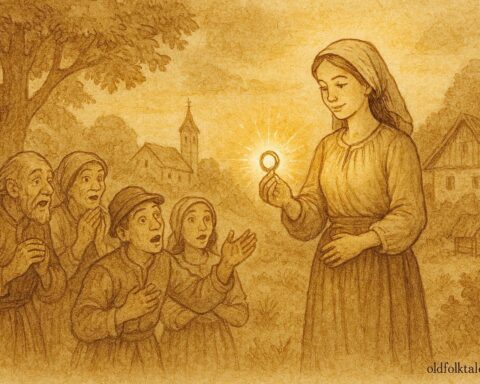
One evening, an object was found missing from the household, a small silver ornament passed down through generations.
Without proof, the mother-in-law accused the bride.
“You are newly come,” she said sharply. “You must have taken it.”
The bride protested softly.
“I have taken nothing.”
But her words carried little weight.
The sisters echoed the accusation. Their voices overlapped like harsh wind against stone.
When the husband returned and heard the claims, he hesitated.
He did not see guilt in his wife’s eyes. Yet he feared opposing his mother.
So he said nothing.
His silence wounded more deeply than any shout.
The bride felt herself alone in a house meant to be her refuge.
Sorrow in the Courtyard
Days passed, and though the missing ornament was later found where it had been misplaced, no apology came.
The suspicion remained.
The bride worked harder still, hoping effort would soften hearts. But the glances persisted. The coldness did not fade.
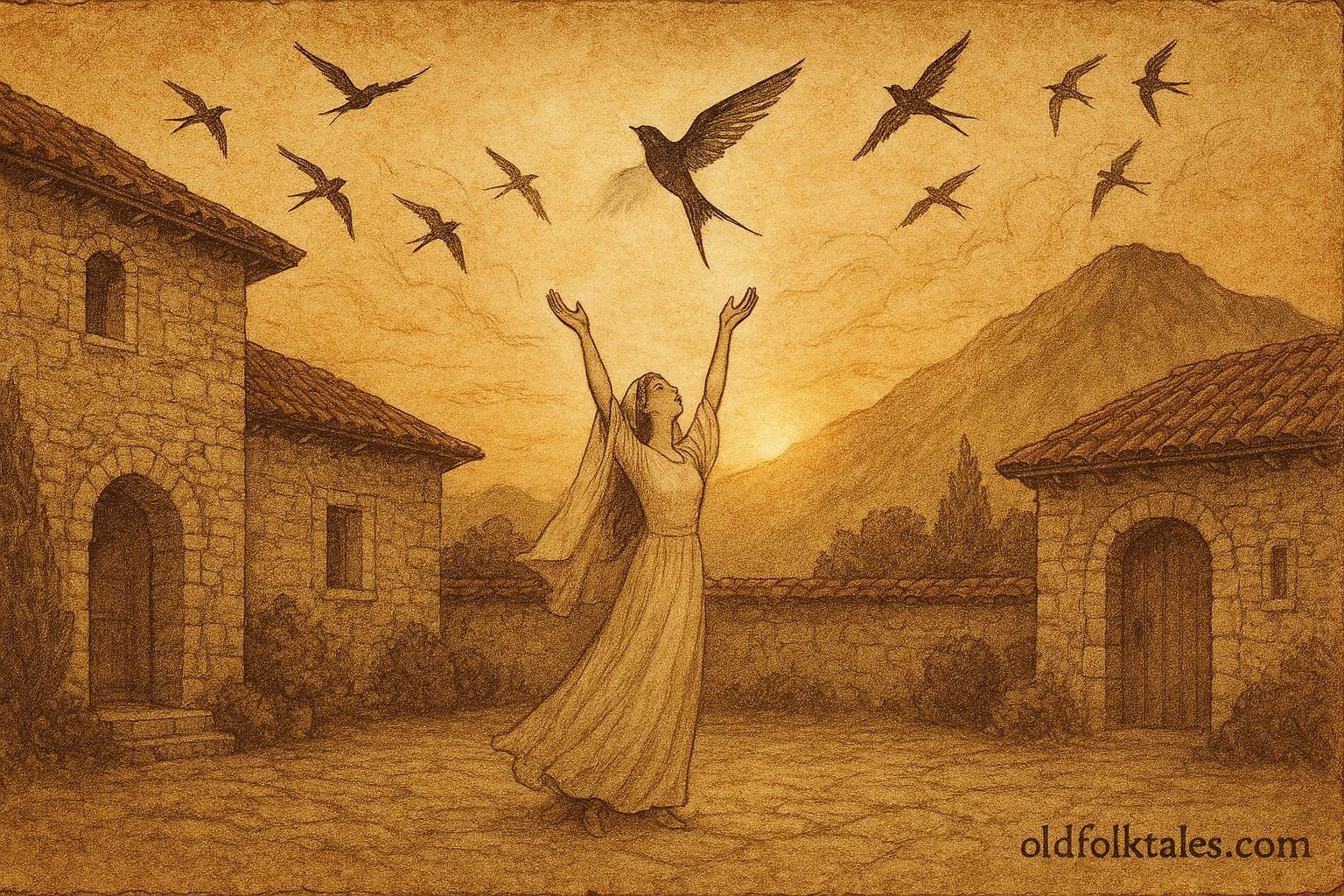
One evening, after another day of sharp words and heavy tasks, she stepped into the courtyard alone.
The sky above the mountains glowed with the last light of sunset. Swallows darted through the air, swift and free.
She watched them with longing.
“I have done no wrong,” she whispered. “Yet I am treated as if I have. If there is justice beyond this house, let it see me. If there is mercy, let it find me.”
Her voice trembled, not with anger, but with exhaustion.
She had borne humiliation without complaint. She had endured injustice without bitterness.
But her heart could endure no more.
The Prayer
In the stillness of the courtyard, she lifted her eyes toward the fading sky.
“If I cannot live here in peace,” she prayed softly, “then release me. Let me be free of this sorrow. Let me rise above it.”
The wind shifted gently.
The swallows circled lower.
Her tears fell onto the stone at her feet.
And in that moment, between daylight and darkness, her prayer was answered.
Transformation
A strange lightness came over her body. The heaviness in her chest lifted. The sharp ache of humiliation dissolved into something distant and faint.
Her arms felt weightless.
Her breath quickened.
The world seemed to tilt upward.
Before the house and mountains and courtyard could settle into understanding, she was no longer standing upon the ground.
Where the bride had stood, a swallow rose into the evening air.
Small. Dark-winged. Swift.
She circled the house once.
Twice.
Her cry rang clear, neither mournful nor joyful, but resolute.
Within the house, the family heard the sound and stepped outside.
They saw the swallow darting above the roof, tracing circles that never strayed far.
The husband looked upward.
A chill passed through him.
He felt suddenly the absence of something precious.
Realization Too Late
The courtyard lay empty.
No bride stood among the stones.
No footsteps marked her leaving.
Only the swallow wheeled through the sky, again and again, above the place where she had once hoped to be welcomed.
The mother-in-law grew pale.
The sisters fell silent.
And the husband, understanding at last the cost of his silence, lowered his head in regret.
But transformation cannot be undone by remorse.
From that day forward, the swallow returned each spring, circling the house in swift arcs before building her nest beneath the eaves.
She did not enter the doorway.
She did not perch upon the windowsill.
She remained above, watchful, distant, untouchable.
The Meaning of the Swallow
In Kosovo and northern Albanian tradition, the swallow is often seen as a bearer of memory, returning faithfully each year to the same roof.
In this tale, the swallow represents endurance and spiritual transcendence. The bride does not perish. She rises.
Her transformation is not revenge.
It is release.
Those who wronged her must live with what they lost. She, though altered, remains near yet beyond their reach.
The story carries both sorrow and dignity.
Innocence persecuted may suffer, but it is not destroyed.
Moral Lesson
The Bride Who Became a Swallow teaches that injustice leaves lasting consequences. Silence in the face of wrongdoing deepens harm. Yet endurance and innocence possess a quiet strength that rises above cruelty.
Knowledge Check
1. Who preserved this folktale in written form?
Anton Çetta in Përralla Popullore Shqiptare (1958).
2. What injustice does the bride suffer?
She is falsely accused and mistreated by her husband’s family.
3. How does the husband contribute to the tragedy?
Through silence and failure to defend her.
4. What transformation occurs in the story?
The bride becomes a swallow after praying for escape.
5. What does the swallow symbolize?
Endurance, spiritual release, and memory.
6. Where does this folktale originate?
Kosovo and northern Albanian oral tradition.
Source: Anton Çetta, Përralla Popullore Shqiptare, 1958.
Cultural Origin: Kosovo and Northern Albanian oral tradition.