Deep in the countryside of Norfolk stands the stately manor known as Raynham Hall. Surrounded by rolling fields and ancient trees, the estate has long been admired for its elegant architecture and noble history.
Yet among England’s great houses, Raynham Hall is known not only for its beauty but also for one of the most famous ghost stories ever recorded.
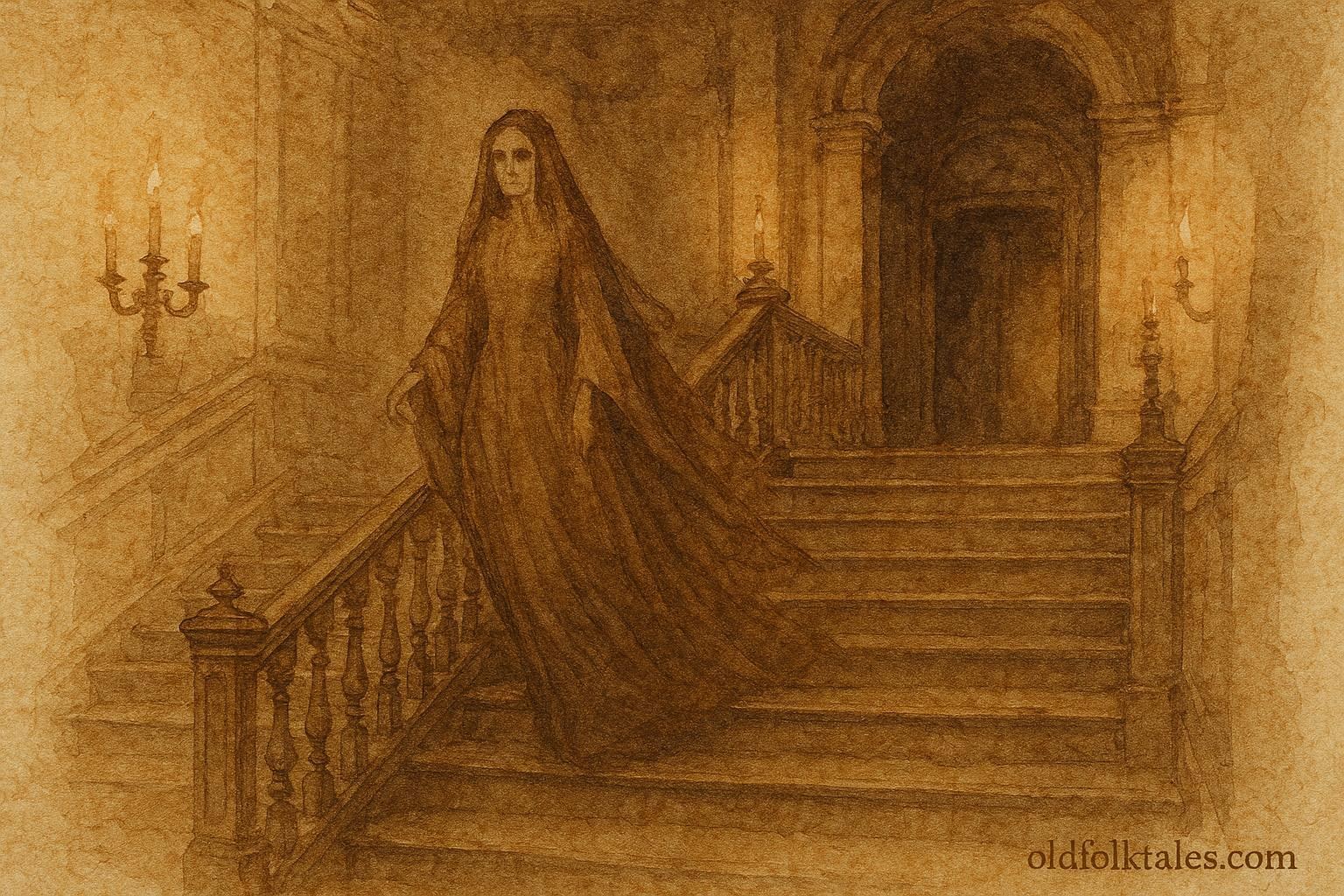
For generations, visitors and residents alike have spoken of a mysterious apparition that wanders the mansion’s grand staircase.
She is known simply as The Brown Lady.
According to legend, the ghost is believed to be the spirit of Dorothy Walpole, a woman whose life was shadowed by sorrow and misfortune.
Dorothy Walpole lived during the early eighteenth century and was the sister of Robert Walpole. Known for her beauty and charm, she married Charles Townshend, an influential nobleman and owner of Raynham Hall.
At first, the marriage appeared promising.
The couple lived in the grand estate, surrounded by servants, lavish furnishings, and the expectations of aristocratic life.
But happiness, according to the legend, did not last.
Stories suggest that Lord Townshend became jealous and suspicious of his wife, believing she had betrayed him. Whether the accusations were true or merely the result of his temper remains uncertain.
What is widely believed in the tale, however, is that Dorothy’s life soon became one of loneliness and confinement.
Some versions of the story claim that she was effectively imprisoned within the walls of Raynham Hall, forbidden to leave the estate and separated from the outside world.
In those vast rooms and silent corridors, her days reportedly passed in isolation.
When Dorothy died, tragedy did not end with her burial.
Not long after, strange stories began to circulate among the household staff.
Servants whispered of footsteps echoing in empty hallways late at night. Doors seemed to creak open without cause, and the soft rustle of silk could sometimes be heard near the staircase.
Then came the first sightings.
A woman dressed in brown silk was seen gliding silently along the corridor.
Her face appeared pale and sorrowful, and her eyes seemed hollow with grief.
Those who claimed to see her said the figure moved slowly and deliberately, as if wandering through memories that could not be escaped.
Before anyone could approach her, the figure would vanish.
The sightings became part of the house’s quiet lore.
Years passed, and new residents arrived, yet the mysterious woman in brown was still reported from time to time.
Some visitors claimed to glimpse her descending the grand staircase, her flowing gown trailing behind her as she moved between shadow and candlelight.
Others believed they saw her standing silently at the top of the stairs, watching those below.
Among the most remarkable events connected to the legend occurred in 1936, when the ghost was said to have been captured in a photograph.
Two photographers working for Country Life were visiting Raynham Hall to document the estate.
While photographing the grand staircase, they suddenly noticed what appeared to be a strange figure descending the steps.
One of the photographers quickly captured the moment.
The resulting image appeared to show a ghostly woman drifting down the staircase, her form blurred yet unmistakably human.
The photograph became one of the most famous ghost images ever published.
To believers, it was proof that the Brown Lady truly haunted Raynham Hall.
To skeptics, it was an illusion or photographic trick.
Yet regardless of explanation, the story spread far beyond Norfolk.
The legend of the Brown Lady soon became one of England’s most famous ghost tales.
Even today, Raynham Hall remains surrounded by stories of unexplained events.
Visitors have reported sudden chills, faint whispers, or the sensation of being watched while standing near the staircase.
A few claim to have seen the mysterious figure herself.
She appears dressed in brown silk.
Her expression is distant and mournful.
And just as suddenly as she appears, she fades back into shadow.
Whether ghost, legend, or misunderstood memory, the story of the Brown Lady continues to linger within the walls of Raynham Hall.
The house itself stands as a reminder that the past is never entirely gone.
Some stories remain, echoing through corridors long after the people who lived them have vanished.
And in the quiet halls of Raynham Hall, many still believe that the sorrowful spirit of Dorothy Walpole continues her silent walk down the staircase.
Moral Lesson
The legend of the Brown Lady reminds us that betrayal and sorrow can leave deep marks on human memory. Stories of the past often endure not only because they frighten us, but because they reflect the emotional truths of the lives once lived.
Knowledge Check
1. Where does the legend of the Brown Lady take place?
At Raynham Hall.
2. Who is believed to be the Brown Lady?
She is thought to be the spirit of Dorothy Walpole.
3. Why is the ghost called the Brown Lady?
Because witnesses describe her wearing a brown silk dress.
4. What tragic story is connected to the legend?
According to tradition, Dorothy Walpole suffered isolation and sorrow within the estate.
5. What event in 1936 made the legend famous worldwide?
A photograph allegedly showing the ghost was published by Country Life.
6. Why is the Brown Lady considered one of England’s most famous ghosts?
Because of the widely circulated photograph and long-standing reports of sightings at Raynham Hall.
Source: Ghost lore documented in Country Life (1936) and earlier English ghost traditions, 1936 (famous photograph; earlier oral tradition).
Cultural Origin: Norfolk, England