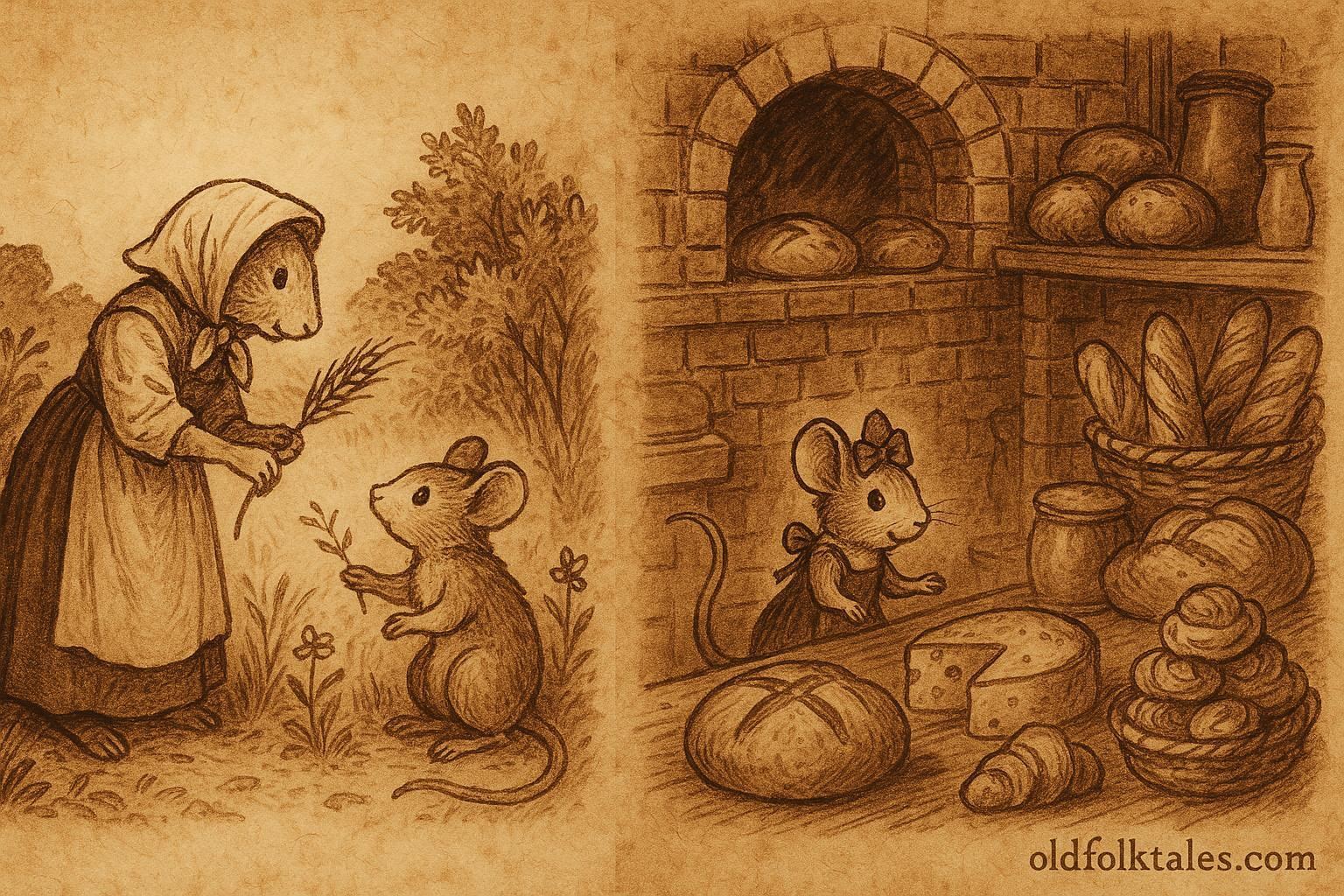
In the quiet meadows of Burmerange, nestled in the southern Luxembourg countryside, lived a small, humble mouse named Ketti. She was known throughout the fields for her modest ways, cheerful heart, and simple habits. Her days were spent gathering grains, seeds, and bits of fruit from the orchards nearby. Life was peaceful, if not a little plain, but Ketti loved it dearly.
Explore the wit and wisdom of Western Europe, where humor and virtue often go hand in hand
Her home was a snug burrow at the foot of a hedgerow, lined with dried leaves and soft moss. In the mornings, she would peek out to see the dew glistening on the grass, and at night, she listened to the crickets sing under the moonlight. Ketti needed nothing more to be happy, she was content in her little world.
One sunny afternoon, while she was sorting acorns, a familiar voice called out from behind a blade of grass. “Cousin Ketti!” The voice was bright, polished, and full of excitement. Out from the field path appeared Mim, Ketti’s cousin from Luxembourg City, wearing a tiny ribbon and a confident smile.
“Ketti, it has been far too long!” Mim exclaimed, brushing off the dust from her sleek gray fur. “Still living here among dirt and weeds, I see.”
Ketti giggled and replied kindly, “Yes, Mim. It may not be grand, but it’s home. What brings you here from the city?”
“I wanted to visit my dear cousin,” said Mim with a glint in her eye, “and to invite you to see my home. You wouldn’t believe the things I have seen! Soft bread, creamy cheese, sweet pastries, all left on great tables in shining rooms. You must come, Ketti. Life in the city is full of pleasure and fine food. You will never want to eat dry grains again.”
Ketti hesitated. She loved her quiet life, but the way Mim described the city stirred a spark of curiosity. “It does sound wonderful,” she said. “Perhaps I will visit, just for a day.”
And so, the next morning, the two cousins set off toward Luxembourg City. They crossed meadows, fields, and cobbled roads until the countryside gave way to stone walls and tall buildings. The noise of carts and people filled Ketti’s ears; the air smelled of bread, smoke, and the faint scent of adventure.
When they reached Mim’s home in Clausen, it was unlike anything Ketti had ever seen, a cozy nook behind a grand kitchen. The shelves above were stacked with loaves of bread, wheels of cheese, and plates filled with cakes and meats. Ketti’s eyes widened. “Oh, Mim! This is a feast fit for a king!”
Mim grinned proudly. “Help yourself, cousin. This is how we live in the city.”
The two mice climbed onto the table and nibbled happily on crumbs of sweet tart and bits of sausage. Never had Ketti tasted such richness! Her heart fluttered with delight, and she thought for a moment that Mim might be right, that this was indeed the good life.
But just as she was about to take another bite, the room trembled with a loud thud. The kitchen door creaked open. In came a giant human cook, humming as she carried a basket of bread. Ketti froze. The woman’s footsteps were thunderous, and before they could hide, a shadow loomed above them, a cat, yellow-eyed and silent, watching from the corner.
“Run, Ketti!” Mim squeaked. Both mice darted across the table, leaping over spoons and dishes as the cat pounced. A plate crashed to the floor; crumbs scattered like raindrops. Heart pounding, Ketti followed Mim through a crack in the wall, barely escaping with her tail intact.
In the darkness of the hole, Ketti gasped for breath. “Mim… how can you live like this? The food may be fine, but the danger, oh, the danger!”
Mim tried to laugh, though her whiskers trembled. “You get used to it, cousin. It’s just part of city life.”
But Ketti shook her head. “No, Mim. I would rather eat plain seeds in peace than feast in fear. I think I’ll return to my quiet fields.”
Mim looked at her cousin sadly but nodded in understanding. “Perhaps you’re right, Ketti. I do miss the calm of the countryside sometimes.”
As dawn broke the next day, Ketti began her journey home. The air grew cleaner, the sounds gentler. When she finally reached her little burrow by the hedgerow, she sighed with relief. She nibbled on a kernel of corn, smiling to herself. “It may not be much,” she said softly, “but it is mine, and it is safe.”
From that day onward, Ketti never longed for city luxuries again. She worked happily in her fields, grateful for her simple meals and the quiet hum of nature. And though she still thought fondly of her cousin Mim, she knew that peace of mind was worth more than all the pastries in Luxembourg City.
Explore the wit and wisdom of Western Europe, where humor and virtue often go hand in hand
Moral Lesson
The story of Ketti and Mim reminds us that true happiness lies not in wealth or luxury but in contentment and safety. A simple, peaceful life often holds more joy than one filled with constant danger and desire.
Knowledge Check
- Who are the main characters in “The Field Mouse Ketti and the City Mouse Mim”?
The main characters are Ketti, a humble field mouse from Burmerange, and Mim, her cousin from Luxembourg City. - What is the main contrast in the story?
The story contrasts rural simplicity and safety with urban luxury and danger. - What lesson does Ketti learn from visiting the city?
Ketti learns that peace and security are more valuable than wealth or fine food. - Where is this Luxembourgish folktale set?
The tale is set between Burmerange in the countryside and Clausen in Luxembourg City. - Who wrote the original story of Maus Ketti?
The story was written by Auguste Liesch in 1936 and is one of Luxembourg’s most beloved folk tales. - Why is “D’Maus Ketti” important in Luxembourgish culture?
It is a classic Luxembourgish children’s tale, teaching timeless moral values while celebrating the country’s language and traditions.
Source: Adapted from “D’Maus Ketti” by Auguste Liesch (1936).
Cultural Origin: Luxembourgish Folklore (Burmerange & Luxembourg City, Luxembourg).