In the age when Europe’s sailors began venturing into the vast unknown oceans, the southern tip of Africa held a reputation darker and more terrifying than any other place on the sea. There, where powerful currents clashed and towering waves rose like mountains, lay the dreaded Cape of Good Hope.
To the sailors of Portugal, the region was once known as the Cape of Storms.
Discover the moral heart and wild spirit of the north through timeless Nordic storytelling
Ships that ventured too close often vanished into the roaring waters. Masts snapped like twigs. Sails were torn away by furious winds. Many vessels disappeared entirely, swallowed by the sea without leaving even a broken plank behind.
Because of this, sailors whispered a legend during long nights at sea. They believed a colossal being lived within the storm clouds surrounding the cape, a giant older than the oceans themselves.
His name was Adamastor.
Some said he had once been a titan cast down by the gods. Others believed he was the spirit of the ocean’s fury given form. Whatever his origin, sailors agreed on one thing: Adamastor guarded the dangerous waters and despised those who dared to challenge the sea.
For generations, Portuguese sailors feared sailing beyond that point.
But the spirit of exploration was stronger than fear.
During the late 1400s, Portugal was determined to discover a sea route to India. Spices, silk, and distant wonders lay beyond the oceans, and brave navigators believed the route could be found by sailing around Africa.
Many tried.
Many failed.
Yet one man refused to turn back.
His name was Vasco da Gama.
In 1497, da Gama led a fleet of ships southward along the coast of Africa. His sailors were experienced men, but even they felt uneasy as the ships approached the infamous cape.
The winds grew colder.
The sky darkened.
The sea began to rise in towering waves that crashed against the hulls with thunderous force.
The sailors exchanged nervous glances. Some crossed themselves. Others whispered prayers to saints for protection.
They knew the stories.
They knew whose waters these were.
Night fell, and the storm intensified.
Lightning split the sky, illuminating enormous waves that surged like living creatures in the darkness. The fleet struggled to maintain its course as winds howled like angry spirits.
Suddenly, the clouds above the ships twisted and swirled in unnatural shapes.
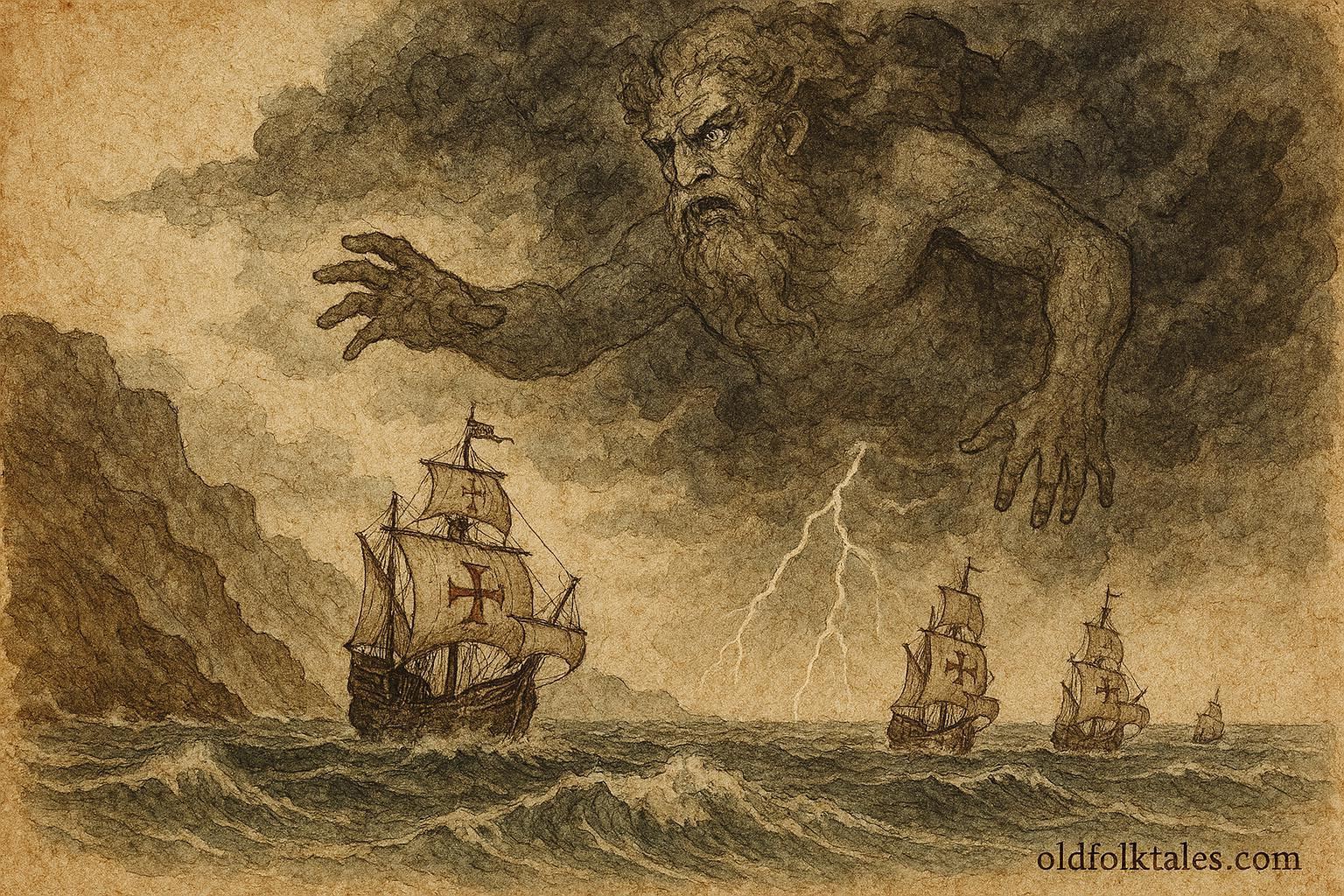
From the heart of the storm, a massive shadow began to form.
The sailors stared upward in horror.
Slowly, impossibly, the clouds took the shape of a gigantic figure.
A face emerged from the thunderheads, ancient, furious, and enormous beyond imagination. His eyes burned like distant lightning, and his beard was formed from dark swirling mist.
The giant had awakened.
Adamastor had risen.
His voice boomed across the sea like the crash of a thousand waves.
“Who dares sail through my waters?”
The ships trembled as if the ocean itself had spoken.
The sailors fell to their knees in terror.
“I am Adamastor,” the giant roared, his voice echoing through the storm. “Guardian of these seas and lord of the Cape of Storms. Many have tried to pass this place. Many have been swallowed by the ocean for their arrogance.”
Lightning flashed across his towering form.
The giant leaned closer to the fleet, his immense presence filling the sky.
“And yet you sail onward,” he thundered. “Why?”
For a moment, silence hung over the stormy sea.
Then Vasco da Gama stepped forward on the deck of his ship.
Though the winds howled around him, he stood firm.
“We sail not from arrogance,” he replied, raising his voice above the storm. “We sail to discover what lies beyond these waters. The ocean was not made to imprison mankind in fear.”
The giant’s eyes narrowed.
“You challenge the ocean itself,” Adamastor said slowly. “You challenge the unknown.”
The waves crashed harder against the ships, as if the sea itself had become angry.
“You do not understand the dangers that await,” the giant continued. “These waters have broken kings and swallowed fleets. Storms will rise against you. Shores will betray you. Many of your men will never see their homes again.”
Some sailors trembled at the giant’s warning.
But da Gama did not retreat.
“Every voyage carries danger,” he answered. “But courage carries us forward.”
For a long moment, the giant studied the fleet.
The storm raged around him, yet his voice grew quieter, almost sorrowful.
“You remind me of another time,” Adamastor said.
The sailors looked at one another in confusion.
The giant’s gaze turned toward the distant horizon.
“I was not always a monster of storms,” he said.
His story poured from the clouds like rain.
Long ago, Adamastor had been a mighty titan who fell in love with a sea goddess. But the gods forbade their union, punishing him for daring to love beyond his place.
In his anger and sorrow, Adamastor rebelled against the heavens.
The gods struck him down and condemned him to wander the oceans forever.
Over time, his body became part of the storm itself, and he became the spirit of the cape’s violent seas.
“I guard these waters not only out of fury,” the giant said, “but out of grief.”
The sailors listened in silence.
Adamastor turned once more toward the fleet.
“You seek to pass my domain,” he said. “But know this: the ocean will never belong to mankind.”
The storm surged again.
“Even if you succeed, countless dangers await you. The sea is vast and merciless. Many explorers will follow your path, and many will perish.”
Lightning flashed across the sky one final time.
“But if you possess the courage you claim,” Adamastor said, “then sail on.”
The giant slowly began to dissolve back into the storm clouds.
“Remember my warning,” his voice echoed as his form faded.
“Respect the sea… or it will destroy you.”
Moments later, the storm began to weaken.
The winds calmed.
The waves slowly settled into long rolling swells.
The sailors looked around in disbelief.
The giant had vanished.
The fleet continued its journey around the cape, eventually reaching the Indian Ocean and completing one of the greatest voyages in maritime history.
Yet the legend of Adamastor never faded.
For generations afterward, sailors spoke of the giant who rose from the storm clouds to warn explorers about the dangers of the sea.
Even today, when violent storms gather around the Cape of Good Hope, some sailors say they can still see a massive shadow within the clouds.
A shadow watching the ships below.
A guardian reminding humanity that the ocean, no matter how much we explore it, will always remain wild, powerful, and mysterious.
Moral Lesson
The story of Adamastor reminds us that human courage can challenge the unknown, but nature must always be respected. Exploration brings discovery, yet the forces of the world remain far greater than any single traveler.
Knowledge Check
1. Who was Adamastor?
A mythical sea giant believed to guard the stormy waters around the Cape of Good Hope.
2. Which explorer encountered the giant?
Portuguese navigator Vasco da Gama.
3. What did Adamastor warn the sailors about?
He warned them of the many dangers and tragedies that awaited explorers on the sea.
4. What does the giant symbolize?
The immense power and unpredictability of nature.
5. Where does this legend originate?
It appears in Os Lusíadas, a famous Portuguese epic poem celebrating the Age of Exploration.
Source: Os Lusíadas by Luís de Camões, 1572
Cultural Origin: Portuguese Age of Discoveries tradition