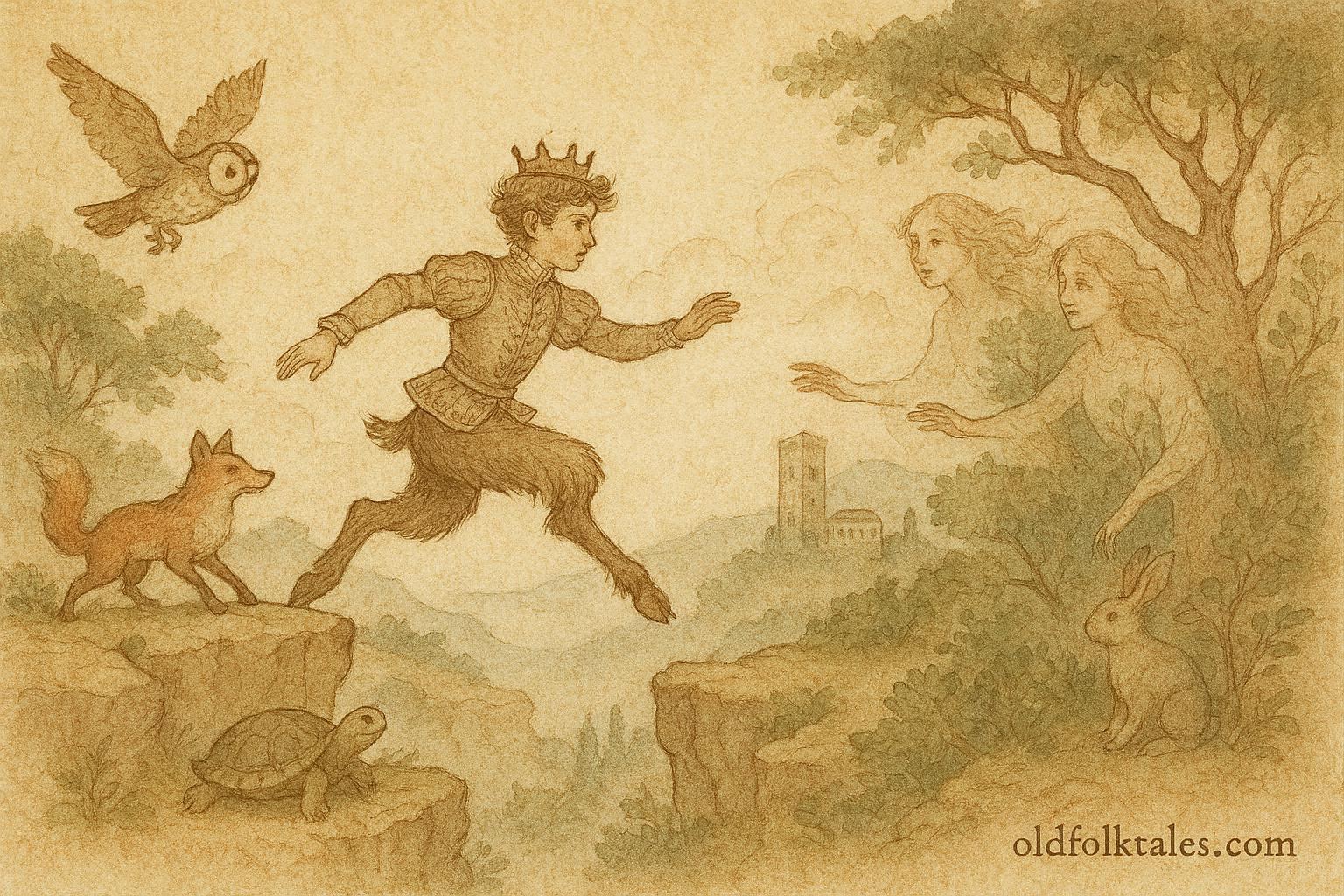
In the sun-drenched hills of the Kingdom of Naples, where olive groves shimmered silver in the wind and the scent of wild herbs drifted through the valleys, a remarkable child was born. This child, a prince, did not resemble ordinary humans: he had the upper body of a boy but the legs and hooves of a goat. The kingdom’s court whispered in astonishment, for the child was both royal and cursed, a living reminder that fate can be cruel, yet providence can shine through courage and cleverness.
His parents, the king and queen, were grief-stricken yet devoted. They named him Prince Caprino, or the Goat-Footed Prince, and sought remedies from wise women, alchemists, and holy men. Though they tried all potions, charms, and spells, nothing could lift the curse.
The boy grew in a palace surrounded by lush gardens and fragrant orange groves, often wandering alone, his hooves clicking softly against marble floors. He was shunned by some of the court, yet admired by a few loyal servants who recognized his keen mind, courage, and gentle heart.
From an early age, Caprino discovered that his unusual legs granted him agility unmatched by ordinary humans. He could leap across walls, scale rocky cliffs, and move with a silent swiftness that left even the palace guards astonished. But more importantly, he cultivated cleverness and patience, understanding that intellect could serve as a shield where strength alone might fail.
One evening, the kingdom was threatened by a great danger: a neighboring prince demanded tribute, threatening war unless the king’s daughter, a beautiful and wise princess, was given in marriage. Many knights volunteered to undertake dangerous quests to protect the kingdom and avert disaster, but all feared the rival’s cunning traps and monstrous guardians.
Prince Caprino, though young and cursed in form, stepped forward. “I shall undertake this quest,” he declared, his voice calm yet resolute. “I may be cursed, but my wits and courage are true.”
The king, torn between fear and hope, agreed, providing Caprino only with a satchel containing bread, water, and a small bag of gold. “Go with caution, my son,” the king said. “And remember, true courage is measured by heart and cleverness, not strength alone.”
Caprino departed at dawn, traversing olive groves, rocky cliffs, and dense forests. Along the way, he encountered magical animals: a golden eagle perched atop a crag, a cunning fox with eyes like molten amber, and a wise tortoise that spoke in riddles. Each offered guidance, for they recognized the purity of his intent and the intelligence of his mind.
The first challenge came at a bridge guarded by a monstrous serpent. Its scales glittered like obsidian, and its eyes burned with fiery hatred. Ordinary knights would have charged, but Caprino observed carefully. He noted the serpent’s pattern of movement and, recalling the counsel of the fox, devised a clever plan.
He rolled a boulder across the bridge, forcing the serpent to strike at shadows, then leapt with his goat-like agility onto a high ledge beyond its reach. From this vantage, he used a mirror of polished bronze to reflect sunlight into the serpent’s eyes, blinding it temporarily. Seizing the moment, he dashed past, leaving the serpent thrashing in confusion.
Further along, Caprino encountered a forest enchanted with illusions, designed to trap travelers in endless loops. Trees appeared to move, paths twisted unnaturally, and whispers misled the mind. Here the tortoise’s advice proved invaluable: “Do not trust what you see. Trust what you feel, and follow the natural signs.” By observing the moss, the wind, and the flight of birds, Caprino discerned the correct path and emerged unscathed.
Finally, he reached the fortress of the rival prince. The walls were lined with guards, traps, and a moat of enchanted water that could freeze or boil at will. Caprino remembered the golden eagle, which circled above, observing every movement. With the eagle’s guidance, he navigated the walls using leaping agility, avoided traps by detecting subtle cues, and slipped into the fortress under the cover of night.
There, he discovered the princess imprisoned in a tall tower, her chains bound by magical iron that resisted ordinary tools. Caprino, however, had brought no key, only cleverness and courage. Using his knowledge of knots, levers, and leverage, he manipulated the chains, freed her, and guided her down a secret stairway he discovered hidden behind a tapestry depicting a mythical hunt.
Together, they fled the fortress as dawn’s light broke over the hills. The rival prince’s men pursued them, but the magical animals Caprino had helped along his journey appeared: wolves, eagles, and foxes formed obstacles, while forest spirits whispered illusions to misdirect the pursuers.
As the princess and Caprino returned to the kingdom, the curse that had afflicted the prince was lifted. The magical trials, the courage displayed, and the harmony he maintained with animals and spirits had proven his worth. His goat legs transformed into human limbs, strong and noble, reflecting not only his royal heritage but the virtues earned through his trials.
The king and queen rejoiced, and the princess, grateful and admiring his bravery and intelligence, accepted Caprino as her husband. The kingdom celebrated not only the lifting of the curse but the triumph of cleverness, courage, and moral integrity over adversity.
In the years that followed, tales of the Goat-Footed Prince traveled through the hills and villages of Naples. Parents told children of the young prince who, though cursed at birth, had overcome every trial through wisdom, courage, and the help of magical allies. Travelers whispered of his agility, cleverness, and gentle heart, emphasizing that true heroism arises not from strength alone, but from perseverance, wit, and the courage to act justly.
Even now, the hills of Naples are said to echo faintly with the memory of a goat-footed prince leaping across cliffs, guided by stars, animals, and unseen spirits, an enduring reminder that misfortune can be overcome, true identity revealed, and honor and virtue rewarded.
Moral Lesson
The Goat-Footed Prince teaches that misfortune and curses do not define one’s worth. Courage, cleverness, perseverance, and harmony with nature and magical allies can overcome the greatest obstacles. True identity and reward come to those who act with intelligence, heart, and virtue.
Knowledge Check
1. Who is the Goat-Footed Prince?
A prince born with goat legs due to a curse, named Caprino, who completes dangerous quests through courage and cleverness.
2. How does Caprino overcome the serpent and the enchanted forest?
He uses observation, clever tricks, and guidance from magical animals to navigate and defeat obstacles.
3. Who helps Caprino during his quests?
A golden eagle, a cunning fox, a wise tortoise, and other magical animals and spirits of the forest.
4. How is the curse lifted?
By proving courage, intelligence, and moral virtue through completing dangerous quests and rescuing the princess.
5. Where does this folktale originate?
Kingdom of Naples, Southern Italy; collected in Lo cunto de li cunti by Giambattista Basile (1634–1636).
6. What is the central theme of the story?
Overcoming misfortune, courage and perseverance, and the triumph of intelligence and virtue over adversity.
Source: Lo cunto de li cunti by Giambattista Basile, 1634–1636
Cultural Origin: Kingdom of Naples (Southern Italy)