Among the famous fairy tales preserved by Jacob Grimm and Wilhelm Grimm is the story of The Goose Girl, a powerful tale from the folklore of Germany.
It tells of a young princess who is betrayed by her own servant during a royal journey. Forced to live as a humble goose keeper, she endures hardship with patience and dignity until magical signs reveal the truth and justice is finally served.
Discover the spiritual depth and wisdom hidden in the ancient folklore of Eastern and Balkan Europe
The story reminds listeners that deceit may succeed for a time, but honesty and integrity will ultimately prevail.
The Princess’s Journey
Long ago, a princess prepared to travel to a distant kingdom where she was to marry a prince she had never met.
Her mother, the queen, arranged the journey carefully and provided her daughter with a faithful maid to accompany her along the road.
Before leaving, the queen gave the princess a small handkerchief marked with three drops of blood.
“This will protect you,” the queen said. “As long as you keep it with you, no harm will come.”
With this charm in her possession, the princess set out on horseback toward the foreign land where her future awaited.
The Maid’s Betrayal
During the long journey, the princess and her maid stopped beside a stream to rest.
When the princess asked her maid to fetch water for her, the servant refused.
Instead, she ordered the princess to fetch the water herself.
This strange behavior shocked the princess, but she quietly obeyed.
When she bent over the stream, the protective handkerchief slipped from her dress and was carried away by the current.
Without the magical protection, the princess suddenly found herself vulnerable.
Seeing her opportunity, the maid forced the princess to exchange clothes and swear an oath of silence.
From that moment on, the maid pretended to be the royal bride while the true princess was forced to ride behind her as a servant.
Arrival at the Royal Court
When they arrived at the distant kingdom, the false princess was welcomed with honor by the court.
The king believed she was the royal bride promised to his son.
Meanwhile, the true princess was ignored and treated as a mere servant.
Because she appeared to be of low rank, she was given the task of tending the royal geese in the fields outside the castle.
There she worked alongside a young goose boy named Conrad.
Though she performed her duties faithfully, sadness filled her heart.
Yet she kept her promise of silence.
The Talking Horse
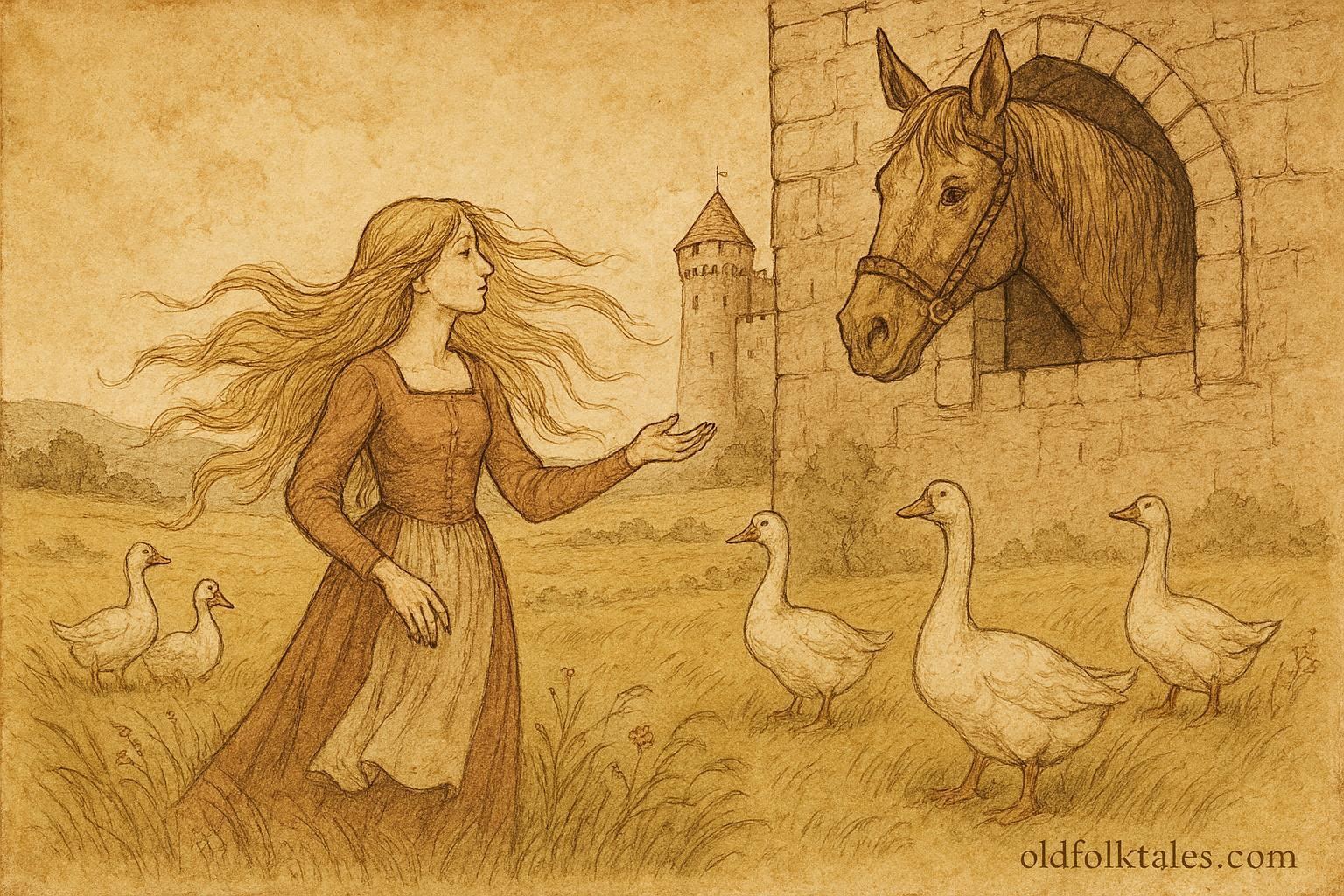
One secret witness remained from the journey, the princess’s faithful horse named Falada.
Fearing that the horse might reveal the truth, the false princess ordered that Falada be killed.
But even after death, the loyal horse continued to help his true mistress.
Falada’s head was hung above the dark gate through which the goose girl passed each morning.
Whenever she walked beneath it, she spoke softly to the horse.
“O Falada, hanging there so high.”
And the horse’s head answered:
“O princess, passing by below,
If your mother knew your sorrow,
Her heart would surely break in two.”
The Wind and the Golden Hair
Each day, the goose girl and Conrad drove the geese into the fields.
When the princess brushed her beautiful golden hair, Conrad often tried to pluck a strand from her head.
But she would call upon the wind to help her.
“Blow, wind, blow,” she would say,
“Carry Conrad’s hat away,
Let him chase it far and wide
Till my golden hair is tied.”
The wind would lift Conrad’s hat and carry it across the field, giving the princess time to braid her hair in peace.
Conrad soon grew suspicious of these strange events and reported them to the king.
The King’s Discovery
Curious about Conrad’s story, the king decided to observe the goose girl himself.
Hidden nearby, he watched as the girl spoke to the horse’s head and commanded the wind.
Realizing something was deeply wrong, the king questioned her about her past.
At first, she refused to speak, bound by her oath.
Finally, the king instructed her to tell her story to an old iron stove in the castle kitchen.
Believing she spoke only to the silent stove, the princess revealed everything, her journey, the lost handkerchief, and the maid’s betrayal.
But the king had been listening from behind the stove.
Now he knew the truth.
Justice Revealed
The king summoned the false princess and asked what punishment should be given to someone who betrayed her royal mistress.
Believing she spoke about another person, the maid suggested a cruel punishment.
The king then revealed that she had described her own fate.
The false princess was punished for her deception.
The true princess was restored to her rightful place and married the prince as originally intended.
Her patience, honesty, and dignity had finally been rewarded.
Experience legends where mountains breathe magic and heroes face moral choices that shape destiny
Moral Lesson
The story of The Goose Girl teaches that truth cannot remain hidden forever. Even when deception seems successful, honesty and loyalty eventually reveal the truth. The tale also reminds us that integrity and patience in times of hardship lead to justice in the end.
Knowledge Check
1. What magical object does the queen give the princess for protection?
A handkerchief marked with three drops of blood.
2. What causes the princess to lose her protection?
The handkerchief falls into a stream and is carried away.
3. Who betrays the princess during the journey?
Her maid, who forces her to exchange identities.
4. What task is the true princess given at the castle?
She becomes a goose keeper.
5. What unusual sign helps reveal the truth?
The princess speaks with the head of her horse Falada and commands the wind.
6. Which collectors preserved this famous tale?
Jacob Grimm and Wilhelm Grimm in Kinder- und Hausmärchen (1815).
Source: Kinder- und Hausmärchen by Jacob Grimm and Wilhelm Grimm (1815)
Cultural Origin: German folklore