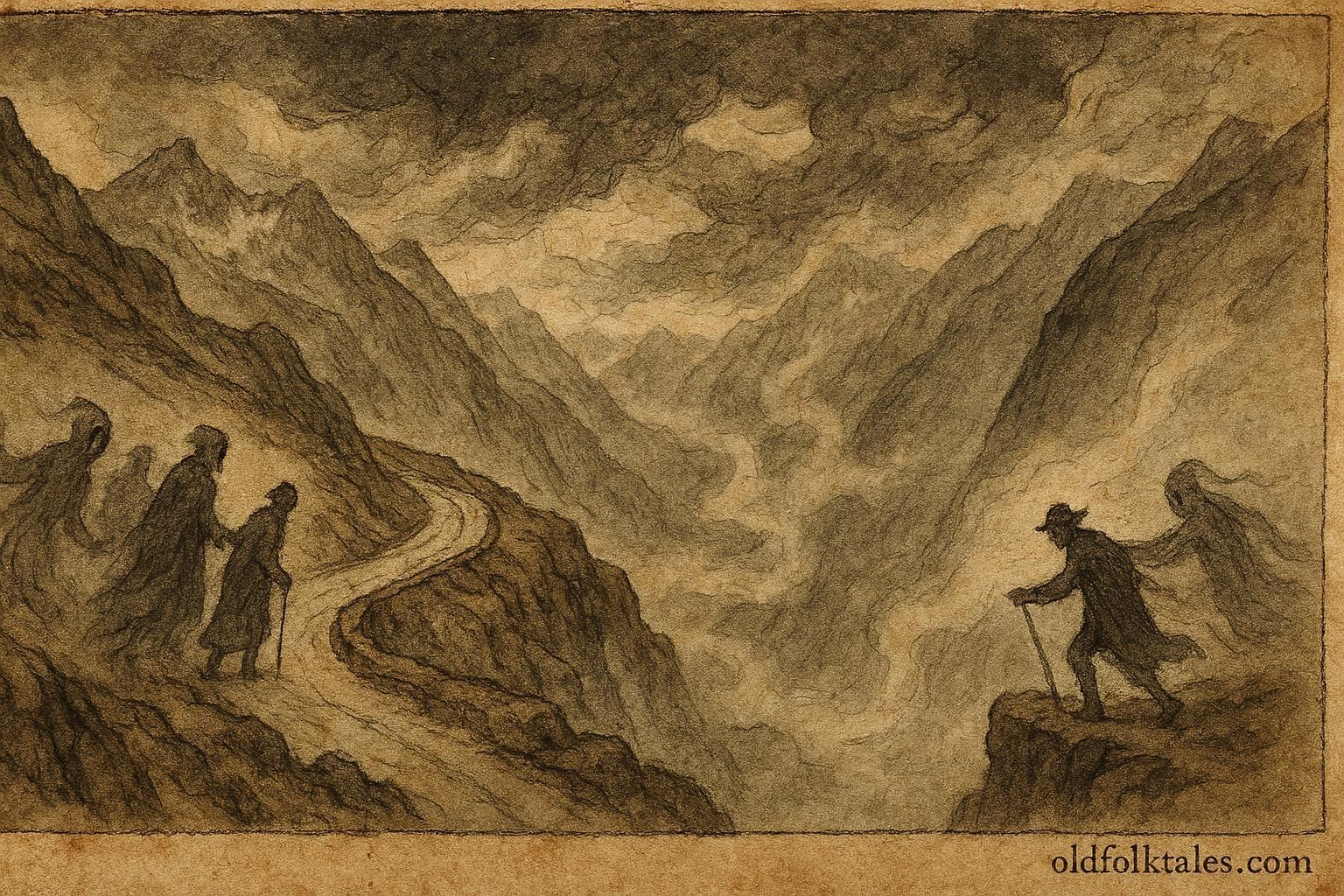
High in the Bernese Alps, where the air thins and the earth rises sharply into jagged peaks, there lies a mountain pass known for both its beauty and its danger, the Grimsel Pass. It is a road carved through stone and silence, where winds sweep without warning and clouds descend like veils over the land.
For centuries, traders, shepherds, and travelers have crossed this high road, carrying goods, stories, and hopes from one valley to another. Yet not all who entered the pass returned unchanged.
Some did not return at all.
The Grimsel Pass was never considered an ordinary route. Even in calm weather, its narrow paths and steep descents demanded caution. But when storms gathered, as they often did without warning, the pass became something else entirely.
A place where the world shifted.
A place where the unseen stirred.
Among those who traveled the high road, there were stories, passed quietly from one traveler to another, spoken in low tones beside hearth fires and in the shelter of roadside inns.
Stories of the spirits of Grimsel.
They were said to dwell within the mountains themselves, unseen but ever watchful. Some called them guardians, others shadows, and a few simply refused to name them at all. But all agreed on one thing:
The spirits did not treat every traveler the same.
There were those who crossed the pass and spoke of a strange guidance, of finding the path more clearly than expected, of sensing which way to turn even when the road was hidden beneath snow or mist. These travelers often reached the other side safely, sometimes without fully understanding how they had done so.
When asked, they would say only that they had felt… led.
Watched over.
But there were other stories, darker in tone and harder to forget.
Stories of traders who entered the pass with heavy packs and heavier ambition. Men who sought profit above all else, who pressed forward despite warnings, eager to reach their destination before others.
These travelers, it was said, did not always find the path so easily.
One such tale tells of a merchant who set out across the Grimsel Pass late in the season, when the first signs of winter had already begun to show. Snow lay thin upon the ground, and the winds carried a sharp edge that spoke of storms to come.
Other travelers advised him to wait.
“The pass is not safe,” they said. “The weather is turning.”
But the merchant would not listen.
Time, to him, was as valuable as the goods he carried. Every delay meant lost profit, and he was determined to reach the next valley before his rivals.
And so, he set out alone.
At first, the journey seemed manageable. The sky remained clear, and the path, though narrow, was visible enough. The merchant pressed forward with confidence, dismissing the warnings he had been given.
But as he climbed higher, the air grew colder, and the wind began to rise.
Then came the mist.
It rolled in without warning, thick and sudden, swallowing the landscape until nothing remained but a pale, shifting haze. The path disappeared beneath his feet, and the markers he had followed were lost from sight.
Still, he continued.
He told himself he could not turn back.
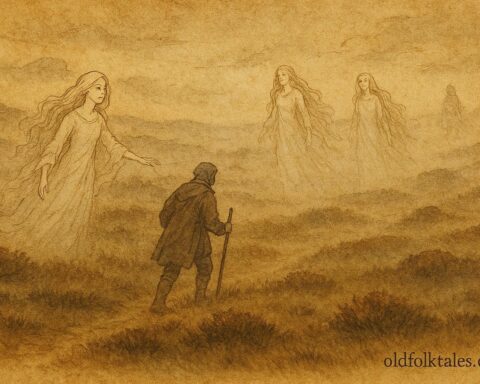
It was then that he saw them.
Shapes moving in the mist.
At first, he thought they were other travelers, figures emerging through the fog, just beyond reach. They seemed to gesture, to beckon him forward, their forms shifting and indistinct.
Relieved, he followed.
The path they led him on felt uncertain, yet he trusted what he saw more than the emptiness behind him. Step by step, he moved deeper into the mist, guided by figures he could not fully see.
The wind howled louder. The ground beneath him grew uneven.
And still, he followed.
Until suddenly, the ground gave way.
The merchant stumbled, barely catching himself at the edge of a steep drop. Rocks tumbled into the void below, their sound swallowed by the wind.
The figures were gone.
The mist remained.
In that moment, realization came too late.
He had not been guided.
He had been led astray.
Some say he managed to find his way back, shaken and changed, abandoning his journey entirely. Others claim he was not so fortunate, that the mountain claimed him, as it had claimed others before.
But all who heard the tale understood its meaning.
The Grimsel spirits did not favor greed.
In contrast, there are stories of those who approached the pass with humility.
One tells of a shepherd who, caught in an unexpected storm, sought only to find his way home. He carried little, asked for nothing more than safe passage, and moved with care, respecting the mountain and its dangers.
As the storm thickened, he, too, lost sight of the path.
But instead of pressing forward blindly, he paused.
He waited.
In the quiet that followed, he felt a presence, not seen, but sensed.
A stillness in the storm.
A direction, gentle yet certain.
Trusting that instinct, he took a different path, one he had not planned, one that seemed to reveal itself step by step.
And before long, he found himself descending safely, the storm lifting behind him as though it had never been.
When he told his story, he spoke not of fear, but of gratitude.
“I was not alone,” he said simply.
Such stories spread across the valleys, shaping the way travelers approached the Grimsel Pass. It became understood that the journey was not merely a physical one, but a test of character.
The mountain, it seemed, could sense the intentions of those who crossed it.
And the spirits responded accordingly.
Over time, the tales of the Grimsel Pass spirits became a part of Alpine tradition, warnings woven into the fabric of travel itself.
Do not rush where patience is required.
Do not take more than you need.
Do not challenge what you do not understand.
For the mountains are not empty.
They watch.
They remember.
And sometimes, they choose.
Even today, those who cross the Grimsel Pass speak of moments that cannot be explained, of sudden clarity in thick fog, of paths found where none seemed to exist, of a feeling that the journey is being observed.
Few speak openly of spirits.
But many remember the old stories.
And they walk with care.
Moral Lesson
The Grimsel Pass Spirits remind us that nature reflects our intentions. Humility and respect are rewarded with guidance, while greed and arrogance can lead us into danger.
Knowledge Check
1. What are the Grimsel Pass Spirits in Alpine folklore?
They are supernatural guardians believed to guide honest travelers and mislead the greedy in the Swiss Alps.
2. Where is the Grimsel Pass located?
It is located in the Bernese Alps of Switzerland, known for its dangerous mountain routes.
3. How do the spirits treat different travelers?
They help humble and respectful travelers but lead greedy or reckless ones into danger.
4. What happened to the greedy merchant in the story?
He followed misleading spirits into danger after ignoring warnings and prioritizing profit.
5. What lesson does the shepherd’s story teach?
It shows that patience, humility, and respect for nature can lead to safety and guidance.
6. What themes are central to this folktale?
Morality, natural justice, fate, and the consequences of human ambition.
Source: Oral traditions from Alpine travelers and traders; noted in 18th–19th century Alpine literature
Cultural Origin: Bernese Alps (Grimsel Pass region)