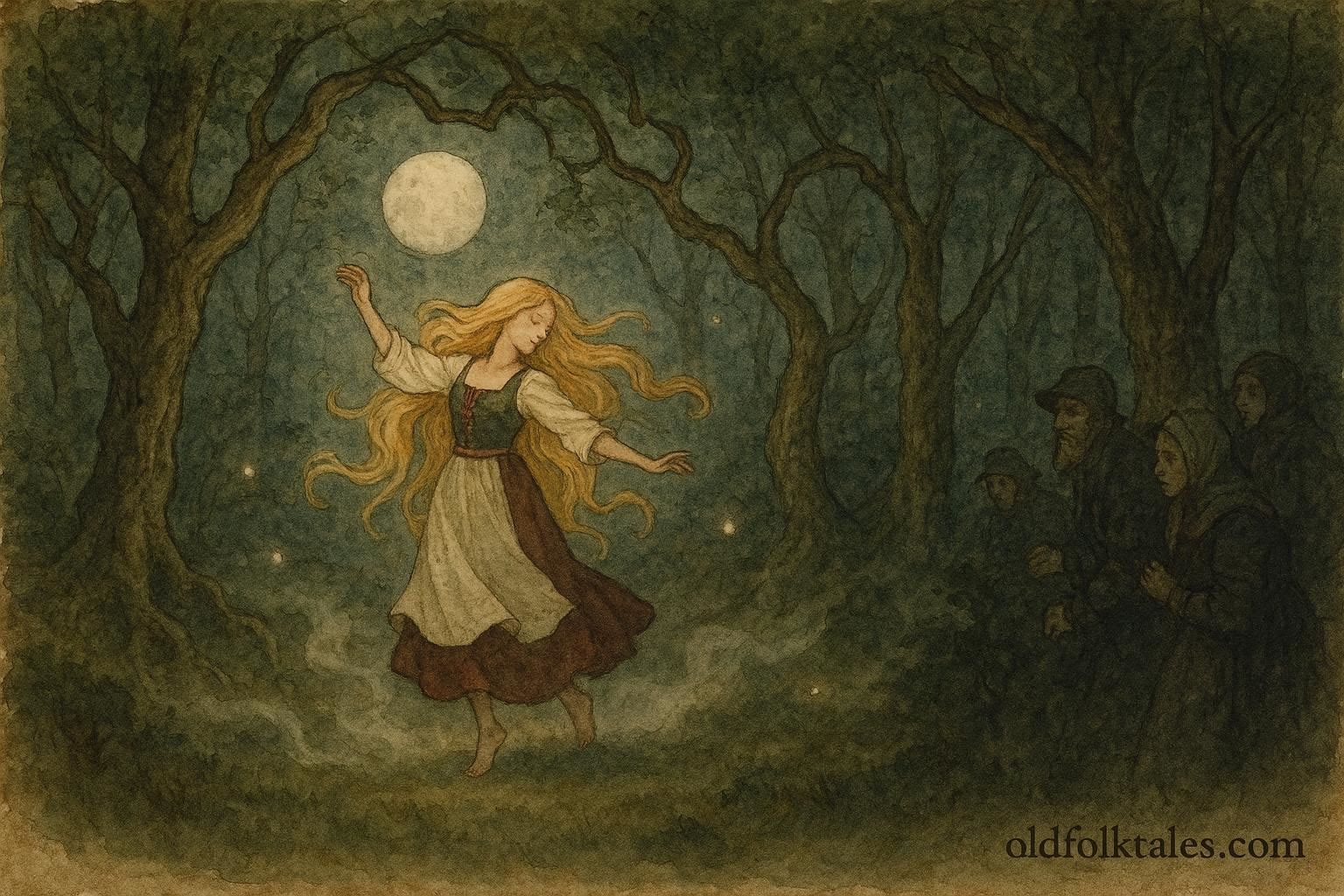
In the dense, shadowed forests of Dalarna, where pine trees rise like cathedral spires and the scent of moss and damp earth fills the air, the villagers whispered of a strange, bewitching sight. On moonlit nights, far from the safety of hearth and home, a figure would appear among the trees, a woman of extraordinary beauty, her hair shimmering like spun gold, and her eyes deep as the forest pools. But her allure hid a secret: a hollow back, concealed by flowing garments, a mark that she was no ordinary woman, but a huldra, a guardian of the woods with powers both enchanting and dangerous.
It was said that those who saw her dance were mesmerized, their steps following hers as if by invisible threads. Some villagers, drawn by curiosity or desire, attempted to join her in the clearing. But the forest is merciless to those who disrespect its spirits. Those who abandoned caution and pride succumbed to her spell, disappearing forever into the woods, their cries lost among the rustling leaves.
The Huldra Appears
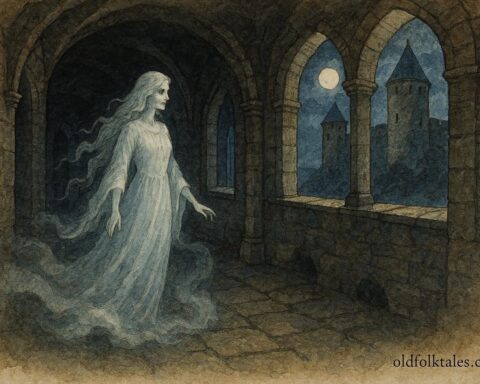
The huldra’s dance is not a mindless spectacle but a ritual of the forest itself. She moves in perfect harmony with the wind through the pines, her gown brushing the moss, her golden hair catching moonlight in radiant streaks. Around her, shadowy forms of other forest beings, the silent deer, glimmering foxes, and owl-eyed spirits, seem to watch, waiting to see who may be worthy of the forest’s blessings.
The villagers describe a sound like a thousand tiny bells ringing softly with each of her steps, mingled with the rustle of leaves and distant laughter that carries the thrill of danger. She is both terrifying and beautiful, a living embodiment of the forest’s dual nature: generous and fertile to the respectful, cruel and unforgiving to the arrogant.
Temptation and the Risk of the Dance
It was during midsummer that the dance was most often observed. Farmers and hunters, eager to impress neighbors or gain fortune, ventured into the forest.
One young hunter, eager to prove his skill, stumbled upon a clearing bathed in silver moonlight. There she stood, the huldra, spinning and twirling, calling him with her smile. He approached, and she extended her hand, her hollow back hidden beneath her silk gown. He felt an irresistible pull to join the dance, to mirror her movements.
But as he stepped closer, a wise old villager who had followed the sound called out, warning him to remain rooted to the earth. He hesitated, remembering the warnings of his elders: the huldra’s dance was a test of discipline and respect. With one final glance at her radiant eyes, he bowed and withdrew.
That night, he returned home unscathed, yet he had glimpsed her fleeting blessing, a herd of deer appeared near his hunting lodge the following dawn, abundant and easy to track. Crops near his fields thrived, as if the forest itself approved of his caution.
The Cost of Curiosity and Pride
Contrast his fortune with the tale of a neighboring farmer, full of pride and disbelief in old stories. One summer night, he ventured deep into the Dalarna woods, laughing at the warnings of neighbors and elders. He found the huldra in the clearing, and ignoring the signs of her hollow back, he stepped into her circle.
The forest shifted around him. Trees seemed to move like dancers themselves, roots twisting beneath his feet. He could not turn away. Her laughter echoed through the pines, and he realized too late that he had been ensnared. Villagers searched for weeks but found no trace of him, save for a single gold coin etched with a tiny huldra image left at the edge of the forest, a silent warning to all who might follow his path.
Lessons of the Forest
The huldra is not a creature of mere cruelty. She embodies the forest’s duality: it provides sustenance, shelter, and life, yet it demands respect. Her blessings, fertile fields, abundant game, and safe passage, come to those who honor her and the unseen spirits of the woods.
The tales remind villagers that curiosity must be tempered with humility, and that temptation, when unchecked by respect, can lead to ruin. Those who approached the huldra with caution, reverence, and understanding often found the forest rewarding, while those who ignored her nature suffered.
Over time, the huldra’s presence became a living lesson woven into the culture of Dalarna. Children were told her stories to instill respect for nature and the unseen, hunters observed forests silently, and farmers blessed their fields with offerings to ensure they did not anger the woodland spirits.
A Living Legacy
Even today, travelers along Dalarna’s ancient forest paths report strange dances in moonlit clearings. Shadows shift oddly, a melody of bells carries faintly, and the outline of a figure in white is seen briefly among the trees. These tales reinforce the old truths: respect the natural world, heed the wisdom of those who came before, and never underestimate the power of enchantment.
The huldra’s dance is a reminder that the forest watches and acts as guardian of moral and natural law. Her hollow back is a symbol, not just of her supernatural nature, but of the hidden costs of arrogance and the importance of looking beyond appearances.
Moral Lesson
Respect the unseen and honor the natural world. Temptation and pride can lead to peril, while humility, caution, and reverence bring blessings and protection. The forest rewards the careful and punishes the careless, teaching that wisdom often comes from heeding the old stories.
Knowledge Check
1. Who is the huldra in Swedish folklore?
A forest spirit with a hollow back who tests humans through her enchanting dance.
2. What risks do those who join her dance face?
They risk being trapped in the forest forever if they act with pride or disrespect.
3. How are respectful visitors rewarded?
With blessings such as abundant game, fertile fields, and safe passage through the woods.
4. What does the hollow back symbolize?
It represents the hidden dangers behind beauty and the importance of respecting appearances and nature.
5. Which region of Sweden is associated with this tale?
Dalarna, central Sweden.
6. Who recorded these tales in the 19th century?
Hyltén-Cavallius and other regional folklore collectors during the 1840s.
Source: Recorded in regional Swedish folklore collections by Hyltén-Cavallius, 1840s.
Cultural Origin: Dalarna forests, central Sweden, Scandinavian folklore.