In a time when mountains shadowed the valleys and rivers gleamed like silver threads under the sun, the people of a small Albanian village lived in harmony with the land. They sowed their fields, tended their flocks, and celebrated the turning of the seasons with songs and firelight. Yet, for many weeks, the land had suffered an unnatural stillness. The rivers ran thin, the trees drooped, and the grains shriveled in their husks. The villagers whispered fears of a dark power, and their prayers to the saints and elders brought no relief.
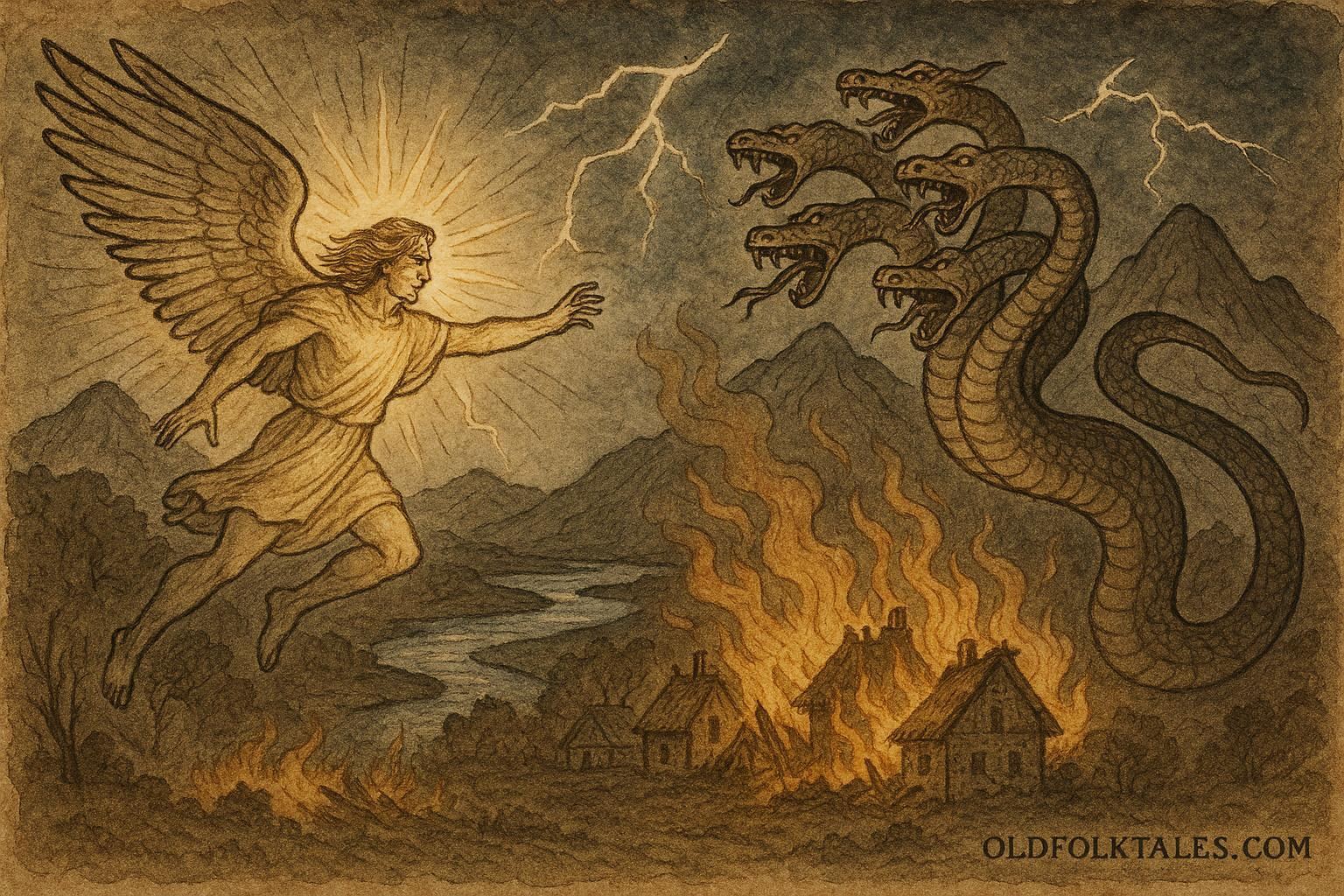
At the heart of this turmoil lay the Kulshedra, a monstrous serpent-demon, feared across central and northern Albania. Its many heads writhed like the twisting branches of an ancient oak in a storm, and its scales shimmered with the colors of a thunderstorm, black as midnight clouds and green as forest shadows. Wherever it slithered, drought followed, crops failed, and livestock perished. Villagers spoke in hushed tones of the Kulshedra’s fiery breath and its venomous gaze, which could turn the hearts of the brave to stone. Yet its threat extended beyond mere fear; it disrupted the balance of life itself.
In a remote valley, the elders convened at the village square, their faces lined with worry. “Our prayers are not enough,” said one, voice trembling like the leaves in autumn wind. “The Kulshedra grows bolder. If it is not stopped, we shall perish.” No one dared act, for even the strongest men knew their swords and spears could do nothing against a creature so vast and cunning. It was a darkness born from both earth and spirit, a force older than the mountains themselves.
But far above the village, in the peaks of the surrounding mountains, a solitary figure descended from the clouds. Wings like polished bronze stretched wide, catching the first rays of dawn. This was the Drangue, a celestial warrior whose strength and courage were beyond human measure. Born of both sky and fire, the Drangue was called upon only when the natural and human worlds were in peril. It had heard the cries of the land and flown swiftly to answer them.
The Drangue landed near the riverbed, where cracked earth split under the sun, and the fish floundered helplessly in shallow pools. Its eyes, bright as lightning, surveyed the village and its fields. It could sense the Kulshedra’s presence, its many-headed form coiled in the forest beyond the western ridge. Each head rose and fell, as if sniffing the air, tasting the fear that clung to the village. The Drangue flexed its talons, wings beating a rhythm of power, and whispered a prayer to the mountains and the rivers: “By the sky and by the land, I shall confront you, serpent, and restore the balance.”
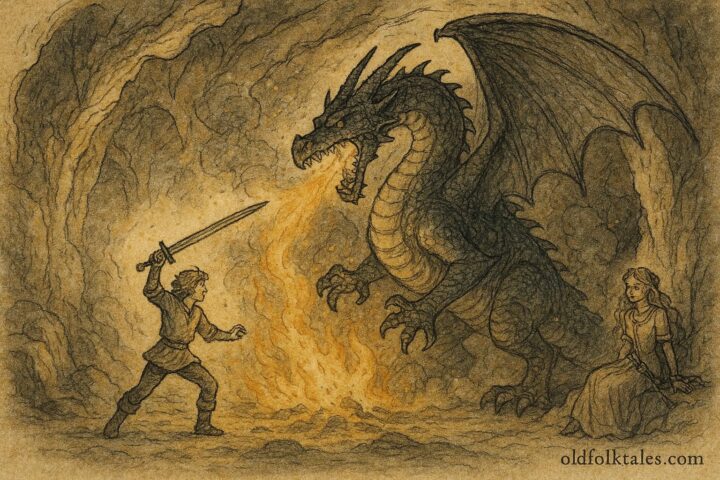
As dusk fell, the Kulshedra slithered down into the valley, its heads striking the fields with venomous might. Crops withered instantly under its gaze, and the wind carried a stench of decay. The villagers, huddled in their homes, could only watch in terror. Then, with a sudden beat of wings and a roar that echoed through the mountains, the Drangue descended. Its claws struck the earth, sparking fires that danced along the dry soil, and the air shimmered with the heat of its presence.
The battle was unlike anything the villagers had ever imagined. The Kulshedra’s heads struck like whips, each attack swift and deadly, yet the Drangue moved with grace, dodging and weaving, its wings slicing the night air. With a powerful swing of its tail, the Drangue shattered a tree to create a barrier, shielding the village from the serpent’s fiery breath. Sparks flew, scales clashed, and a storm of wind and fire raged through the valley. The earth trembled beneath the might of the two creatures, and the mountains themselves seemed to hold their breath.
For hours, they fought, a struggle that balanced on the edge of chaos. The Kulshedra’s venom sprayed rivers into mist, and its shrieks echoed across the hills. The Drangue, however, had the wisdom of ages. It did not attack recklessly but studied the serpent’s movements, looking for a weakness in its many heads. Then, with the patience of the mountain itself, the Drangue found it: the central head, larger and older than the rest, carried the creature’s power.
Summoning its strength, the Drangue dove, wings tucked tight and struck with the force of a thunderbolt. The central head fell back, hissing and writhing, while the remaining heads recoiled in disarray. With each strike, the Drangue drove the Kulshedra back toward its lair in the mountain cave, finally cornering it under a cliff where the earth had cracked like broken glass. With one final, mighty blow, the serpent was subdued, coiled forever in a stone prison of its own making.
The valley, once withered and silent, began to breathe again. Rivers swelled, green returned to the fields, and the air smelled of fresh earth and rain. Birds sang once more, and the villagers emerged from their homes, eyes wide with awe. They knelt before the Drangue, offering songs, gifts, and prayers of thanks. Yet the Drangue, proud yet humble, simply lifted into the sky and vanished among the clouds, leaving behind only the knowledge that courage, wisdom, and strength could restore harmony to a troubled world.
From that day forward, the villagers honored both the Drangue and the memory of the Kulshedra, telling the tale from generation to generation. They remembered that evil, though fearsome, could always be overcome when valor met cunning, and that the balance of nature and humanity was not to be taken lightly.
Moral Lesson
The tale of the Kulshedra and the Brave Drangue teaches that courage alone is not enough; wisdom, patience, and respect for the natural order are essential. True heroism protects the community and restores balance between humanity and the forces of nature, showing that good can triumph over even the most fearsome evil.
Knowledge Check
-
Who is the Kulshedra in Albanian folklore?
The Kulshedra is a multi-headed serpent-demon that brings drought, destruction, and imbalance to villages in central and northern Albania. -
What role does the Drangue play in the story?
The Drangue is a winged hero who protects the community, battles the Kulshedra, and restores harmony between nature and humans. -
What themes are central to the tale of the Kulshedra and Drangue?
Themes include heroism, the battle of good versus evil, protection of community, and the restoration of natural order. -
How do villagers interact with supernatural forces in the story?
Villagers pray, fear, and ultimately witness the Drangue’s intervention, highlighting respect for nature and humility in the face of powerful beings. -
What lesson does the tale impart about courage and wisdom?
Courage must be paired with strategy, patience, and understanding to overcome formidable threats, illustrating the importance of moral and practical intelligence. -
What is the cultural origin of the Kulshedra and Drangue legend?
The story originates from Albanian oral tradition, specifically from central and northern regions, and was documented by Maximilian Lambertz in 1922.
Source: Maximilian Lambertz, Albanische Märchen (1922)
Cultural Origin: Central and Northern Albania