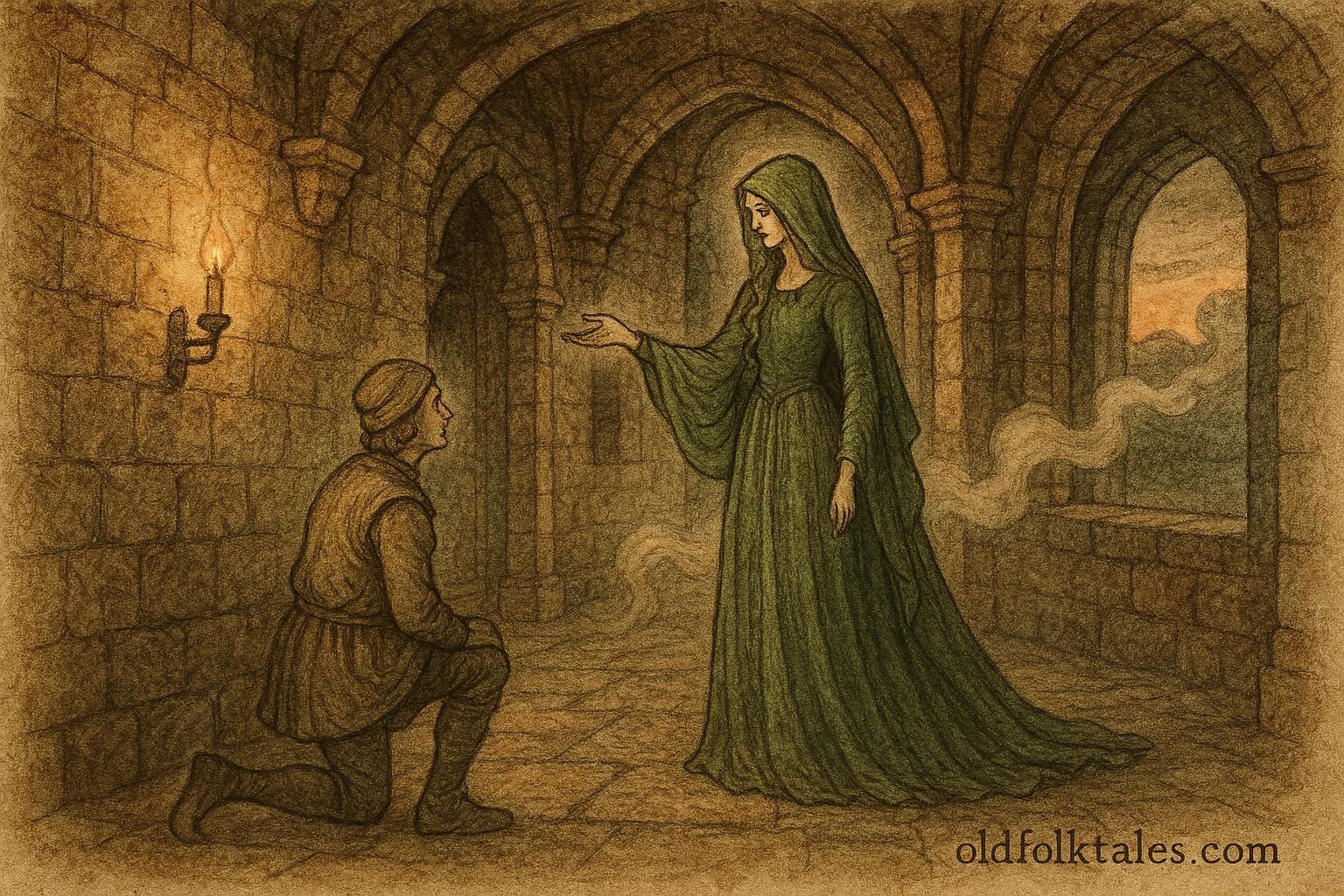
In the mist-shrouded valleys and dense forests of Tyrol and Salzburg, Austria, villagers and nobles alike spoke in reverent whispers of a spectral lady dressed entirely in green. She was not a common ghost, nor a malevolent wraith, but a vigilant presence whose purpose was to warn and guide. Those who heeded her appeared protected from misfortune and betrayal, while those who ignored her counsel often met with sorrow. Many believed she was an ancestral spirit, tied to the old houses and manors of the land, moving unseen through corridors and forests, guarding the living from the mistakes of the past.
This is the tale of the Lady in the Green Dress, a guardian of virtue, a messenger of the past, and a spectral guide whose appearance ensured that moral vigilance and respect for history were never forgotten.
Appearance in the Castles and Manors
The Lady’s first appearances were said to occur at dusk, when shadows lengthened in the halls of ancient castles and the great manor houses dotted across Tyrol and Salzburg. Her dress was a deep, shimmering green, flowing like liquid moss, and her presence carried a subtle, almost musical sigh that seemed to echo through corridors and chambers.
Servants and children often caught glimpses of her as they carried firewood or swept the floors, only to find the apparition vanished a moment later. Noble families would awaken to see the soft green glow of her dress along the hallway walls, accompanied by a gentle voice or a sense of urgent warning. Sometimes, she appeared at the threshold of a bedroom, holding her hands gracefully, signaling that a critical decision or impending event required attention.
The Lady’s purpose was not to frighten, but to alert. Those who ignored her presence were often plagued by accidents, betrayals, or financial misfortune, while those who listened or took heed found themselves guided safely through trials.
A Warning Foretold
One story tells of Count Albrecht, a proud and ambitious nobleman who was preparing to host a grand feast. On the evening before the event, as the sun dipped behind the mountains, the Lady appeared in the main hall. Her green gown shimmered in the candlelight, and her eyes glowed faintly with the wisdom of ages.
“Beware the guest who smiles too sweetly,” she whispered, “for not all kindness is true, and treachery hides behind the mask of courtesy.”
The Count, taken aback, hesitated. He dismissed her warning as a trick of the candlelight and the fatigue of preparation, choosing instead to proceed with his feast as planned.
During the banquet, a visiting noble, flattering and charming in appearance, attempted to manipulate the Count into signing over land holdings. The Count’s advisors, who had witnessed the Lady’s presence, quietly reminded him of her warning. Trusting their counsel, he refused the deceptive guest, avoiding the potential betrayal. The Lady’s early apparition had spared him disaster, even though he initially failed to act.
Guidance for the Humble and Attentive
Not all encounters involved the wealthy or the noble. Villagers, too, reported seeing the Lady in green while tending fields, fetching water, or walking along forest paths. She would appear to a farmer on the edge of a clearing, or to a young girl collecting herbs. Her voice, soft but clear, advised careful planning, honesty, and attention to neighbors’ needs.
One such account tells of Anna, a young village girl, who saw the Lady near an old forest chapel. The spirit whispered:
“Do not leave the path tonight and warn your father of the weakened bridge across the stream.”
Anna hurried home and relayed the message. That very night, a heavy cart attempted to cross the damaged bridge. Thanks to Anna’s warning, the driver and passengers avoided a deadly fall, and the villagers repaired the structure before anyone else could be harmed. The Lady’s guidance had preserved lives, demonstrating that her warnings extended to all social classes, emphasizing vigilance and virtue over status.
Protection Through Respect
Across Tyrol and Salzburg, tales of the Lady in the Green Dress emphasized the importance of respect for tradition, family, and moral behavior. She was believed to appear in houses with strong ancestral ties, protecting the lineage and ensuring that past mistakes were not repeated. Families learned to honor the Lady’s warnings, often lighting candles in her memory or leaving offerings of fresh herbs or flowers in the hallways she frequented.
The Lady’s presence also reinforced the cultural importance of ancestral wisdom. Villagers understood that the past was not merely history but a living guide. By observing her guidance, they respected both their elders and the moral principles handed down through generations.
Consequences of Ignoring the Lady
Disregard for the Lady’s counsel brought misfortune. One tale recounts a wealthy merchant, too proud to heed the Lady’s apparition, who ignored her repeated appearances. His family suffered betrayal from a business partner, and he lost significant holdings due to a legal trick he had failed to anticipate. Stories like this reinforced that arrogance, carelessness, or disrespect toward ancestral guidance carried tangible consequences.
Even those who were initially skeptical often changed their behavior after a narrow escape or unexpected warning. Villagers and nobles alike came to see the Lady as both a moral compass and a supernatural protector, a reminder that vigilance and virtue are closely intertwined.
A Symbol of Ancestral Guidance
The Lady in the Green Dress remains a symbol of guidance and protection in Tyrolean and Salzburg folklore. She embodies the idea that those who respect tradition, act virtuously, and pay attention to warnings, whether supernatural or human, are shielded from misfortune. Her spectral presence is a timeless lesson in moral attentiveness, demonstrating that respect for the past, combined with vigilance, ensures safety, prosperity, and community harmony.
The green of her dress, vivid against the stone walls of castles or the dark shadows of forests, represents life, growth, and renewal, qualities tied to both the natural world and the human spirit. By appearing in moments of crisis or uncertainty, she reminds all who see her that the past carries wisdom, and that careful attention to guidance, whether whispered or observed, ensures survival and virtue.
Moral Lesson
Vigilance, respect for the past, and moral attentiveness protect against misfortune. The Lady in the Green Dress teaches that guidance is often available to those who are observant, humble, and virtuous, and that ignoring wisdom, ancestral or supernatural, can bring consequences.
Knowledge Check
1. Who is the central figure in this Austrian folktale?
The Lady in the Green Dress, a spectral guardian of castles and forests.
2. What does she warn people about?
Imminent misfortune, betrayal, or mistakes that could affect families or villages.
3. Who benefits from her guidance?
Those who act with vigilance, humility, and respect for the past.
4. How do villagers and nobles show respect to the Lady?
By heeding her warnings, lighting candles, leaving herbs or flowers, and honoring ancestral wisdom.
5. What themes define the story?
Vigilance, virtue, respect for tradition, and supernatural guidance.
6. Who collected the story and when?
Ignaz & Joseph Zingerle, published in 1854 from Tyrolean and Salzburg oral tradition.
Source: Ignaz & Joseph Zingerle, Sagen und Märchen aus Tirol und Salzburg (1854), Austria.
Cultural Origin: Tyrolean and Salzburg folk tradition, Austria.