In the mist-laden lands of Galicia, where ancient forests stretch across rolling hills and narrow paths wind between stone villages, night carries more than silence. When darkness falls and the wind moves softly through the trees, the people of these lands close their doors early, lower their voices, and keep close to the warmth of their homes. For in Galicia, the night does not belong entirely to the living. Among the oldest and most feared tales is that of La Santa Compaña, the Holy Company, a procession not of the living, but of the dead.
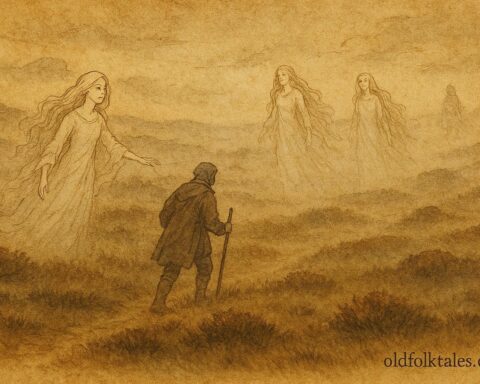
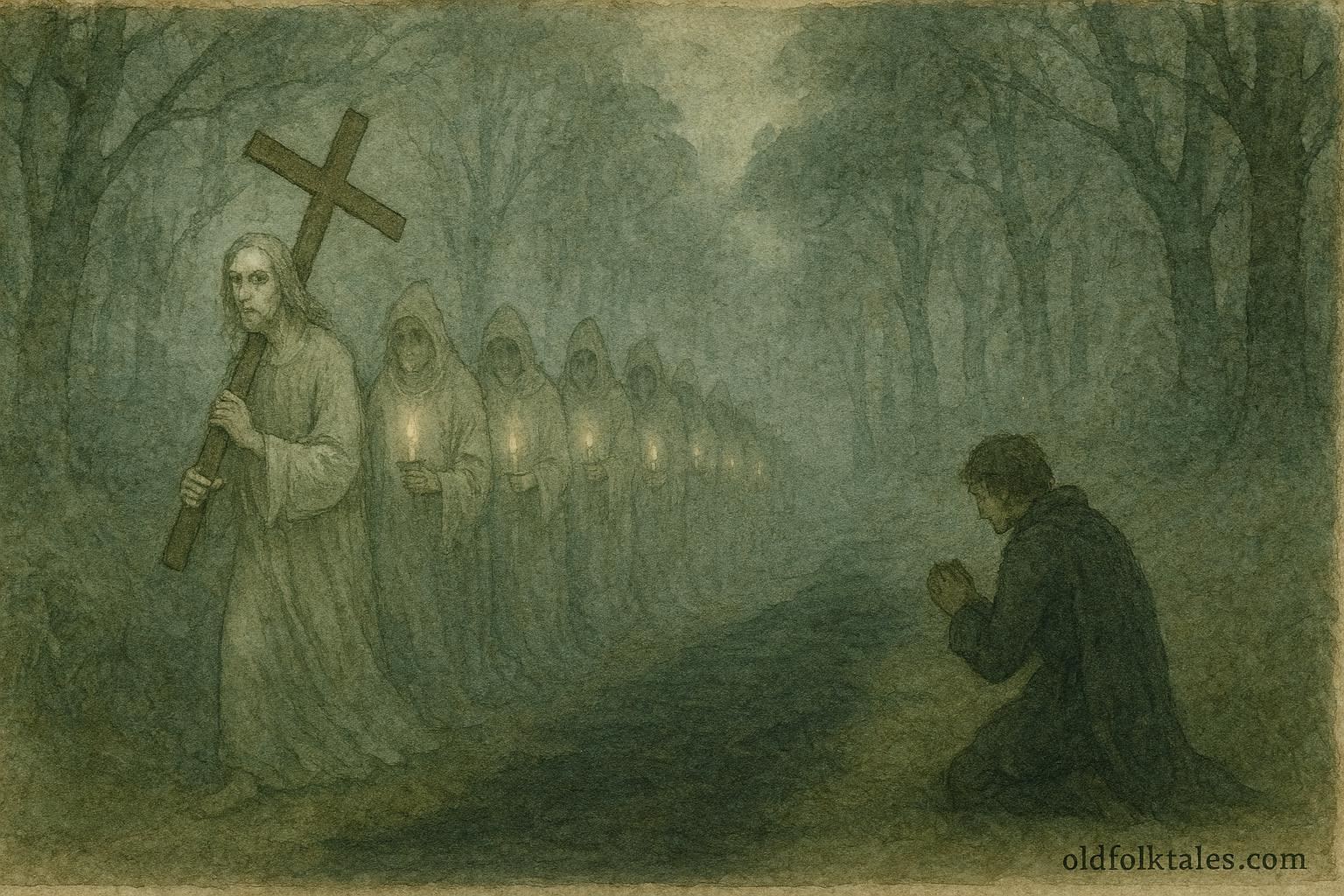
It is said that on certain nights, when the air grows cold and heavy, a line of spectral figures emerges from the darkness. They move in silence along forgotten roads and forest paths, their presence marked by the faint scent of wax and damp earth. Each carries a candle, its flame pale and unsteady, casting a ghostly light that does not quite touch the ground.
At the head of the procession walks a figure unlike the rest.
This leader is not dead.
He is one of the living, chosen, or rather cursed, to guide the souls of the departed. In his trembling hands, he carries a wooden cross, and though his body still breathes, his spirit is bound to the march. By day, he appears as any other man, pale and weary, his eyes shadowed by a burden he cannot escape. But by night, he walks with the dead.
And unless he can pass the burden to another, he will one day join them fully.
The villagers know the signs of La Santa Compaña’s passing.
Dogs begin to whimper and hide. The wind falls still. An unnatural silence settles over the land, broken only by the faint sound of footsteps, many footsteps, moving in unison.
And if one listens closely, there may come the soft murmur of prayers spoken in voices that are no longer alive.
It was on such a night that a man named Mateo found himself walking alone along a narrow path between villages.
He had stayed later than he intended, visiting a distant relative. Though warned not to travel after nightfall, he trusted in the familiarity of the road. The moon, though partially hidden by clouds, offered enough light to guide his way.
At first, all seemed ordinary.
The trees stood still, their branches reaching like silent watchers into the night. The path beneath his feet was firm, the air cool but not yet unsettling.
Then, without warning, everything changed.
The wind ceased.
The sounds of the night, the distant call of an owl, the rustle of leaves, vanished as though swallowed by the earth itself.
Mateo slowed his steps.
A chill crept along his spine, not from the air, but from something deeper, an instinct he could not ignore.
Then he smelled it.
Wax.
Not the warm, comforting scent of candles in a chapel, but something colder, heavier, like candles long extinguished.
His breath caught.
He remembered the stories.
La Santa Compaña.
Panic threatened to take hold, but he forced himself to remain still, to listen.
And then he heard it.
Footsteps.
Soft at first, distant, but unmistakable. Many feet moving together, their rhythm steady and unbroken.
Mateo turned slowly, his heart pounding in his chest.
From the darkness beyond the bend in the path, a faint glow began to appear.
It flickered like candlelight, pale and wavering.
The procession emerged.
Figures cloaked in white, their faces obscured, moved silently forward. Each held a candle, its flame casting a dim light that seemed to consume rather than illuminate. The air around them felt thick, as though the world itself resisted their passage.
Mateo could not move.
At the front walked the leader.
A man, pale and hollow-eyed, clutching a wooden cross. His expression was one of quiet suffering, as though each step carried the weight of something unbearable.
Their eyes met.
And in that instant, Mateo understood.
The stories were true.
And worse, he had been seen.
The leader slowed.
The procession halted.
The silence deepened, pressing against Mateo’s ears until it felt almost deafening.
The man with the cross took a step toward him.
Mateo’s mind raced.
He remembered what the elders had said, that to encounter La Santa Compaña was to stand at the edge of fate. That those who did not act, who did not protect themselves, could be drawn into the procession, forced to take the place of the living guide.
He could not let that happen.
With trembling hands, Mateo reached into his coat and pulled out a small object he always carried, a rosary, worn smooth by years of use.
He dropped to his knees.
Pressing the rosary tightly in his hands, he began to pray.
His voice shook at first, barely rising above a whisper. But he forced himself to continue, each word stronger than the last.
The figure with the cross paused.
The candle flames flickered violently, as though stirred by a wind that could not be felt.
Mateo kept his gaze lowered, refusing to meet their eyes again. He had been warned, never look directly at them, never speak to them, never accept anything they offer.
The air grew colder.
The footsteps resumed, but slower now, hesitant.
The leader stood before him, so close that Mateo could sense his presence without looking.
For a moment, it seemed as though the man might reach out, might place the cross into Mateo’s hands.
But the prayer continued.
And something shifted.
The procession began to move again, not toward Mateo, but past him.
One by one, the figures drifted by, their candles casting fleeting shadows across the ground. The murmured prayers rose and fell like a distant tide, their words indistinct but heavy with sorrow.
Mateo remained still, his voice unwavering, until the last light faded into the darkness.
Only then did the night return.
The wind stirred.
The sounds of the forest crept back, hesitant at first, then steady.
Mateo lifted his head.
The path was empty.
He stayed where he was for a long while, his body trembling, his mind struggling to grasp what he had witnessed.
When at last he rose, he did not look back.
He returned to his village before dawn, his steps quick and certain, guided not by the path alone, but by the knowledge that he had come dangerously close to something beyond the world of the living.
From that day on, Mateo spoke little of the encounter.
But when others mentioned La Santa Compaña, he did not laugh, nor did he doubt.
He simply warned them.
If you walk alone at night and the world grows still…
If you smell the wax and hear the footsteps…
Do not run.
Do not speak.
And above all…
Do not let them place the cross in your hands.
Moral Lesson
Respect for spiritual forces and awareness of unseen dangers can protect one from fate, while ignorance and fear may lead to irreversible consequences.
Knowledge Check
- What is La Santa Compaña in Galician folklore?
Answer: A ghostly procession of the dead that walks at night, foretelling death. - Who leads La Santa Compaña?
Answer: A living person cursed to carry a cross and guide the spirits. - What are the signs of the procession’s approach?
Answer: Silence, the smell of wax, and the sound of synchronized footsteps. - What danger does La Santa Compaña pose to the living?
Answer: A person may be forced to join and take the place of the living leader. - How did Mateo protect himself?
Answer: By praying and using a rosary while avoiding eye contact. - What does the legend symbolize?
Answer: Mortality, fate, and the consequences of encountering the supernatural.
Source: Galician Superstitions by Aurelio M. Espinosa (1930).
Cultural Origin: Galicia, Spain.