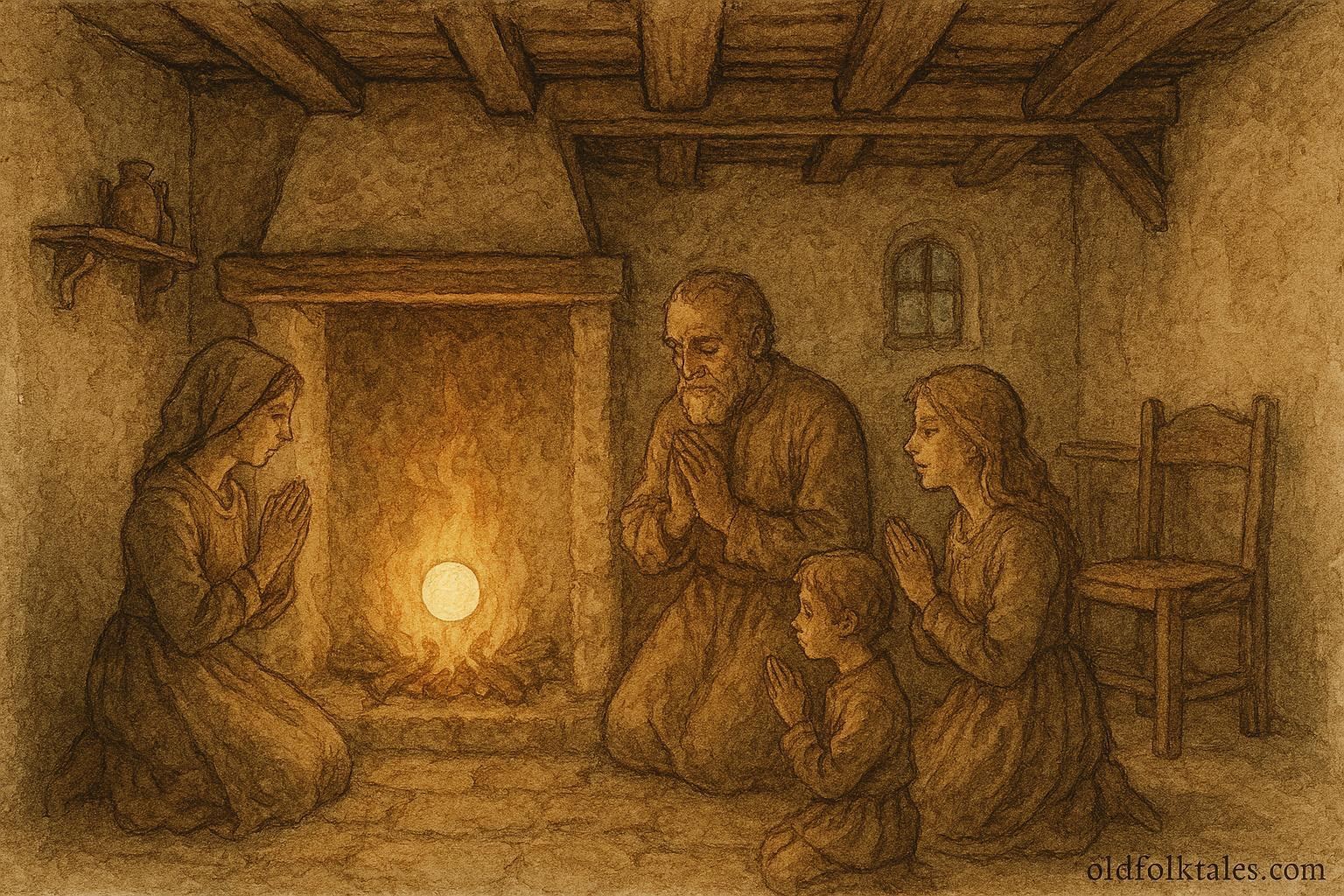
In the year 1345, the city of Amsterdam was far from the bustling center it would one day become. It was a modest settlement of wooden houses and narrow streets, built along canals that reflected the shifting skies above. Merchants traded goods brought by river and sea, fishermen cast their nets into cold waters, and church bells marked the rhythm of daily life. Faith shaped everything.
In those days, the people lived close to both hardship and devotion. Illness came swiftly, and death was never far. When sickness struck, the Church was often the final refuge, and the sacraments were believed to bring not only comfort, but the presence of the divine itself.
It was in such a time that a man lay dying in a humble home along one of the city’s canals. His body had been weakened by illness, his breathing shallow and uneven. Family members gathered around him, their faces drawn with worry and grief. Knowing that his end might be near, they sent for a priest, hoping he might receive the final sacrament, the Eucharist.
The priest arrived swiftly, carrying with him the consecrated host, treated with the utmost reverence as the body of Christ. The small room grew quiet as he administered the sacrament, placing the host gently upon the man’s tongue. Those gathered watched with solemn hope, believing that this sacred act would prepare the man’s soul for whatever lay beyond.
For a moment, all was still.
But then, as the illness took hold once more, the man convulsed and, to the horror of those present, vomited. The sacred host was expelled, mixed with the contents of his sickness.
A heavy silence fell over the room.
The family was overcome with distress. The Eucharist was not merely bread, it was holy, divine, and to be treated with the greatest care. To see it cast out in such a way filled them with both sorrow and fear.
Unsure of what to do, they consulted among themselves. The priest had already departed, and they feared mishandling something so sacred. In their confusion, they made a decision that seemed practical in the moment but would soon prove extraordinary: they gathered the soiled remains and placed them into the fire, believing that flames would purify what could no longer be consumed.
The hearth burned steadily, its flames rising and falling with quiet intensity. The family watched as the fire consumed the refuse.
But what happened next would change the course of their lives, and the city itself.
When the fire burned low, one of the household approached the hearth to tend it. There, among the embers, something unusual caught their eye.
The host.
It lay intact upon the coals, untouched by the flames.
Its surface was unscorched, its form unchanged, as though the fire had refused to touch it.
The family stared in disbelief. Surely this was impossible. Fire consumed wood, cloth, and flesh, nothing remained unchanged within its grasp. And yet here, before them, was the consecrated host, whole and radiant in the dying embers.
Word spread quickly. Neighbors were called, and soon the small house filled with people eager to witness the strange occurrence. Many knelt in awe, crossing themselves and whispering prayers. Others stood back in stunned silence, unsure whether to believe what their eyes showed them.
The host was carefully removed from the fire and placed in a secure vessel. Messengers were sent for the clergy, who returned to examine the phenomenon. After careful consideration, they declared it a miracle, a sign of divine presence, a manifestation of holiness beyond human understanding.
The event did not end there.
The host was taken to a nearby church for safekeeping, where it was placed with great reverence. But the following day, something even more remarkable occurred.
The host was found to have returned, mysteriously and without explanation, to the very house where the miracle had first taken place.
The clergy, astonished, brought it back once more to the church. Yet again, it returned to the house.
This happened multiple times, each occurrence strengthening the belief that the location itself had been chosen, marked by something sacred.
At last, it was decided that a chapel should be built on the site of the house, to honor the miracle and preserve the place where it had occurred. The structure would serve not only as a place of worship but as a testament to the enduring presence of the divine in the world.
And so, the site became holy ground.
As news of the miracle spread beyond Amsterdam, pilgrims began to arrive. They came from nearby villages, then from distant towns, traveling long roads and waterways to witness the place where fire had failed to consume the sacred.
They came seeking healing, forgiveness, and reassurance of faith.
The city, once quiet and modest, began to change. Inns filled with travelers, markets grew busier, and the chapel became a center of devotion. Processions were held, prayers offered, and stories shared among those who had come to see the miracle for themselves.
For many, the event was more than a wonder, it was a reminder. A reminder that the divine could manifest in the ordinary, in the humble homes and daily lives of common people. That holiness was not confined to grand cathedrals, but could reveal itself in the simplest of places.
Over time, the miracle became woven into the identity of the city. Generations grew up hearing the story, passing it on with reverence and pride. Even as the world changed, and the city expanded into a center of trade and culture, the memory of the miracle endured.
Each year, commemorations were held, processions retracing the path of the sacred host, honoring the event that had transformed the city. The faithful walked in silence, reflecting on the mystery and meaning of what had occurred centuries before.
Yet beyond its historical significance, the legend carried a deeper message.
It spoke of faith, not as something distant or abstract, but as something living, present even in moments of confusion and imperfection. The family who had cast the host into the fire had not acted out of malice, but uncertainty. And yet, even in that moment, the sacred endured.
It spoke of divine presence, that holiness could not be destroyed by human error or circumstance.
And it spoke of transformation, how a single event, born from an ordinary household in a time of illness and fear, could reshape a community and draw people together in shared belief.
To this day, in the streets of Amsterdam, echoes of the miracle remain. Though centuries have passed, and the city has grown beyond anything its medieval inhabitants could have imagined, the story continues to be told.
Some see it as history, others as legend, and still others as a profound expression of faith.
But all who hear it are reminded of one simple truth:
That even in the most ordinary moments of life, something extraordinary may be waiting to reveal itself.
Moral Lesson
The Amsterdam Miracle teaches that faith endures even in moments of doubt and imperfection. The sacred cannot be destroyed by human error, and divine presence may reveal itself in the most unexpected circumstances.
Knowledge Check
1. Where did the Amsterdam Miracle take place?
In Amsterdam.
2. What happened to the Eucharist after the sick man vomited it?
It was placed in the fire but remained unharmed.
3. What unusual event followed in the church?
The host repeatedly returned to the house where the miracle occurred.
4. What was built as a result of the miracle?
A chapel on the site of the event.
5. What themes are central to the story?
Faith, divine presence, holiness in everyday life.
6. What lesson does the legend convey?
That faith and holiness endure beyond human understanding and can appear in unexpected ways.
Source: Derived from medieval church records and pilgrimage accounts (1345 CE).
Cultural Origin: Amsterdam, Netherlands