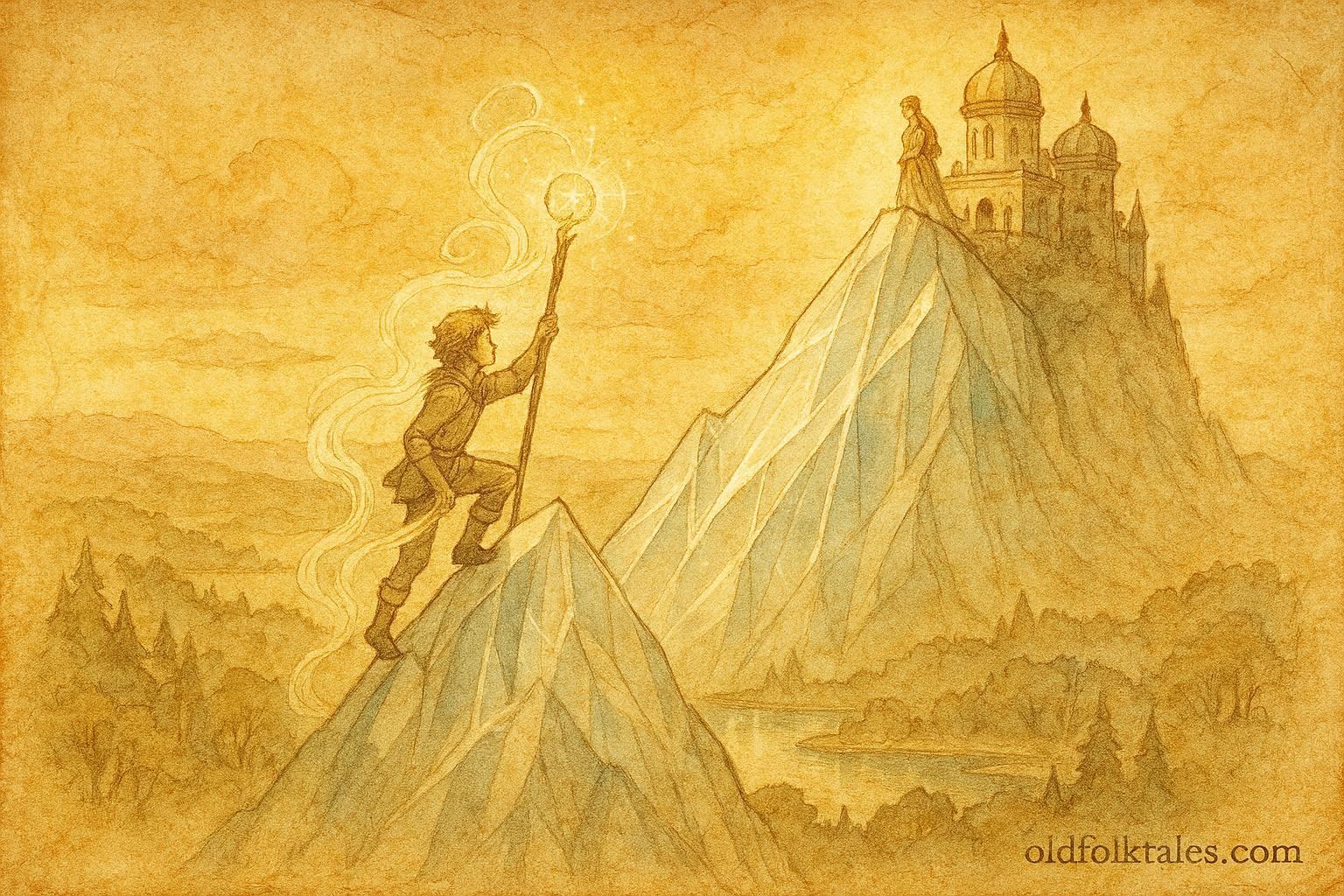
In a kingdom surrounded by deep forests and shimmering lakes, where winter winds carved the land into silence and summer brought fields alive with light, there stood a mountain unlike any other. It rose steep and tall, its surface smooth as polished crystal, gleaming like ice beneath the sun. No path led to its peak. No hand could find grip upon its sides.
At the very top of this glass mountain stood a palace, and within it, a princess held captive.
Many had tried to reach her. Knights, princes, and warriors from distant lands had come with confidence and strength, believing themselves worthy of the challenge. But the mountain defeated them all. Horses slipped, ropes failed, and even the bravest fell back in defeat. Over time, the quest became less a mission and more a legend, an impossible task spoken of in hushed tones.
Yet hope remained, for the king had made a promise: whoever could climb the glass mountain and rescue his daughter would win her hand and a place of honor in the kingdom.
Not far from the kingdom lived a poor family with three sons. The two eldest were strong, proud, and certain of their abilities. They spoke often of glory and fortune, dreaming of winning the princess and proving themselves to the world.
The youngest, however, was different. Quiet and often overlooked, he spent his days tending to simple tasks. He listened more than he spoke, observed more than he acted, and was often dismissed as lacking ambition. His brothers mocked him, calling him slow and unworthy of great deeds.
But within him lay patience, thoughtfulness, and a steady determination that few recognized.
When news of the princess and the glass mountain reached their home, the two elder brothers immediately set out, eager to claim the prize. They prepared fine horses, gathered strong ropes, and armed themselves with confidence.
The youngest son watched them leave, saying nothing.
Days later, word returned. The brothers had failed. Like all before them, they could not climb the mountain’s smooth surface. Their strength had been useless against the impossible.
Still, the youngest son felt a quiet resolve grow within him.
“I will go,” he said one morning.
His brothers laughed.
“You?” they mocked. “If we could not succeed, what chance do you have?”
But he did not argue. He simply prepared, taking only what he needed, and set off toward the kingdom.
The journey was long and filled with quiet challenges. Along the way, the young man encountered small moments that others might have ignored, creatures in need, paths that required patience, obstacles that demanded thought rather than force. He treated each with care, offering help where he could, never rushing, never boasting.
Though these moments seemed insignificant, they shaped his path in ways he did not yet understand.
At last, he arrived at the base of the glass mountain.
The sight was breathtaking. The mountain rose like a pillar of light, reflecting the sky in shifting hues. Its surface was so smooth that even the slightest attempt to climb resulted in a swift and helpless slide back to the ground.
Around its base stood the remnants of past attempts, broken ropes, discarded tools, and the weary expressions of those who had failed.
The young man studied the mountain carefully. He did not rush forward as others had. Instead, he walked around it, observing its surface, its angles, the way the light struck it.
“This cannot be overcome by strength alone,” he thought.
It was then that help came, quietly, unexpectedly, as it often does for those who act with kindness.
From the shadows of the forest emerged helpers, beings touched by magic, drawn perhaps by the young man’s earlier deeds. They did not speak loudly or boast of their power. Instead, they offered him what he needed: tools not of brute force, but of clever design.
With their aid, he obtained special means to ascend the mountain, whether through enchanted shoes, clever devices, or guidance that revealed the mountain’s hidden secrets.
Armed with these, he prepared for the climb.
The ascent was not easy.
Even with magical assistance, the mountain tested him at every step. The surface remained treacherous, the height daunting, and the air grew colder as he climbed. Doubt crept into his mind, whispering that he might fail as all others had.
But he did not turn back.
Step by step, he advanced, using not only the tools he had been given but also his patience and determination. Where others had rushed and slipped, he moved carefully. Where others had relied on strength, he relied on thought.
At last, after a long and grueling climb, he reached the summit.
There stood the palace, silent and shimmering, as if untouched by time. Inside, the princess waited.
When she saw him, she was filled with astonishment and relief. Many had come before, but none had succeeded.
“You have done what no one else could,” she said. “How did you reach this place?”
“Not by strength alone,” he replied. “But by patience, cleverness, and help along the way.”
Together, they prepared to leave the mountain.
The descent, like the ascent, required care. But with the same determination that had brought him to the top, the young man guided them safely back to the ground.
When they reached the base, the kingdom rejoiced. The impossible had been achieved. The princess was free, and the young man who had once been overlooked stood as a hero.
His brothers, who had mocked him, now saw him with new eyes. The people celebrated not only his success, but the manner in which he had achieved it, with humility, perseverance, and wisdom.
True to his word, the king honored the young man. He was welcomed into the royal family, his courage recognized, his determination rewarded.
Yet he did not forget who he was. Though he had climbed the glass mountain and won great honor, he remained the same thoughtful and patient soul, proving that greatness does not come from pride, but from character.
And so, the tale of the glass mountain was told for generations, a story not just of a daring rescue, but of the quiet strength that lies within those who are willing to persevere when others give up.
Moral Lesson
This Scandinavian folktale teaches that perseverance, patience, and clever thinking can overcome even the most impossible challenges. True success comes not from strength alone, but from determination and humility.
Knowledge Check
- What is the Glass Mountain in the folktale?
It is a smooth, enchanted mountain that cannot be climbed by ordinary means, symbolizing an impossible challenge. - Who rescues the princess?
A humble and underestimated young man, often the youngest son in his family. - Why do others fail to climb the mountain?
They rely on strength and confidence rather than patience and cleverness. - What helps the hero succeed?
Magical assistance, careful observation, and perseverance allow him to reach the top. - What is the main theme of the story?
The story emphasizes determination, cleverness, and the reward for persistence. - What does the princess represent in the folktale?
She symbolizes a goal or reward that can only be achieved through effort and resilience.
Source: Popular Tales from the Norse (1859)
Cultural Origin: Scandinavian (widely told in Sweden)