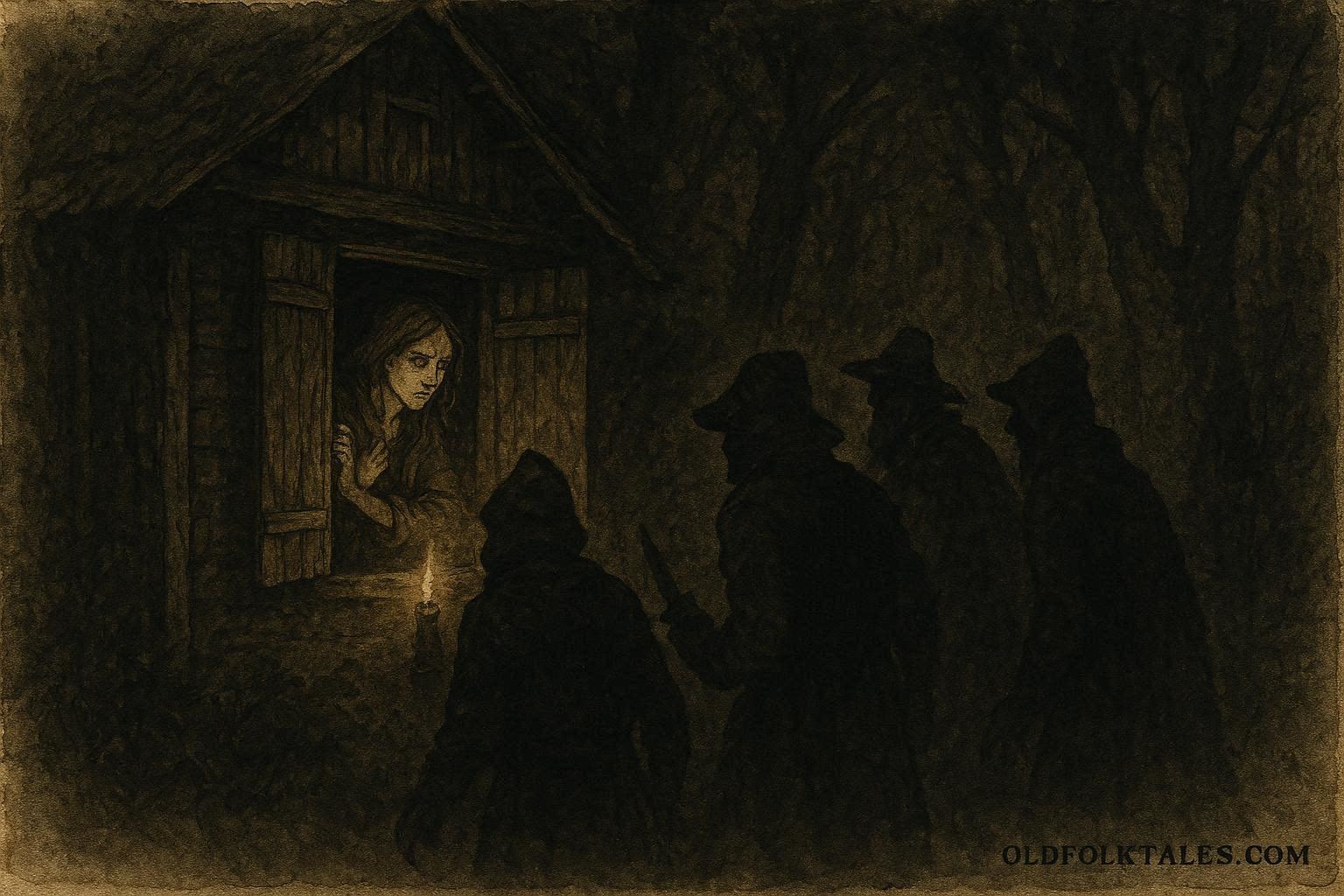
In a quiet village bordered by thick, shadowed forests, there lived a young woman whose beauty and gentle nature were known to all. Her family was respectable, her upbringing careful, and her future, so it seemed, secure.
So, when a well-dressed suitor came forward to ask for her hand, her parents saw no reason to refuse.
The man was courteous, composed, and spoke with a confidence that reassured them. He lived, he said, in a house deep within the forest, where he managed his affairs in solitude. Though his manner was somewhat distant, nothing in his appearance betrayed danger.
The engagement was agreed upon.
Yet from the beginning, the young woman felt something she could not easily explain.
An unease.
Whenever the bridegroom visited, his words were kind, but his eyes seemed to linger too long, as though measuring rather than admiring. His smile did not quite reach his expression, and though he spoke of their future, he avoided giving details of his home or his life beyond the forest.
Still, her parents insisted there was no cause for concern. A match such as this, they said, was not to be questioned.
And so, the engagement remained.
One day, the bridegroom told her she must visit him at his house in the forest, as was proper before the wedding. He gave her clear directions, describing a narrow path that wound deep into the trees.
“You will find the way easily,” he said. “I will mark the path for you.”
Though reluctant, she agreed.
On the morning of her journey, the young woman set out alone. The village lay behind her, and before her stretched the forest, vast, silent, and waiting. As she walked, she noticed small signs along the path, ashes scattered here and there, just as the bridegroom had promised.
Yet the deeper she went, the heavier the air seemed to grow.
The trees closed in, their branches casting shadows that shifted even when the wind did not blow. The silence was unnatural, broken only by the sound of her own footsteps.
Still, she continued.
At last, she reached the house.
It stood alone in a clearing, its walls darkened with age, its windows still and watchful. No smoke rose from the chimney. No sound came from within.
She approached cautiously and pushed the door open.
Inside, the house was empty.
The silence within was deeper than that of the forest. It pressed against her ears, unsettling and complete. She stepped forward, calling out softly, but no answer came.
Room by room, she searched.
Everything seemed in place, yet nothing felt lived in. The air was cold, and the shadows lingered too long in the corners.
Then, as she entered another room, she heard a voice.
“Turn back,” it whispered.
Startled, she looked around, but no one stood before her.
The voice came again, low and urgent, seeming to rise from the walls themselves.
“Turn back, while you still can.”
Her heart began to race, but something, whether fear or determination, kept her moving. She followed the sound until she came upon a door she had not yet opened.
Slowly, she pushed it ajar.
Inside, the truth revealed itself.
The room was filled with horror.
Remains lay scattered, grim evidence of violence and cruelty. The signs were unmistakable, this was no ordinary house, no peaceful dwelling hidden in the forest.
This was a place of death.
Terror seized her, but she did not cry out.
Instead, she turned to flee.
At that moment, she heard footsteps outside.
Voices followed, harsh, rough, and unmistakably close.
The robbers had returned.
With no time to escape, she searched desperately for a place to hide. She slipped into a corner, concealing herself as best she could, her breath shallow, her body still.
The door burst open.
The men entered, their laughter filling the house, carrying with it a cruelty that chilled her to the bone. Among them stood the bridegroom.
His voice, once calm and composed, now revealed its true nature, cold, commanding, and merciless.
They had brought with them another young woman.
What followed confirmed the horror she had already seen.
The robbers showed no mercy. Their actions were swift and deliberate, their cruelty practiced.
The young woman watched in silence, her fear held tightly within her. She knew that any sound, any movement, would betray her presence.
During the chaos, something small fell unnoticed, a ring.
It rolled across the floor and came to rest near where she hid.
Without thinking, she picked it up and kept it close.
It was proof.
When the robbers had finished, they left the room, their voices fading as they moved deeper into the house.
The young woman did not wait.
She slipped from her hiding place and fled the house, running through the forest without stopping, guided only by instinct and the faint traces of the path she had followed before.
She did not look back.
By the time she reached her home, her strength had nearly failed her.
Her parents, alarmed by her condition, demanded to know what had happened. At first, she could not speak, but when she found her voice, she told them everything.
Every detail.
The house.
The robbers.
The truth about her bridegroom.
Plans were made quickly.
The wedding, which had already been arranged, would proceed, but not as the bridegroom expected.
On the day of the feast, guests gathered, unaware of what was to come. The bridegroom arrived with confidence, believing his secret safe.
The young woman greeted him calmly, her fear hidden beneath composure.
When the time came for stories to be shared, as was customary at such gatherings, she stood before them all.
And she began to speak.
She told her tale as though it were a dream.
A journey into the forest.
A house filled with silence.
A hidden room of horrors.
A band of robbers led by a man who wore kindness as a mask.
The guests listened, their expressions shifting as the story unfolded. The bridegroom laughed at first, dismissing it as nonsense.
Until she produced the ring.
The room fell silent.
The truth could no longer be denied.
The bridegroom’s composure broke, his calm replaced by something darker, but it was too late.
He was seized, along with his companions, and brought to justice.
The young woman, who had once been chosen as a victim, had instead become the voice of truth.
Her courage had not only saved her life, but ensured that others would never suffer the same fate.
And though the forest remained, and the shadows within it unchanged, the danger that had once hidden there was gone.
Exposed.
Defeated.
By truth.
Moral Lesson
The Robber Bridegroom teaches that trust must be given wisely, and that courage in the face of danger can bring justice. Truth, when spoken boldly, has the power to expose even the darkest deception.
Knowledge Check
1. What is The Robber Bridegroom folktale about?
It is about a young woman who discovers her fiancé is a robber and exposes him to bring justice.
2. Who wrote The Robber Bridegroom?
It was collected by the Brothers Grimm in Kinder- und Hausmärchen (1812).
3. What warning signs did the young woman notice?
She felt unease about her fiancé and discovered his house was filled with danger and secrets.
4. How did the woman escape the robbers?
She hid, witnessed their crimes, took a ring as evidence, and fled when it was safe.
5. How was the robber bridegroom exposed?
She revealed the truth during the wedding feast and presented the ring as proof.
6. What is the main lesson of the story?
It teaches caution in trust, courage in danger, and the power of truth to bring justice.
Source: Kinder- und Hausmärchen by Jacob and Wilhelm Grimm (1812)
Cultural Origin: German folklore