Long ago, in a great kingdom under distant hills and wide skies, there reigned a king and queen who despaired at their childless fate. They gazed upon their empty cradle and sighed often. In whispered prayers and hushed tears, the queen confessed even to a snake she would welcome, so desperate she was for a child.
And so it was: in the silken stillness of dawn, the queen gave birth, not to a babe with human form, but to a serpentine child, slender and scaly, whose forked tongue darted in the air. The court recoiled in shock and horror; no one dared to care for him. But the queen, bound by hope and love, refused to let the snake, child perish. She entrusted him to a poor old woman who lived alone in a wooden cottage at the edge of the forest, begging her to raise and feed him as her own.
Under the old woman’s care, the snake child grew, day by day, his scales sleek and firm, his body long and strong. Time passed, and at last he spoke. “Mother,” he said to the old woman, “go to the king, and demand that he give me his daughter in marriage.”
The poor woman trembled, but the snake insisted. Reluctantly she sought an audience with the king. When the guards learned of her request, they refused her entry. She pleaded and begged until finally, bruised and exhausted, she was allowed to reach the king’s throne. With trembling voice she declared the snake’s demand: that she, the old woman, must have the royal princess as wife for her son. The king recoiled in anger, outraged at the very thought. In fury he struck the old woman down the palace stairs, she fell, her leg broken, and limped away bleeding, cursing the snake for her pain.
When she returned to the cottage, she wailed in sorrow. But the snake said calmly: “Do not grieve, mother. I will heal you.” And with a wave of his tail and soft hiss, he produced a ring, blew upon it, and instantly the woman’s broken leg mended as though it had never been wounded.
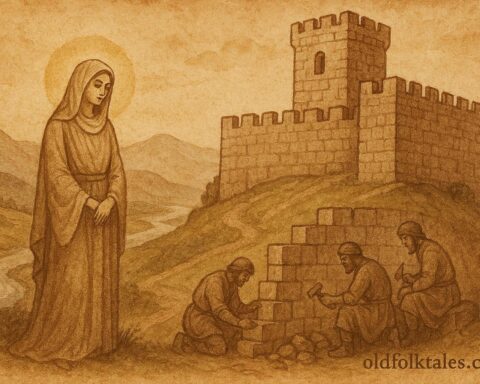
Once more the next day, she returned to the king, only to be turned away again. On the third day, though, the king grudgingly proposed a challenge: if the old woman’s humble cottage could be transformed into a palace grander than his own by the morning light, and a silk path laid between doors, and four hundred horsemen of every hue ready at her command, only then would she be worthy of the king’s daughter as bride for the snake. If she failed, her petition would be scorned forever.
That night, under the silver gleam of moonlight, the snake whispered ancient words over the ring. The little cottage blossomed into a vast palace; the dusty path outside turned to gleaming silk under starlight; and at the gate stood four hundred proud horsemen, their armor and banners shimmering with every color under heaven. When the king peered out the next morning, astonished, he turned to his queen and asked, “Is this really a palace, or are my eyes deceiving me?”
Reluctantly, yet bound by his word, the king consented. The princess, the youngest of the vizier’s three daughters, was given to the snake as his bride.
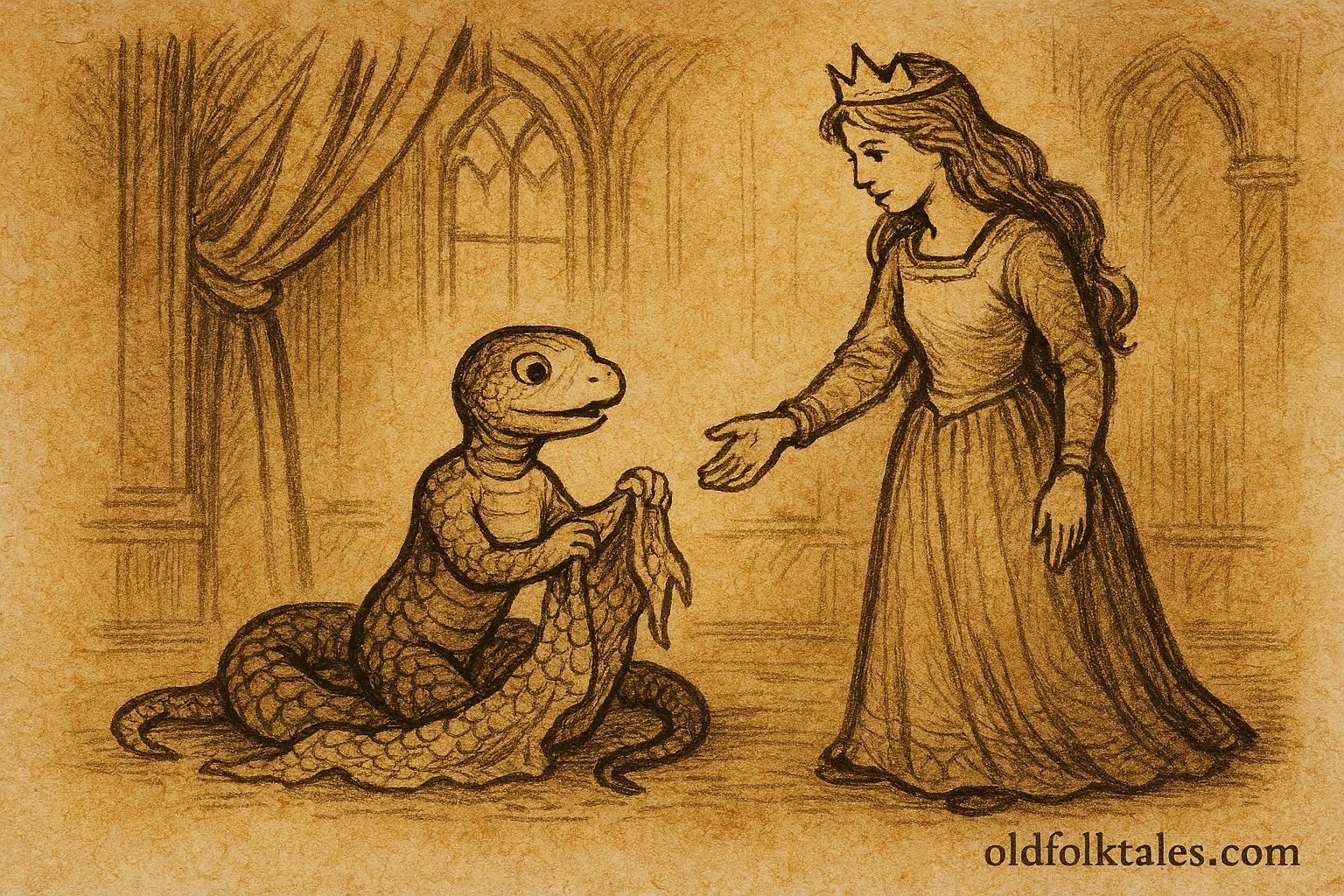
But the princess trembled with dread. On the night of their wedding, she shut herself in her chamber and dressed in forty layers of silken garments, forty robes. Meanwhile, the snake prince waited in the bedchamber, his cold scales gleaming under torchlight. At last, she lay beside him and with quiet courage said: “Take off your skin.”
Slowly, layer by layer, the snake peeled away his scaly hides, and as each layer slid off, the princess removed one of her robes. Forty skins, forty robes; in the dim glow of the lamps, scale after scale fell away until the monstrous shape gave way to human form. There, in place of the snake, stood a handsome young man.
He took her hand and promised: “You are my wife now. But you must not tell my mother, the queen.” The princess nodded. For a time they lived together in peace under the mighty palace’s roof.
Yet fear and doubt crept like shadows in her heart. One evening, under pressure from curiosity and whispering relatives, she revealed the secret to the queen. The next morning, the prince was gone. His presence vanished like smoke; the halls were cold and empty.
In anguish, the princess discovered that he had cursed her, her womb closed, and no child could ever come from her womb until she found him again, and asked his forgiveness.
Determined, she abandoned her fine robes, donned the coarse habit of a nun, and set out on a long pilgrimage to search for her husband. The journey tested her courage: she traversed dark forests, climbed rocky hills, and passed through forgotten valleys. Along the way she encountered a silent pool of stagnant water. Guided by the words of a kindly old woman she had met, she bent and drank from the pool, marveling at the bitterness, then praised the water’s freshness as though it were sweetest wine. Immediately after, she called out to the earth: “Rise and swallow me, that I may pass!” The ground cracked open beneath her, and she slipped down into an underworld realm, unknown and uncanny.
Deeper still she traveled, through tunnels where time had no meaning, until she came across three strange sisters who lived beneath the soil, guardians of hidden light. The eldest offered her a polished walnut, the second a hazelnut, the third an almond. They told her: “These gifts may aid you, though your path is difficult.”
With nothing but hope and the three nuts in her hand, the princess pressed onward. At journey’s end, she arrived at a dark castle beyond mortal reach, where a false bride lay in the bed where her husband slept. Using the three nuts, she negotiated for three nights beside her husband. Each night she gathered her courage, calling to him, but the false bride used magic to keep him asleep. On the final dawn, the prince awoke. When his eyes opened and fell on the true princess, heartbreak, hope, and recognition flickered in his gaze.
With trembling voice she begged his forgiveness. He reached out his hand, placed it over her heart, and in that moment, the curse was broken: her womb opened, and in time she bore a son, a beautiful child who grew under the warmth of their renewed love.
They left the dark halls of the underworld, riding upon swift horses, their hearts soaring as though freed from chains. They returned to the upper world, to a palace alight with joy, and the kingdom celebrated their return with feasting, laughter, and the promise of new life. Love, faith, and courage had triumphed over fear and curse.
Moral of the Story
True love demands trust, courage, and patience. When appearance deceives and fear threatens, faith and inner strength can reveal hidden goodness. Secrets broken may cost dearly, but with repentance, perseverance, and love, what was lost can be regained.
Knowledge Check
Q1: Who are the first parents of the snake‑child?
A1: A powerless king and queen who longed for a son, even if he came as a snake.
Q2: Why did the princess marry the snake‑child despite his frightening appearance?
A2: Because the old woman’s miraculous magic (palace, silk path, hundred horsemen) had convinced the king to give his daughter, and the princess accepted out of duty and courage.
Q3: How does the snake transform into a handsome prince?
A3: On their wedding night, the princess wears forty robes and the snake sheds forty layers of skin; when the last layer is gone, he becomes a human.
Q4: What mistake causes evil to befall their union?
A4: The princess reveals the secret of his snake‑skin to the queen, breaking his trust.
Q5: What trials does the princess endure to find her lost husband?
A5: She becomes a nun, journeys through dark lands, drinks from a stagnant pool, asks the earth to swallow her, passes through an underworld, helps three mysterious sisters, and uses magical nuts to win three nights with her husband.
Q6: What does the tale emphasize about appearance and inner worth?
A6: That true worth lies beneath outer form, courage, faith, and love can unveil hidden goodness and bring redemption.
Cultural Origin: Albanian folktale
Source: Das Schlangenkind by Johann Georg von Hahn.